3251 results for: Seattle Post-Intelligencer, The
Photograph
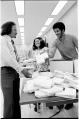
"Target 50" workers delivering voter registration cards, Seattle, July 14, 1972
The City of Seattle launched the Target 50 voter registration drive in June 1972, with the goal of registering 50,000 new voters by the end of August. Funded by Model Cities and the Office of Human Resources Youth Division, the program recruited about 50 people aged 18-21 to spend the summer registering voters across the city. The project met its…
ID Number:2000.107.19720714.3.08
Date:1972
Photograph
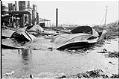
Mud and scrap at the future Gas Works Park site, Seattle, August 25, 1972
The Seattle Gas Light Company opened a coal and oil gasification plant at the north end of Lake Union in 1906. It supplied gas to homes and industries in and near Seattle, until natural gas became more available in the mid-1950s. Over the years, the gas works and a nearby tar plant badly polluted the soil, air, and water in…
ID Number:2000.107.19720825.2.20
Date:1972
Photograph
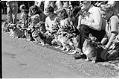
Corgis and their owners at Seattle Center, Seattle, August 27, 1972
On August 27, 1972, members of the Cascade Welsh Corgi Club gathered with their dogs at Seattle Center for the club's second annual “Corgi Walk.” This wasn’t a competition but a demonstration of the dogs’ obedience as they walked around the park. Here, members of the club and their pets wait for the beginning of the walk. Caption information source:…
ID Number:2000.107.19720827.2.27
Date:1972
Photograph
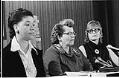
Panel at a quarterly meeting of NOW board members, Seattle, October 9, 1972
In October 1972, board members of the National Organization of Women (NOW) held a three-day quarterly meeting in Seattle. At the end, they called a press conference to voice dissatisfactions and to present priorities for upcoming months. Aileen Hernandez, NOW’s immediate past president, stated their observation that the current emphasis on law and order didn't’t seem to include the enforcement…
ID Number:2000.107.19721004.1.28
Date:1972
Photograph
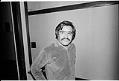
Roberto Gallegos, Seattle, October 13, 1972
While 1970 census figures showed that Spanish-speaking residents made up 5% of Seattle's population – similar in numbers to Black residents - the fact that they were scattered in various parts of the city made them less visible as an ethnic group. Language issues and historically based fears of deportation were also a factor, particularly for those from Mexico. In…
ID Number:2000.107.19721013.1.08a
Date:1972
Photograph
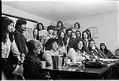
Jim Robideau and others at BIA protest, Seattle, November 6, 1972
On November 2nd, 1972, several hundred Indigenous people occupied the headquarters of the Bureau of Indian Affairs (BIA) in Washington, DC. They presented 20 demands for better conditions for Indigenous peoples in the United States, including reform of the BIA, enforcement of existing treaties, protection of Indigenous lands, and improved treaty procedures. Over the following days, BIA offices in other…
ID Number:2000.107.19721106.1.24
Date:1972
Photograph
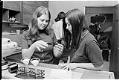
Two women at the Aradia Women's Clinic, Seattle, November 16, 1972
The Aradia Women’s Clinic opened on Seattle’s First Hill in February 1972. A feminist women’s clinic, it provided birth control, health care, counseling, and advocacy by women for women. Once the Supreme Court’s Roe v. Wade decision made abortion legal, it also became one of Seattle’s first abortion clinics and a model for similar operations elsewhere in the country. Aradia…
ID Number:2000.107.19721116.3.14
Date:1972
Photograph
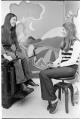
Two staff members at the Aradia Women's Clinic, Seattle, November 16, 1972
The Aradia Women’s Clinic opened on Seattle’s First Hill in February 1972. A feminist women’s clinic, it provided birth control, health care, counseling, and advocacy by women for women. Once the Supreme Court’s Roe v. Wade decision made abortion legal, it also became one of Seattle’s first abortion clinics and a model for similar operations elsewhere in the country. Aradia…
ID Number:2000.107.19721116.3.19
Date:1972
Photograph
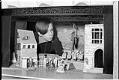
Erhard Rom with model of scene from "Manon Lescaut" on miniature Seattle Opera House stage, January 3, 1973
Erhard Rom became enamored with opera after seeing his first live performance at the age of eight. At home, he built a stage from a box and made paper figures to reenact the opera. Later, he created more sophisticated sets on a custom-made scale model of the Seattle Opera House, complete with dimmable stage lighting and battens for manipulating scenery.…
ID Number:2000.107.19730103.1.06
Date:1973
Photograph
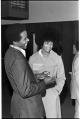
People at preview of Black Arts/West production of "Black Girl," Seattle, March 22, 1973
Black Arts/West was Seattle's first Black theater and functioned as a three component program: theater, dance, and an art gallery displaying the work of local and national artists. Founded by Douglas Q. Barnett (1931-2019) in 1969, Black Arts/West evolved out of the Civil Rights movement of the 1960s. As a division of the Central Area Motivation Program (CAMP), an anti-poverty…
ID Number:2000.107.19730322.2.14A
Date:1973