450 results for: Military
Photograph
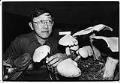
Ben Woo with mushroom display at Pacific Science Center, Seattle, October 14, 1978
Asian community leader Benjamin Woo (1923-2008) was born in Seattle and attended Queen Anne High School and the University of Chicago. After military service he returned to Seattle and opened an architectural firm in Madison Park. He directed King County’s Construction and Facilities Management Department and served as president of the Seattle Chapter of the American Institute of Architects. Mr.…
ID Number:2000.107.232.28.07
Date:1978
Photograph
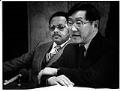
Ben Woo and Bruce Terry speaking about low-income housing plans, Seattle, January 30, 1984
Asian community leader Benjamin Woo (1923-2008) was born in Seattle and attended Queen Anne High School and the University of Chicago. After military service he returned to Seattle and opened an architectural firm in Madison Park. He directed King County’s Construction and Facilities Management Department and served as president of the Seattle Chapter of the American Institute of Architects. Mr.…
ID Number:2000.107.232.28.08
Date:1984
Photograph
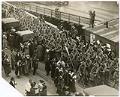
Coast Artillery companies departing Seattle, October 13, 1917
On April 6, 1917, the U.S. joined its allies to fight in World War I and three months later the Coast Artillery Reserve Companies of the Washington National Guard were drafted into service. This image was taken in October 1917 as the four companies of the Seattle Battalion, Washington 63rd Coast Artillery, march to the trains that will take them…
ID Number:2000.107.233.10.01
Date:1917
Photograph
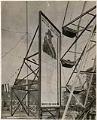
Second Liberty Loan poster outside The Bon Marche, Seattle, October 14, 1917
In 1917, during World War I, the U.S. government borrowed money to pay for the war effort by selling war bonds, known as Liberty Bonds. The Second Liberty Loan aimed to raise $3 billion. During the Second Liberty Loan campaign, a huge replica of a James Montgomery Flagg recruiting poster stood outside the Bon Marche in downtown Seattle. The image…
ID Number:2000.107.233.10.02
Date:1917
Photograph
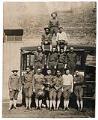
Soldiers promoting the P-I Army Athletic Fund carnival, Seattle, August 29, 1917
On Friday, August 31, 1917, during World War I, many branches of the service gathered at Seattle's Civic Arena for a military carnival in support of the Seattle Post-Intelligencer's Army Athletic Fund.Here, on August 29, members of the Second Washington Infantry gather for their photograph. They will be participating in a "Platoon Going Into Bivouac" scene. Caption information derived from…
ID Number:2000.107.233.10.03
Date:1917
Photograph
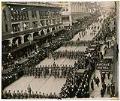
Returning soldiers parading up Second Avenue, March 12, 1919
Although the armistice for World War I was signed on November 11, 1918, it took months before soldiers returned to Seattle. The 63rd Coast Artillery was the first local group to arrive. Crowds filled the sidewalks on March 12, 1919 as the soldiers marched up Second Avenue. The city celebrated throughout the night with parties, a street carnival, and fireworks.Here,…
ID Number:2000.107.233.10.04
Date:1919
Photograph
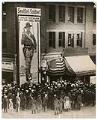
Celebration at Liberty Loan headquarters, Seattle, October 28, 1917
In 1917, during World War I, the U.S. government borrowed money to pay for the war effort by selling war bonds, known as Liberty Bonds. The Second Liberty Loan aimed to raise $3 billion. During the Second Liberty Loan campaign, a 40-foot replica of a James Montgomery Flagg recruiting poster stood in downtown Seattle. The image was gradually completed as…
ID Number:2000.107.233.10.05
Date:1917
Photograph
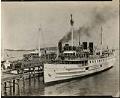
Service men lined up on training ships, Seattle, 1918
In 1918 the U. S. government chartered the steamships Chippewa and Iroquois for service in World War I as school ships to be based at the Seattle Yacht Club buildings (recently purchased by the U. S. government) in West Seattle. William Jacob Grambs (1862-1943), previously an engineer at the Puget Sound Traction, Light & Power Company, was appointed supervisor of…
ID Number:2000.107.233.10.07
Date:1918
Photograph
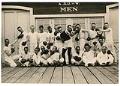
UW Naval Training Station boxing team, Seattle, July 20, 1918
With the United States engaged in World War I in 1917 and 1918, training in boxing was seen as important both to prepare troops for combat and to boost morale and provide entertainment at stateside military camps and stations. The Army made boxing a regular training exercise while the Navy emphasized boxing as entertainment. In this image members of the…
ID Number:2000.107.233.10.08
Date:1918
Photograph
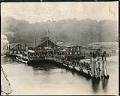
Servicemen posing at naval training station, West Seattle, circa 1919
In 1918, the U. S. government chartered the steamships Chippewa and Iroquois for service in World War I as school ships to be based at the Seattle Yacht Club buildings in West Seattle. The yacht club had recently been purchased by the U. S. government for $3,000. William Jacob Grambs (1862-1943), previously an engineer at the Puget Sound Traction, Light…
ID Number:2000.107.233.10.09
Date:Circa 1919