365 results for: Homes and Housing
Photograph
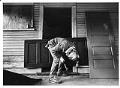
Boarding up a vacant house on Capitol Hill, Seattle, April 13, 1982
This image shows Dennis Lehtinsen, an employee of the owners, boarding up one of nine turn-of-the-century houses on the 1200 block of 15th Avenue East on Capitol Hill. The houses across from Volunteer Park were purchased by Parkridge Development eight years prior with the intention of tearing them down and building a 50-unit apartment building at the site. The plans…
ID Number:2000.107.168.11.04
Date:1982
Photograph
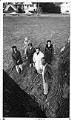
Activists posing in vacant lot, Seattle, February 28, 1981
In this image, members of the Central Area Housing Alliance stand in the vacant lot they want to purchase at 24th Avenue and Yesler Way. From left are, Rena Boyd, Anna David, Viola Johnson, Eloise Graham, Gerald Lenoir, and Lillian Feist. The Alliance protested the proposed sale of the property to build a 50-unit condominium, saying they wanted new housing…
ID Number:2000.107.168.29.03
Date:1981
Photograph
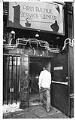
Man entering the First Avenue Service Center, Seattle, August 25, 1988
Seattle's First Avenue Service Center was one of many service organizations seeking to help the homeless and others needing help. Located near Pike Place Market, the Center operated as a daytime drop-in center, with laundry, bathrooms, and shower, and it offered shelter on cold nights. The organization had problems from time to time due to drug dealing on the premises.…
ID Number:2000.107.172.34.01
Date:1988
Photograph
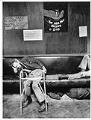
Men sleeping at the First Avenue Service Center, November 15, 1982
Seattle's First Avenue Service Center was one of many service organizations seeking to help the homeless and others needing help. The Center operated as a daytime drop-in center, with laundry, bathrooms, and shower, and it also offered all-night shelter on cold nights. Here, three men sleep in the day room. Caption information derived from captions written by Post-Intelligencer staff and…
ID Number:2000.107.172.34.02
Date:1982
Photograph
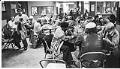
People at the First Avenue Service Center, Seattle, January 4, 1983
Seattle's First Avenue Service Center was one of many service organizations seeking to help the homeless and others needing help.The Center operated as a daytime drop-in center, with laundry, bathrooms, and shower, and it offered all-night shelter on cold nights. Here, First Avenue Service Center clients sit together at tables. Caption information derived from captions written by Post-Intelligencer staff and…
ID Number:2000.107.172.34.03
Date:1983
Photograph
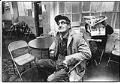
Howard Vail at the First Avenue Service Center, Seattle, December 20, 1979
Seattle's First Avenue Service Center was one of many service organizations seeking to help the homeless and others needing help. Located at 98 Union Street, the Center operated as a daytime drop-in center, with laundry, bathrooms, and shower, and it offered all-night shelter on cold nights. Late in 1979, it was announced that the Center would be evicted due to…
ID Number:2000.107.172.34.04
Date:1979
Photograph
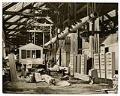
Men working at General Housing Corporation, Seattle, February 10, 1939
This image shows employees working on the assembly line at the General Housing Corporation in Seattle's Georgetown neighborhood. The company manufactured "pre-built" (also called prefabricated or modular) homes. The four room, wooden frame houses were made in two 12-foot-wide sections which were delivered completely finished with all electric, heating, and plumbing equipment installed, then bolted together on site. Caption informations…
ID Number:2000.107.173.07.01
Date:1939
Photograph
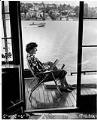
Marjorie Lothrop reading on houseboat docked on Lake Union, Seattle, July 16, 1952
The unique floating homes of Seattle got their start almost simultaneously with the development of the city itself. Seattle's first industries were logging and fishing, both seasonal enterprises, and it became common for loggers and sailors to build themselves floating shacks from scrap boards during their off seasons. As the trend spread, houseboats were built as permanent homes for families…
ID Number:2000.107.176.17.01
Date:1952
Photograph
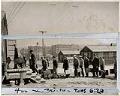
Civilian workers moving into Denny Regrade Transient Camp, Seattle, April 13, 1943
In the spring of 1943, new barracks were built in the Denny Regrade area to house civilian men awaiting transport to Alaska to work with the U.S. Army Corps of Engineers. Sometimes called the Denny Regrade Transient Camp, the fifteen barracks had a total capacity of 600, and were built because of the difficulty of finding hotel accommodations for non-military…
ID Number:2000.107.176.17.02
Date:1943
Photograph
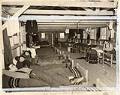
Civilian workers lying in beds at Denny Regrade Transient Camp, Seattle, April 13, 1943
In the spring of 1943, new barracks were built in the Denny Regrade area to house civilian men awaiting transport to Alaska to work with the U.S. Army Corps of Engineers. Sometimes called the Denny Regrade Transient Camp, the fifteen barracks had a total capacity of 600, and were built because of the difficulty of finding hotel accommodations for non-military…
ID Number:2000.107.176.17.03
Date:1943