22 results for: McCurdy, James G.
Photograph
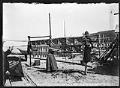
Makah woman drying fish on a rack, Neah Bay, circa 1900
The Makah people of the northwest tip of the Olympic Peninsula refer to themselves as Kwih-dich-chuh-ahtx, which translates roughly to "the people who live by the rocks and seagulls." The early Makah were skilled mariners, using several types of canoes which they carved from western red cedar for various purposes - war, whaling, fishing, sealing, carrying cargo, and long voyages.…
ID Number:1955.970.470.23
Date:Circa 1900
Photograph
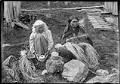
Two Makah basketmakers, Neah Bay, circa 1900
The Makah people of the northwest tip of the Olympic Peninsula refer to themselves as Kwih-dich-chuh-ahtx, which translates roughly to "the people who live by the rocks and seagulls." The early Makah were skilled mariners, using several types of canoes which they carved from western red cedar for various purposes - war, whaling, fishing, sealing, carrying cargo, and long voyages.…
ID Number:1955.970.470.25
Date:Circa 1900
Photograph
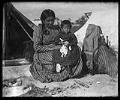
Makah woman and child with puppy, Port Townsend, circa 1900
The Makah people of the northwest tip of the Olympic Peninsula refer to themselves as Kwih-dich-chuh-ahtx, which translates roughly to "the people who live by the rocks and seagulls." The early Makah were skilled mariners, using several types of canoes which they carved from western red cedar for various purposes - war, whaling, fishing, sealing, carrying cargo, and long voyages.…
ID Number:1955.970.470.26
Date:Circa 1900
Photograph
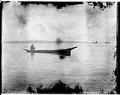
Coast Salish canoe in Port Townsend Bay, circa 1900
The Coast Salish style canoe was designed for use in the calm waters of Puget Sound and its many small bays and inlets. Both the prow and the stern curve upwards from a rounded bottom. Salish canoes were often painted black with brightly colored figures near the prow and stern. The Coast Salish style of canoe was more lightly constructed…
ID Number:1955.970.470.512
Date:Circa 1900
Photograph
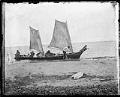
West Coast style canoe with two sails, circa 1900
By the turn of the 20th century, Indigenous seafarers adapted cloth sails, usually of the sprit-rig type seen in this image. Traditional sails of woven mats and wood slats had been used prior to the arrival of Europeans, but they were replaced by cloth once the Native peoples began trading with the settlers. This photograph was probably taken in Port…
ID Number:1955.970.470.513
Date:Circa 1900
Photograph
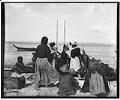
Women shopping for baskets on the beach, Port Townsend, circa 1895
The Makah people of the northwest tip of the Olympic Peninsula refer to themselves as Kwih-dich-chuh-ahtx, which translates roughly to "the people who live by the rocks and seagulls." The early Makah were skilled mariners, using several types of canoes which they carved from western red cedar for various purposes - war, whaling, fishing, sealing, carrying cargo, and long voyages.…
ID Number:1955.970.470.546
Date:Circa 1895
Photograph
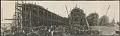
Puget Sound Bridge & Dredging Company shipyard, Seattle, circa 1917
Founded in 1889, the Puget Sound Bridge and Dredging Company, later Lockheed Shipbuilding and Construction Company, worked on many important construction projects in the Pacific Northwest. During World War I, they were commissioned to create naval vessels, including the steam-powered cargo ships shown here. Construction on U.S. No. 1116 (second from left) was canceled as it was too late to…
ID Number:1995.37.2
Date:Circa 1917
Photograph
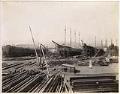
Puget Sound Bridge & Dredging Company shipyard, Seattle, September 20, 1917
This view of the Puget Sound Bridge & Dredging Company shipyard, taken on September 20, 1917 shows a four-masted schooner and other vessels under construction. The yard is filled with stacks of heavy milled lumber from the Pacific Northwest's huge trees. Shipyard workers used the hoists (left center) to lift the lumber and move it from one place to another.…
ID Number:1995.37.19.2.5
Date:1917
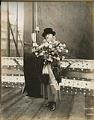
Photograph
Sponsor Gertrude Van Doren Hardenberg at launch of Blakeley, Seattle, November 7, 1918
This portrait of Gertrude Van Doren Hardenberg was taken November 7, 1918 at the Puget Sound Bridge & Dredging Company shipyard at the launch of the steamship Blakeley. The Blakeley was a 4,000 ton wooden steamship, the first ship contracted with PSB&DC by the U. S. government. Gertrude Van Doren Hardenberg was the sister of George E. Hardenberg, secretary of…
ID Number:1995.37.19.2.39
Date:1918
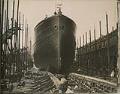
Photograph
Launch of the steamer Snoqualmie at the Puget Sound Bridge & Dredging Company shipyard, Seattle, August 11, 1919
This image was taken on August 11, 1919 during the launch of the steamer Snoqualmie at the Puget Sound Bridge & Dredging Company's shipyard in Seattle on Harbor Island. The vessel was named for the Snoqualmie Tribe, in honor of its friendship with pioneer settlers and its war record in service to the United States. Many Snoqualmie Tribe members traveled…
ID Number:1995.37.19.2.46
Date:1919