653 results for: Urban
Photograph
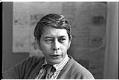
Bob Santos, Seattle, 1971
Bob Santos was a Filipino American community activist who helped start many organizations and programs in the Chinatown International District. In 1994, President Bill Clinton appointed Santos as the Housing and Urban Development (HUD) secretary's representative for the Northwest-Alaska area. Handwritten on sleeve: Robert Santos.Date photograph was filed at the Seattle Post-Intelligencer (date of photograph and file date may differ…
ID Number:1986.5.54102.1
Date:1971
Photograph
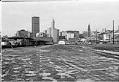
Kingdome site looking north, Seattle, 1971
Handwritten on sleeve: Domed stadium site, King Street Station.Date photograph was filed at the Seattle Post-Intelligencer (date of photograph and file date may differ by a month or more): March 27, 1971.
ID Number:1986.5.54113.1
Date:1971
Photograph
Benefit rock concert at Seward Park for Pike Place Market, Seattle, 1971
In 1963 Seattle City Council proposed razing the Pike Place Market in hopes of obtaining federal urban renewal funds. Opponents to the demolition banded together in organizations to "Save the Market." Fundraisers included concerts, selling shopping bags, cookbooks and buttons. After an eight year battle the Market was saved by Initiative No. 1 on November 2, 1971. Handwritten on sleeve:…
ID Number:1986.5.54480.1
Date:1971
Photograph
Japanese dancers performing at the Northwest bandshell at Festival 71, Seattle Center, August 1971
Held in August 1971, Festival 71 was the first event after the 1961 Seattle World's Fair to utilize the entire Seattle Center campus. The event was repeated as Festival 72 the following year, becoming Bumbershoot in 1973. Bumbershoot continues as North America's largest urban arts festival, taking place annually at Seattle Center over the Labor Day weekend.In this photo, dancers…
ID Number:1986.5.54911.1
Date:1971
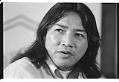
Photograph
Bernie Whitebear, Seattle, 1971
Bernie Whitebear was born in the town of Nespelem on the Colville Reservation in 1937. After growing up in poverty on the reservation, he moved to Western Washington in 1955 and shortly became a fisherman on the Puyallup River. In the late 1950s, Bernie Whitebear joined a campaign of activism to protect Native fishing rights, which had been guaranteed by…
ID Number:1986.5.55140.1
Date:1971
Photograph
Mosquito Creek Falls, site of Stampede Tunnel, circa 1886
In February 1886, workers from the Northern Pacific Railroad set up camp near Martin, Washington and began work on the east portal of the Stampede Tunnel. Nearby Mosquito Creek Falls provided water for the camp, and its rock face was an ideal site for the tunnel entrance. Before the construction workers could start digging the tunnel, they had to divert…
ID Number:1986.17.11
Date:Circa 1886
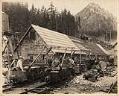
Photograph
Electric engines at the new Cascade Tunnel, February 24, 1927
During the construction of the new Cascade Tunnel in 1927, electricity was needed for lighting, power drills and blasting equipment. It also powered the small railroad engines, called motors, which carried the workers and equipment to the construction sites in the tunnel shaft.This photo, taken in 1927, shows a group of construction workers and small electric engines during the construction…
ID Number:1990.85.2
Date:1927
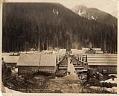
Photograph
Railroad tunnel construction camp at Scenic, Washington, April 30, 1927
In 1925, the Great Northern Railway Company began work on its new Cascade Tunnel beneath Stevens Pass, Washington. A. Guthrie & Company of St. Paul, Minnesota, the general contractor, built a camp at Scenic to house some of the construction workers. The tunnel, still in use in the 1990s, runs from Scenic, on the west side of the summit, to…
ID Number:1990.85.7
Date:1927
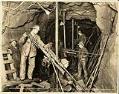
Photograph
Men drilling in the new Cascade Tunnel, 1927
In 1925, the Great Northern Railway Company began work on its new Cascade Tunnel near Stevens Pass, Washington. On the western part of the route, crews first bored and blasted a pioneer work tunnel which then let them start work on various sections of the parallel main tunnel.This 1927 photo shows construction workers in the center heading of the Great…
ID Number:1990.85.10
Date:1927
Photograph
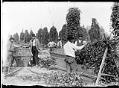
Indigenous men at work picking hops, circa 1890
From the late 1860s to the early 1890s, hop farming was an important activity in the valleys of the Puget Sound region, including Puyallup, White River, and Snoqualmie. Indigenous workers came from throughout the Pacific Northwest, Canada, and Alaska (but especially from regional tribes like the Puyallup, Snoqualmie, Muckleshoot, Duwamish, Sammamish, Lummi, and Nisqually) as a seasonal labor force to…
ID Number:1991.79.36
Date:Circa 1890