294 results for: Century 21 Exposition (1962 World's Fair)
Photograph
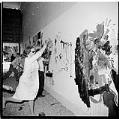
Merrily Dam painting mural at Seattle Center, June 1, 1963
After the close of the 1962 Century 21 Exposition (Seattle World's Fair) many of the buildings built for the fair were converted for community use. The Seattle Center reopened in June of 1963 with an informal opening attended by 20,000 people. A formal dedication was held 6 days later on June 7.In this image Merrily Dam, a member of UW…
ID Number:1986.5.7759.11
Date:1963
Photograph
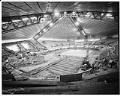
Seattle Center Coliseum during renovation, March 1964
The Washington State Pavilion was built by the state to house the World of Tomorrow exhibit for the 1962 World's Fair (also Century 21 Exposition). After the fair closed, the city of Seattle bought the Pavilion, renamed it the Seattle Coliseum, and converted it into a convention, sports, and entertainment facility. After an extensive remodel in 1995, the building was…
ID Number:1986.5.8802.1
Date:1964
Photograph
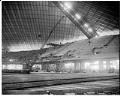
Seattle Center Coliseum during renovation, April 1964
The Washington State Pavilion was built by the state to house the World of Tomorrow exhibit for the 1962 World's Fair (also Century 21 Exposition). After the fair closed, the city of Seattle bought the Pavilion, renamed it the Seattle Coliseum, and converted it into a convention, sports, and entertainment facility. After an extensive remodel in 1995, the building was…
ID Number:1986.5.8803.1
Date:1964
Photograph
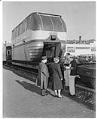
First monorail train arriving at railroad yards, Seattle, 1962
The ALWEG Rapid Transit System of West Germany won the $3.5 million contract to build the Century 21 monorail system. By the time the World's Fair closed, the system had carried over eight million people and more than paid for itself. Here, the first monorail car has arrived in Seattle by train. The system opened to the public on March…
ID Number:1986.5.9876.1
Date:1962
Photograph
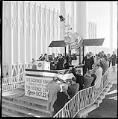
Opening of Pacific Science Center, Seattle, October 22, 1962
Many of the buildings at the Seattle World's Fair were intended to be permanent. The day after the World's Fair closed, the U.S. Science Pavilion reopened as the Pacific Science Center. President John F. Kennedy had been scheduled to make the official transfer to the City of Seattle, but was detained in Washington by the Cuban missile crisis.Here, Senator Warren…
ID Number:1986.5.10058.1
Date:1962
Photograph
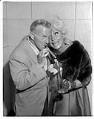
George Burns and Carol Channing during the World's Fair in Seattle, June 1, 1962
George Burns arrived in Seattle to start rehearsals with his partner Carol Channing in preparation for their variety show at the Orpheum Theatre. Miss Channing lights his cigar with a Space Needle lighter. The celebrities looked forward to visiting the Science Pavilion and getting a larger view of the Worlds Fair from the top of the Space Needle. Handwritten on…
ID Number:1986.5.20502.1
Date:1962
Photograph
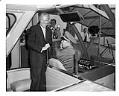
John Glenn on the monorail at the World's Fair, Seattle, 1962
Colonel John Glenn visited the World's Fair on May 10, 1962. He came to Seattle to help Vice-President Lyndon Johnson dedicate the NASA exhibit and to participate in a national conference on the peaceful uses of space.The astronaut rode the Monorail to the fair. When offered a chance to take over the controls of the train, he politely declined. John…
ID Number:1986.5.26300.1
Date:1962
Photograph
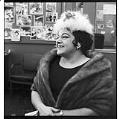
Entertainer Gracie Hansen, the woman behind the Paradise International nightclub at the Seattle World's Fair, 1962
One of the most memorable women of the Seattle World's Fair, Washington State native Gracie Hansen was brash, witty and charming. Hansen ran the Paradise International on "Show Street," the adult entertainment section of the Seattle World's Fair. She hired Barry Ashton, a top showman, to produce "A Night in Paradise," a Las Vegas-type show that was as controversial as…
ID Number:1986.5.27554.1
Date:1962
Photograph
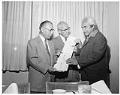
Joseph Hillaire (Kwul-kwul'tw) showing totem pole sketch to William Devin and Genji Mihara, Seattle, June 1961
Joseph Raymond Hillaire, or Kwul-kwul'tw, (1894–1967) was an Lummi artist known for his carved totem poles in the style of the Coast Salish peoples. Hillaire was also a storyteller, performer, and activist, bringing attention to Native culture, and fostering cross-cultural communication and understanding. In 1961, Hillaire was commissioned to create two story poles for the Seattle Worlds Fair (Century 21…
ID Number:1986.5.28647.1
Date:1961
Photograph
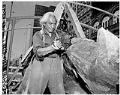
Joseph Hillaire (Kwul-kwul'tw) carving totem pole in Pioneer Square, Seattle, August 3, 1961
Joseph Raymond Hillaire, or Kwul-kwul'tw, (1894–1967) was an Lummi artist known for his carved totem poles in the style of the Coast Salish peoples. Hillaire was also a storyteller, performer, and activist, bringing attention to Native culture, and fostering cross-cultural communication and understanding. In 1961, Hillaire was commissioned to create two story poles for the Seattle Worlds Fair (Century 21…
ID Number:1986.5.28648.2
Date:1961