233 results for: Animals
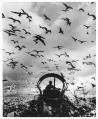
Photograph
Seagulls at Montlake Landfill, Seattle, 1955
The Montlake Dump (known variously as the Ravenna Dump, University Dump, Union Bay Dump, and the Montlake Landfill) was used as a garbage dump by the city of Seattle for over 40 years, until it closed in 1966. Photographer Josef Scaylea capture this view of one of the sanitation workers surrounded by seagulls in 1955.Scaylea (1913-2004) worked for 35 years…
ID Number:Lib1993.20.170
Date:1955
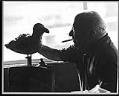
Photograph
Ivar Haglund, Seattle, 1962
Ivar Haglund shares a tender moment with one of his long-time companions. One of Seattle's most colorful and popular characters, Ivar won his way into the hearts of local residents with his zany antics. Born to Swedish/Norwegian parents in West Seattle in 1905 he grew up playing guitar and singing, performing on radio, on stage and on the sidewalk, eventually…
ID Number:Lib1993.20.236
Date:1962
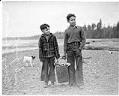
Photograph
Skip George and Benny Anderson carrying clams at Point Julia, February 1939
In February 1939, the representatives of the Port Gamble band of the Clallam (now S’Klallam) people invited a Seattle Post-Intelligencer reporter and photographer to come to their village south of Hansville on the Olympic Peninsula. Chairman of the tribe’s governing committee Benny George, along with his aid Jackson and Rev. Karl Leonard of Bremerton, had been in contact with the…
ID Number:PI23828
Date:1939
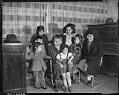
Photograph
Chief Jerry Kanim and his family, Snoqualmie, February 21, 1948
The Snoqualmie people are a Coast Salish group who have lived in the Snoqualmie River Valley since time immemorial. They made dugout canoes which they used to navigate the river and reach Puget Sound. Traditionally the Snoqualmie burned off the bottom lands of the Snoqualmie Valley to create open areas that ensured an abundance of edible plants for foraging as…
ID Number:PI23889
Date:1948
Photograph
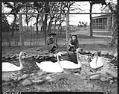
Girls with swans at Woodland Park Zoo, Seattle, 1937
In 1899, Seattle bought Woodland Park and its small zoo from the Phinney family. Most of the animals were kept in cages with bars and concrete floors. Visitors could go right up to the cages and feed the animals. During the economic depression of the 1930s, workers with the federal government's Works Projects Administration (WPA) built several animal habitats at…
ID Number:PI24721
Date:1937
Photograph
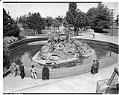
Monkey Island at Woodland Park Zoo, May 13, 1946
During the economic depression of the 1930s, workers with the federal government's Works Projects Administration (WPA) built Monkey Island and several other animal habitats at Seattle's Woodland Park Zoo. This photo, taken on a sunny day in May 1946, shows people watching the antics of the monkey colony on Monkey Island at Woodland Park. Written on original envelope: Seattle-parks-Woodland ZooDate…
ID Number:PI24732
Date:1946
Photograph
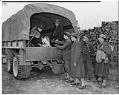
Mr. and Mrs. Moji in back of military truck, March 30, 1942
On March 30, 1942, the Seattle Post-Intelligencer reported that the removal of Japanese Americans from Bainbridge Island, Washington, went off with only one hitch. Mr. and Mrs. Moji had arranged with Filipino American neighbors to look after their berry farm and their Alaskan husky dog, King. When it was time for the Mojis to leave their home, King jumped into…
ID Number:PI28046
Date:1942
Photograph
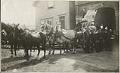
Members of Seattle Volunteer Fire Company No. 1, 2nd and Columbia, Seattle, 1883
The creation of the Seattle Fire Department (SFD) can be traced back to July 6th, 1876, when the all-volunteer Seattle Engine Company No.1 was organized. In 1883, the City Charter was amended to create and fund equipment, but not staff, for a centralized municipal fire department. The volunteer-based system persisted until pressure from the insurance industry and citizens after the…
ID Number:SHS323
Date:1883
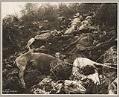
Photograph
Dead horses on White Pass Trail, 1898
In 1897 and 1898, many of the Klondike stampeders used pack horses and mules to carry supplies along the White Pass Trail. Smart pack train owners took good care of their animals, but the trail was rough and the work was extremely hard. There was no feed in the mountain canyons and no water in winter. Animals who were too…
ID Number:SHS411
Date:1897
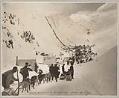
Photograph
Scales and summit of Chilkoot Pass, 1898
The gold seekers packed their supplies from Sheep Camp to just below Chilkoot Pass. At this point, they assembled their goods, weighed them, and, if they could afford it, arranged have their supplies carried to the top of the pass by packers or tramway. Packers charged more to carry the load up the steep slope than along the trail from…
ID Number:SHS412
Date:1898