780 results for: Activism
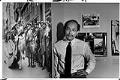
Photograph
Ron Chew at Wing Luke Museum, January 1992
Ronald A. "Ron" Chew (b. 1953) was born in Seattle, the son of Chinese immigrants who worked in the restaurant and garment industries in Seattle’s Chinatown International District (CID). Chew attended Franklin High School and University of Washington (UW), leaving UW in 1975 to pursue community-based journalism. Chew was a reporter for, then editor of, the CID newspaper International Examiner,…
ID Number:2000.107.035.07.01
Date:1992
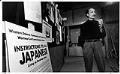
Photograph
Ron Chew at Wing Luke Museum, April 27, 1993
Ronald A. "Ron" Chew (b. 1953) was born in Settle, the son of Chinese immigrants who worked in the restaurant and garment industries in Seattle’s Chinatown International District (CID). Chew attended Franklin High School and University of Washington (UW), leaving UW in 1975 to pursue community-based journalism. Chew was a reporter for, then editor of, the CID newspaper International Examiner,…
ID Number:2000.107.035.07.02
Date:1993
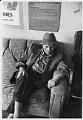
Photograph
Magno Rudio at the International Drop-In Center, Seattle, 1972
Magno Rudio (1908-1995) was born in the Philippines and moved to Seattle in 1929. Like many other Filipino immigrants Rudio worked in canneries in Alaska, where he became a labor organizer. Rudio participated in strikes for higher pay and shorter hours and over a long career he was part of an eventually successful movement to improve working conditions in Alaska…
ID Number:2000.107.036.10.05
Date:1972
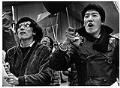
Photograph
Taiwanese students from University of Washington protesting China policy, December 17, 1978
On December 17, 1978, about fifty University of Washington students demonstrated in downtown Seattle to protest President Carter's decision to recognize the People's Republic of China and sever diplomatic ties with Taiwan. The students decried what they saw as Carter's inconsistency in his human rights program, which had previously supported free people over those under Communist regimes. This photos shows…
ID Number:2000.107.036.11.02
Date:1978
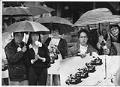
Photograph
Tienanmen Square Massacre remembrance at Hing Hay Park, Seattle, June 3, 1990
On June 3, 1990, about 200 people gathered at Hing Hay Park to remember the victims of the Tienanmen Square massacre in Beijing one year earlier, when Chinese troops with tanks and assualt weapons killed hundreds, perhaps thousands, of protestors seeking democratic reform. Most of the attendees wore a white tissue flower, a traditional Chinese remembrance of the dead. As…
ID Number:2000.107.036.11.06
Date:1990
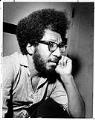
Photograph
Mark Cook giving an interview at Walla Walla State Penitentiary, January 1978
Mark Edwin Cook (b. 1936) was born in Seattle and grew up in the Seattle's Central Area. First arrested at age 17, Cook was in and out of prison for petty crimes until 1973. After his release, he became involved with the George Jackson Brigade, a small revolutionary group in Seattle that committed mostly property crimes to draw attention to…
ID Number:2000.107.041.03.01
Date:1978
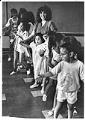
Photograph
Dorothy Cordova teaching Filipino folk dancing to children, Seattle, August 31, 1987
Dorothy (Laigo) Cordova (b. 1932) and Frederic Pilar “Fred” Cordova (1931-2013), both second-generation Filipino Americans, met and married in Seattle, where they devoted their lives to their family, to championing social justice issues, preserving Filipino American history, and empowering youth. In 1957, the couple founded the Filipino Youth Activities of Seattle (FYA) to engage young people in activities that instilled…
ID Number:2000.107.041.21.01
Date:1987
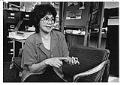
Photograph
Dorothy Cordova discussing education policy, Seattle, February 29, 1988
Dorothy (Laigo) Cordova (b. 1932) and Frederic Pilar “Fred” Cordova (1931-2013), both second-generation Filipino Americans, met and married in Seattle, where they devoted their lives to their family, to championing social justice issues, preserving Filipino American history, and empowering youth. In 1957, the couple founded the Filipino Youth Activities of Seattle (FYA) to engage young people in activities that instilled…
ID Number:2000.107.041.21.02
Date:1988
Photograph
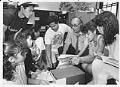
Fred Cordova and students looking at Filipino American archive, Seattle, August31, 1987
Dorothy (Laigo) Cordova (b. 1932) and Frederic Pilar “Fred” Cordova (1931-2013), both second-generation Filipino Americans, met and married in Seattle, where they devoted their lives to their family, to championing social justice issues, preserving Filipino American history, and empowering youth. In 1957, the couple founded the Filipino Youth Activities of Seattle (FYA) to engage young people in activities that instilled…
ID Number:2000.107.041.21.03
Date:1987
Photograph
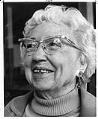
Ida May Daly, Seattle, September 1979
Ida May Daly, born in Cedar Rapids, Iowa, developed muscular dystrophy at age three. While this progressive disease weakened her muscles and confined her to a wheelchair in her thirties, it challenged her to become a tireless advocate for people with disabilities. In the 1950s, she worked with the Seattle Parks Department to found and run the Handicapped Center, which…
ID Number:2000.107.044.037.01
Date:1979