1804 results for: wdh24metadata
Ephemera
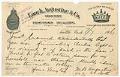
Request for installation of electricity in home, July 7, 1906
In 1906, businessperson Manuel Brock Augustine (1844-1922) wrote the note pictured here to the superintendent of the Seattle Light and Water Department (now Seattle Public Utilities), Luther Burns Youngs (1860-1923), asking to have electric lights installed in his home. Mr. Augustine and his business partner, Charles Louch (b. 1850), had between them been operating grocery, wholesale, mining supply stores in…
ID Number:1969.5072.104
Date:1906
Correspondence
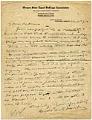
Letter from Abigail Scott Duniway to Missouri Hanna, November 8, 1910
This personal letter regarding suffrage movements in Washington and Oregon was written by Abigail Jane (Scott) Duniway (1834-1915), a writer, pioneer, editor, and champion of women's suffrage. At the time she wrote the letter, Ms. Duniway was president of the Oregon State Equal Suffrage Association, and her efforts were instrumental in the passage of Oregon's women's suffrage bill in 1912.…
ID Number:1970.4814.1
Date:1910
Ephemera
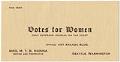
Missouri Hanna business card, circa 1910
This business card belonged to Missouri (Saunders) Hanna (1857-1926), in her role as publisher of "Votes for Women," a Seattle newspaper published from 1909-1912. Ms. Hanna, often known as "Mrs. M. T. B. Hanna," was Washington Territory’s first woman newspaper publisher. Her Seattle and Edmonds-based newspapers "Edmonds Review," "Votes for Women," and "The New Citizen" made her a powerful voice…
ID Number:1970.4814.2
Date:Circa 1910
Ephemera
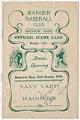
Rainier Baseball Club scorecard, 1906
The Seattle Rainiers were a Minor League Baseball team that played in the Pacific Coast League from 1903 to 1906 and 1919 to 1968. Originally named the Seattle Indians and also known as the Seattle Angels, they changed their name after being acquired by the Rainier Brewing Company, which was in turn named for nearby Mount Rainier. This official score…
ID Number:1970.4835.1
Date:1906
Ephemera
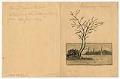
Invitation to Denny School program, February 20, 1903
Seattle was a fast-growing community in the 1880s and an elementary school was needed to serve the families in Seattle's north end (now the Belltown neighborhood). In 1884 the school board opened a two-story wooden building adorned with a bell tower located at Battery Street between Fifth Avenue and Sixth Avenue. They named the new school Denny School in honor…
ID Number:1970.4875.1
Date:1903
Manuscript
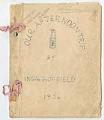
Our Afternoon Trip, April 17, 1906
Inga Caroline Hoffield (1894-1945) was born in Iowa to Norwegian-immigrant parents Benjamin Kornelius Hoffield (1865-1949) and Ellen B. (Strom) Hoffield (1872-c. 1905). The family moved to Seattle before 1900, and Inga and her two younger sisters attended Salmon Bay School at 26th Avenue W and W Prospect Street.The manuscript pictured here is an essay that Inga wrote while a student…
ID Number:1970.4879.1
Date:1906
Photograph
Employees inside Admiral Line terminal at Pier D, Seattle, 1925
The Pacific Coast Steamship Company was an important early shipping company that operated steamships on the west coast of North America. Organized in 1867 under the name of Goodall, Nelson and Perkins, the company effectively ceased business in 1916 when its vessels were purchased by the Admiral Line. The Admiral Line (also American Mail Line, and later Admiral Oriental Line)…
ID Number:1970.4892.3
Date:1925

Photograph
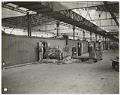
Members of Co. C, 318th National Guard, posing in front of barracks, Vancouver, Washington, 1917
In preparation for and during World War I, many local National Guard units were called into service, both in foreign service and in service protecting the home front. This picture shows Company C, 318th National Guard Unit, Engineers, which was mobilized from the Vancouver (Washington) Barracks to serve in France. One of the individuals in the group is Lt. George…
ID Number:1970.4969.29
Date:1917
Ephemera
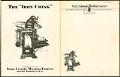
Brochure for the "Iron Chink" fish cleaning machine, circa 1909
In 1903, Seattle inventor Edmund A. Smith (1870-1909) developed a machine that gutted and cleaned salmon for canning 55 times faster than human workers. Most Northwest cannery workers were Chinese immigrants, and Smith, with "unselfconscious racism" (in the words of historian Carlos Schwantes), called his invention the Iron Chink. The innovation increased cannery profits, but forced thousands of people to…
ID Number:1970.4992.2
Date:Circa 1909
Photograph
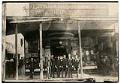
Employees posing outside Lowman & Hanford Co. building on First and Cherry, Seattle, 1882
James D. Lowman (1856-1947) and Clarence Hanford (1857-1920) were business and civic leaders in early Seattle, each with ties to Seattle's founders. In 1882, they joined forces to found Lowman & Hanford Stationery and Printing Company. The firm advertised as booksellers, stationers, printers and binders but also sold typewriters, sewing machines, pianos and organs. After losing their original building in…
ID Number:1970.5046.3
Date:1882