365 results for: Homes and Housing
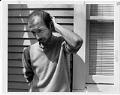
Photograph
Man living with AIDS at Rosehedge House, Seattle, July 27, 1990
In this image a man with AIDS is standing in front of his residence at Rosehedge House, a nursing facility on Capitol Hill for those in the disease's terminal stages. "He is seemingly resigned to his fate," Post-Intelligencer staff writes, "but would like others to understand that AIDS touches many lives. 'Nobody wants to acknowledge the deaths,' he says." Caption…
ID Number:2000.107.001.06.17
Date:1990
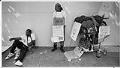
Photograph
Two men protesting a Seattle Housing Authority decision, Seattle, July 15, 1992
In this image Keith Powe (center), wearing a sign declaring that he is dying of AIDS, and a friend protest a recent Seattle Housing Authority decision allegedly denying him admittance to public housing. Powe, still homeless, died in 1995. Caption information source: "`Forgotten' Remembered In Death -- Characters Of City Streets Memorialized," by Linda Keene, Seattle Times, December 30, 1995.Caption…
ID Number:2000.107.001.06.19
Date:1992
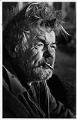
Photograph
Portrait of Dale Hayes, a man experiencing homelessness in Seattle, November 14, 1979
This image of Dale Hayes, 61, was taken under the Alaskan Way Viaduct, where he had been sleeping. Concerns for Hayes and many others living under the city's bridges and the approaching winter prompted Mayor Charles Royer and others to make promises of aid and calls for the help from the middle class. Caption information derived from captions written by…
ID Number:2000.107.005.32.01
Date:1979
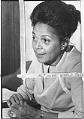
Photograph
Vivian Caver, Seattle, September 9, 1975
Vivian Caver (1928-2021) was a civil rights activist from Seattle. She was born in Tennessee and grew up in Washington. While a student at the University of Washington, Caver worked for the Seattle Urban League as it fought to integrate department store workforces in Seattle. In the 1960s, she set up race relations councils in white neighborhoods to make housing…
ID Number:2000.107.033.27.01
Date:1975
Photograph
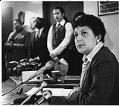
Vivian Caver at press conference, Seattle, February 1980
Vivian Caver (1928-2021) was a civil rights activist from Seattle. She was born in Tennessee and grew up in Washington. While a student at the University of Washington, Caver worked for the Seattle Urban League as it fought to integrate department store workforces in Seattle. In the 1960s, she set up race relations councils in white neighborhoods to make housing…
ID Number:2000.107.033.27.02
Date:1980
Photograph
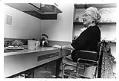
Ida Daly at Center Park Apartments for the Handicapped, Seattle, September 1979
Ida May Daly, born in Cedar Rapids, Iowa, developed muscular dystrophy at age three. While this progressive disease weakened her muscles and confined her to a wheelchair in her thirties, it challenged her to become a tireless advocate for disabled people. In the 1950s, she worked with the Seattle Parks Department to found and run the Handicapped Center, which provided…
ID Number:2000.107.044.037.02
Date:1979
Photograph
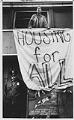
Low-income housing advocate protesting at McKay Apartments, Seattle, July 1, 1989
In this image Ben Factory leans out of a window at the McKay Apartments, on the corner of Seventh Avenue and Pike Street. A group known as "Operation Homestead" sponsored the occupation of the building, closed by the state in 1987, to protest the steady decline of low-income housing in downtown Seattle. An unidentified police officer stands on the street…
ID Number:2000.107.047.35.01
Date:1989
Photograph
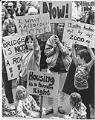
Protestors demonstrating in favor of low income housing, Seattle, October 12, 1988
On October 12, 1988, some 300 demonstrators crowded the steps of the federal courthouse in downtown Seattle to protest the lack of affordable housing. Speakers noted that some 20,000 children were homeless in Washington state. The demonstration was organized by a variety of church and activist groups and took place during a housing conference at the Washington State Convention and…
ID Number:2000.107.047.36.01
Date:1988
Photograph
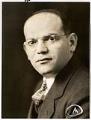
Portrait of Jesse Epstein, Seattle, August 2, 1941
Jesse Epstein (1910-1989) was the first director of the Seattle Housing Authority (SHA) in 1939, having been a primary force in its creation. When the U.S Housing Act of 1937 was passed, subsidizing the construction of low-income housing, Epstein worked for legislation to enable the creation of a local housing authority in Seattle. Two housing bills, the Housing Authorities Law…
ID Number:2000.107.057.02.01
Date:1941
Photograph
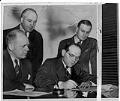
Jesse Epstein signing off on Yesler Terrace project, February 27, 1941
Jesse Epstein (1910-1989) was the first director of the Seattle Housing Authority (SHA) in 1939, having been a primary force in its creation. When the U.S Housing Act of 1937 was passed, subsidizing the construction of low-income housing, Epstein worked for legislation to enable the creation of a local housing authority in Seattle. Two housing bills, the Housing Authorities Law…
ID Number:2000.107.057.02.02
Date:1941