1804 results for: wdh24metadata
Photograph
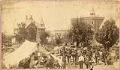
Seattleites posing with goods salvaged from the fire, June 1889
The Great Fire of June 6, 1889 was a significant turning point in Seattle's history and changed both the physical and political landscapes of the City, destroying 100 acres of Seattle's business district and waterfront. The city didn't take much time to mourn; most businesses decided to rebuild where they had been, and rebuilding began almost immediately. Relief bureaus were…
ID Number:SHS2150
Date:1889
Photograph
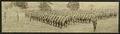
Members of the National Guard of Washington posing in formation, 1910
During the period before statehood, the U.S. Federal Government authorized Washington Territory to form independent militia units to assist the civil authorities in maintaining law and order. A more permanent force was created on March 9, 1886, with the formation of the First Infantry Regiment of the Washington National Guard, led by Lieutenant-Colonel George D. Hill. The Second Infantry Regiment…
ID Number:SHS2173
Date:1910
Photograph
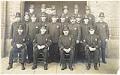
Members of Seattle Police Department, Ballard Station, April, 1913
Ballard was an independent city from its incorporation in 1890, until a vote to annex to Seattle passed 996 to 874 on November 6, 1906. On May 29, 1907, the City of Ballard officially became simply Ballard, a neighborhood of Seattle.In the 1910s, Seattle had neighborhood police headquarters in Ballard, West Seattle, Columbia City, Densmore (now Wallingford), and Georgetown. This…
ID Number:SHS2273
Date:1913
Photograph
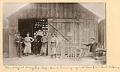
August Wenzel in front of his blacksmith shop at 7th and Pike, Seattle, 1889
August Joseph Wenzel (1856-1945) was born in Kingdom of Prussia, Germany, and moved to Seattle in 1888 with his wife Maria and their 8 children. He opened a blacksmith and cooper shop on Pike Street between Fourth Avenue and Fifth Avenue. Next door to the blacksmith shop he owned a wagon works shop and next to that a meat market.…
ID Number:SHS2303
Date:1889
Photograph
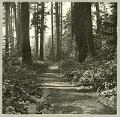
Military road on Beacon Hill, Seattle, circa 1900
The Fort Steilacoom to Fort Bellingham Military Road was a network of roads running through the Puget Sound area to promote the migration of settlers to Washington Territory and to secure U. S. interests in the region from those of Native Americans. Today’s I-5 roughly follows the route north from Fort Vancouver, built in 1924 by the Hudson's Bay Company…
ID Number:SHS2354
Date:Circa 1900
Photograph
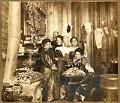
Theodore Wernecke and employees inside fur store, Seattle, circa 1898
An estimated 100,000 prospectors migrated to the Klondike region of the Yukon in north-western Canada between 1896 and 1899. Most of them stopped in Seattle to purchase supplies, greatly contributing to the city's economic success. Ohio-born Charles Theodore Wernecke (1852-1922) came to Seattle around 1897 and operated at least one store catering to miners headed to Alaska during the Klondike…
ID Number:SHS2508
Date:Circa 1898
Photograph
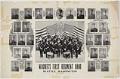
Wagner's First Regiment Band, Seattle, 1889
Cornetist Theodore H. “Dad” Wagner arrived in Seattle in the mid-1880s. As leader of the Second Regiment National Guard Band, Wagner’s band gained community fame by providing free concerts at Pioneer Square after Seattle’s Great Fire of 1889. That same year, he led the First Regiment Washington National Guard Band in celebration of Washington’s statehood. His own band, Dad Wagner’s…
ID Number:SHS2514
Date:1889
Photograph
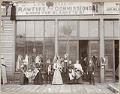
Exterior of C.T. Wernecke fur store, Seattle, circa 1897
Fur trading in the Pacific Northwest dates back to the 1700s. The first raw fur auction in the United States was organized in Seattle in 1898, coinciding with the Klondike Gold Rush, which had started in 1896. Ohio-born Charles Theodore Wernecke had come to Seattle in 1897 and ran a store that bought raw furs, manufactured fur clothing, and catered…
ID Number:SHS2525
Date:Circa 1897
Photograph
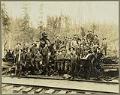
Smith Logging Company, Monroe, 1912
Darius Kinsey (1869-1945) was a prominent photographer in the Pacific Northwest, specializing in logging photography. After five years as a photographer for the Seattle and Lake Shore Railroad Co, in 1897 he opened a photography studio in Sedro-Wooley with his wife Tabitha working as his photography assistant. In 1906, he moved his photography studio to Seattle, but continued to document…
ID Number:SHS2626
Date:1912
Photograph
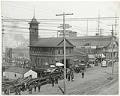
Fire Station No. 5, Seattle, 1911
The Seattle Fire Department opened Fire Station No. 5 in 1902. It was located on the waterfront at the foot of Madison Street, where the fireboat “Snoqualmie” (known as Engine 5) was berthed. The building, shown here, housed the fireboat crew as well as Hose Company 5, with its chemical and hose wagon. Fire Chief Frank Stetson condemned the building…
ID Number:SHS2781
Date:1911