234 results for: Northwest Coast Native Peoples
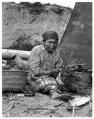
Photograph
Puget Sound Salish basketmaker, circa 1900
Coast Salish peoples are a diverse group of Indigenous people of the Pacific Northwest who speak related languages and have some common cultural traditions. The Coast Salish grouping includes many different tribal groups, all with their own names for themselves and most with their own languages. Coast Salish peoples have lived in the Pacific Northwest since time immemorial and their…
ID Number:Lib1988.33.115
Date:Circa 1900
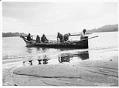
Photograph
Makah whale hunters landing their canoe at Neah Bay, 1900
The Makah people of the northwest tip of the Olympic Peninsula refer to themselves as Kwih-dich-chuh-ahtx, which translates roughly to "the people who live by the rocks and seagulls." The early Makah were skilled mariners, using several types of canoes which they carved from western red cedar for various purposes - war, whaling, fishing, sealing, carrying cargo, and long voyages.…
ID Number:Lib1988.33.122
Date:1900
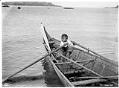
Photograph
Makah boy rowing a canoe at Neah Bay, 1900
The Makah people of the northwest tip of the Olympic Peninsula refer to themselves as Kwih-dich-chuh-ahtx, which translates roughly to "the people who live by the rocks and seagulls." The early Makah were skilled mariners, using several types of canoes which they carved from western red cedar for various purposes - war, whaling, fishing, sealing, carrying cargo, and long voyages.…
ID Number:Lib1988.33.136
Date:1900
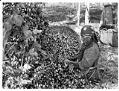
Photograph
Woman with hop basket, circa 1900
From the late 1860s to the early 1890s, hop farming was an important activity in the valleys of the Puget Sound region, including Puyallup, White River, and Snoqualmie. Indigenous workers came from through the Pacific Northwest, Canada, and Alaska (but especially from regional tribes like the Puyallup, Snoqualmie, Muckleshoot, Duwamish, Sammamish, Lummi, and Nisqually) as a seasonal labor force to…
ID Number:Lib1988.33.139
Date:Circa 1900
Photograph
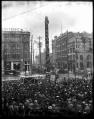
Unveiling the totem pole at Pioneer Square, Seattle, 1899
This Tlingit totem was carved around 1790 to honor a tribal woman named Chief-of-All-Women and it was placed in the village of Tongass on the Alaska coast. In 1899, a group of leading Seattle businessmen on a goodwill tour of southeastern Alaska stole the totem and brought it back to Pioneer Square. The businessmen were indicted for the theft, but…
ID Number:Lib1988.33.146
Date:1899
Photograph
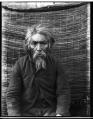
Portrait of Yaht-le-min, circa 1900
This is a portrait of Yaht-le-min, a sub-chief of the S'Klallam. He was called "General Taylor" by the settlers and was identified as such by the photographer. Caption information source: "Land and People and Lifestyle," by Jerry Gorsline for the Port Gamble S'Klallam Tribe, retrieved from https://www.pgst.nsn.us/tribal-enterprises/noo-kayet-development/35-top-level/land-and-people-and-lifestyle
ID Number:Lib1988.33.288
Date:Circa 1900
Photograph
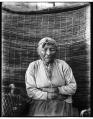
Portrait of Yaht-le-min's wife, circa 1900
This is a portrait of the wife of Yaht-le-min (called General Taylor by the settlers), a sub-chief of the S'Klallam. Her name is not known. She had her portrait taken with a traditional clam basket in front of a handmade cattail mat. She wears a crucifix pendant, a symbol of the Christian faith introduced by missionaries in the mid-1800s. Caption…
ID Number:Lib1988.33.289
Date:Circa 1900
Photograph
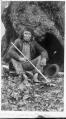
Puget Sound Native man with pipe, circa 1900
Seated in front of a large tree trunk, this Puget Sound Native man holds a pipe in his mouth and looks steadily at the camera. The subject has been identified as Dr. Jack, a Duwamish man who lived on the Cedar River, but this information could not be confirmed.
ID Number:Lib1992.9.2
Date:Circa 1900
Photograph
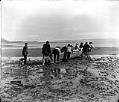
Indigenous group launching their canoe at Port Townsend, August 30, 1899
Many Indigenous peoples of the Pacific Northwest traditionally carve canoes from cedar. The canoes are made in several styles and sizes, and the larger ocean-going canoes required multiple people to launch. This image taken in late August 1899 shows a group of Indigenous people dragging a cedar dugout canoe towards the waters of Port Townsend Bay. In the late 19th…
ID Number:Lib1993.1.722
Date:1899
Photograph
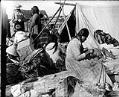
Group of Indigenous people at Port Townsend, August 30, 1899
Port Townsend, site of a S'Klallam village prior to the arrival of settlers in the mid-1800s, became an important trading center by the end of the 19th century. Indigenous peoples from Canada and the tribes of Puget Sound and the Olympic Peninsula gathered along the shores of Port Townsend Bay to trade and socialize. Many also stopped here on their…
ID Number:Lib1993.1.723
Date:1899