584 results for: Alaska
Photograph
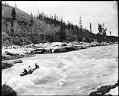
Shooting White Horse Rapids in a canoe, 1905
People traveling to the Klondike had to survive the dangers of the Yukon River to reach the gold fields. The river's White Horse Rapids were so treacherous that the Royal Canadian Mounted Police allowed only men to run them in boats. Women and children had to walk around the rapids.In this 1905 photo, taken at the Yukon River, three men…
ID Number:1983.10.13100
Date:1905
Photograph
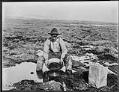
A prospector, Nome, Alaska, circa 1905
The mining in the Alaska gold rush was mainly surface mining. The gold had been washed away from its original location and had collected in river gravel and beach sand. Miners took a sample of sand or gravel, washed it in a pan to separate out any gold, and staked a claim if it looked like there might be more…
ID Number:1983.10.13102
Date:Circa 1905
Photograph
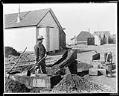
Prospector operating a rocker, Nome, 1904
In 1898, gold was found near Nome, Alaska, setting off a new stampede of fortune hunters. For the next decade or more, crowds of men, women, and children washed gravel and sand through rockers and other equipment, trying to find gold. Rockers were easily built and simple to operate. About $50 million in gold was removed from the Nome area…
ID Number:1983.10.13104
Date:1904
Photograph
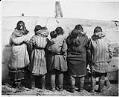
Native Alaskan women and children, 1905
In the early years of the 20th century, Frank H. Nowell, a Seattle photographer, spent several years in the area around Nome, Alaska. He took many photographs of the region and its native inhabitants and sold the photos to tourists and residents alike.In this photo, taken on a summer day in 1905, a group of Alaska Native, likely Inupiat, women…
ID Number:1983.10.13110
Date:1905
Photograph
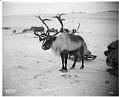
Reindeer, circa 1905
Beginning in 1892, the United States government brought reindeer from Asia and Europe into Alaska as a new food source for the Native Peoples. The idea was to replace hunting with herding. Although the reindeer multiplied until the 1930s, the experiment was not a success. The imported reindeer had to be fenced, fed, and protected from predators. It made more…
ID Number:1983.10.13121
Date:Circa 1905
Photograph
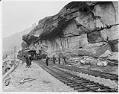
A section of the White Pass & Yukon Route railroad, circa 1899
The trek over Chilkoot and White Passes was grueling at best, particularly since gold seekers had to carry a ton or more of food and supplies. In 1898, businessmen got together to build a railroad through White Pass. The terrain and weather made construction very difficult, but the line was completed as far as Lake Bennett in July 1899.This photo…
ID Number:1983.10.13124
Date:Circa 1899
Photograph
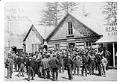
Group outside Skagway City Hall, possibly a meeting about gangster Soapy Smith, circa 1898
Jeff Smith, nicknamed Soapy, was one of Skagway's most notorious con men. In 1898, he and his gang started to take advantage of those whose mind was on the gold rush. Their activities ranged from sending fake telegrams for gold seekers to robbery and murder. Skagway's business owners realized that their town was getting a bad reputation. Smith was killed…
ID Number:1983.10.13145
Date:Circa 1898
Photograph
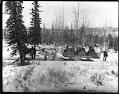
White Pass & Yukon Route sleigh, 1905
Some of the people heading to the Yukon gold fields sailed to Skagway and then packed their equipment and food through White Pass on horses and mules. Conditions along the trail were poor, and thousands of pack animals died. In 1900, the White Pass & Yukon Route railroad was completed between Skagway on the coast and Whitehorse on the Yukon…
ID Number:1983.10.13146
Date:1905
Photograph
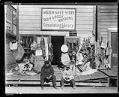
Golden Gate Store and Circulating Library, Alaska, 1905
In Alaska, many general stores still carry a little bit of everything, from thread and canned goods to boots and library books.This 1905 photo, taken during the Nome gold rush, shows an Alaskan Native man and boy sitting on the wooden sidewalk outside the Golden Gate Store. Baskets, furs, dolls, and other souvenirs cover the outside of the building. Even…
ID Number:1983.10.13147
Date:1905
Photograph
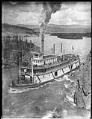
Riverboat "White Horse," circa 1905
The steamer "White Horse," nicknamed "The Old Gray Mare" was one of many Yukon River steamers which carried miners and other travelers to the Klondike gold fields near Dawson. At Five Finger Rapids, the Yukon divided into five channels around four rocky islands. The rapids were so dangerous that a cable was installed and steamboats pulled themselves along through the…
ID Number:1983.10.13153
Date:Circa 1905