1868 results for: Seattle Times
Ephemera
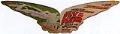
Fly on the Flyer advertising leaflet, 1909
The Flyer was an American steamboat that served from 1891-1929 on Puget Sound, a time in which passenger traffic via boat was very high. The Flyer (later the Washington) was able to complete the 28 miles between Seattle and Tacoma in 77 minutes.This brochure lists the Flyer's departure times from both Seattle and Tacoma, and when opened forms the shape…
ID Number:2018.3.3.28
Date:1909
Program
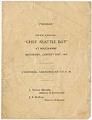
Chief Seattle Day program, 1915
The Tilikums of Elttaes were a fraternal, civic organization composed primarily of influential white Seattle area businessmen, who used Native American imagery to promote tourism and the economic development of the city. In 1912 the Tilikums ("Friends" in Chinook Jargon; Elttaes is Seattle spelled backward) organized the first Potlatch celebration (an early version of Seafair) and financed the statue of…
ID Number:2018.3.3.32
Date:1915
Program
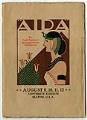
Aida program, August 1927
"Aida" is an opera in four acts composed by Giuseppe Verdi (1813-1901) to an Italian libretto by Antonio Ghislanzoni (1824-1893). Set in Egypt, it was commissioned by and first performed at Cairo's Khedivial Opera House on December 24, 1871. The opera has since been performed thousands of times all over the world, and remains a central piece in the operatic…
ID Number:2018.3.3.33
Date:1927
Program
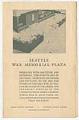
Seattle War Memorial Plaza opening program, January 1951
During World War II, the King County War Finance Committee's Victory Square in downtown Seattle was a gathering place and symbol of Seattle's war efforts. After the war, Mayor William F. Devin (1898-1982) established a War Memorial Committee who oversaw design and construction of a memorial plaza that was built as part of the new Public Safety Building. The building…
ID Number:2018.3.3.34
Date:1951
Ephemera
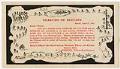
Tilikums of Elttaes invitation, 1912
The Tilikums of Elttaes were a fraternal, civic organization composed primarily of influential white Seattle area businessmen, who used Native American imagery to promote tourism and the economic development of the city. In July 1911 the Tilikums ("Friends" in Chinook Jargon; Elttaes is Seattle spelled backward) organized the first Golden Potlatch celebration. The Golden Potlatch was a city-wide festival held…
ID Number:2018.3.3.43
Date:1912
Ephemera
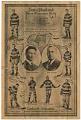
Seattle Metropolitans hockey score card, December 5, 1916
In 1915, Seattle joined the professional men's ice hockey league in western Canada and the western United States with their new team, the Metropolitans. The Mets, as they were known, played their home games at the Seattle Ice Arena (site of the present-day Seattle Center), in a new, state-of-the-art facility built by the Canadian brothers Frank and Lester Patrick. The…
ID Number:2018.3.3.47
Date:1916
Program
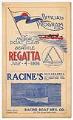
Motor Boat Club regatta program, July 4, 1906
The program pictured here is for the third annual summer Regatta held by the Motor Boat Club of Seattle. Races took place on Lake Washington, and included a one-mile straight course, and three-, five-, and ten-mile triangular courses. The speed boat Comet wowed 3,000 spectators by finishing the ten-mile course in just over 29 minutes. Caption information source: "Comet is…
ID Number:2018.3.3.50
Date:1906
Program
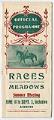
Races at the Meadows program, August 3, 1906
Built in 1902 by the King County Fair Association, The Meadows was the premier venue in the Northwest for horse racing. The track was located just five miles south of downtown Seattle, between the south end of Beacon Hill and the Duwamish River, in what is now known as the Georgetown neighborhood. The grandstands seated 10,000 spectators, who had convenient…
ID Number:2018.3.3.51
Date:1906
Program
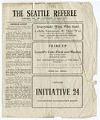
The Seattle Referee, November 3, 1916
The issue of "The Seattle Referee" pictured here was published as a program for a boxing match between William August "Willie" Hoppe (b.1890) of San Francisco and "Smilin' George" Ingle of Seattle. The date on this program, November 3, 1915, is a misprint. The bout actually took place on Friday, November 3, 1916, at the Dreamland Pavilion in Seattle, and…
ID Number:2018.3.3.54
Date:1916
Program
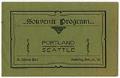
High school football program, November 21, 1903
The program pictured here is for a football game played between Seattle High School and Portland High School on November 21, 1903, at Seattle’s Athletic Park on Madison Street. The program highlights the coaches and players of each team and includes photos, line-ups, and score cards. Seattle won the game 28-0.The Seattle team was coached by Bruce C. Short. Players…
ID Number:2018.3.3.55
Date:1903