1804 results for: wdh24metadata
Ephemera
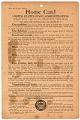
Home card rationing advice, circa 1918
During World War I, America's food production industry was far removed from war-torn Europe, and America’s civilians had easy access to food while European civilians were victims of starvation. The United States Food Administration was established in 1917 to oversee the food reserves for the U. S. Army and its allies. Wide-scale rationing of food and commodities was introduced in…
ID Number:2018.3.3.124
Date:Circa 1918
Ephemera
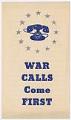
Leaflet on war-time telephone calls, July 1942
During World War II, the telephone company called on citizens to keep personal phone calls to a minimum so lines would be free for war-related communication. This leaflet from Seattle's Pacific Telephone and Telegraph Company, gives guidelines for making long distance and local calls.
ID Number:2018.3.3.125
Date:1942
Ephemera
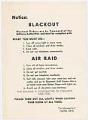
Hotel Frye air raid blackout notice, circa 1943
Seattle, with its military bases and industries, was considered an important target for Japanese air raids. Homes and businesses turned out lights and covered windows to darken the city at night. In order to keep guests safe, Seattle's Hotel Frye posted notices detailing how to black out rooms and what to do in case of an air raid.
ID Number:2018.3.3.126
Date:Circa 1943
Program
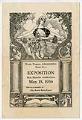
WPA District 4 Exposition program, Seattle, May 15, 1936
The Federal government created the Works Progress Administration (WPA) in 1935, during the Great Depression, to provide jobs to unemployed men, women, and children. The country was divided into regions and districts, and in Washington State, District 4 comprised King, Jefferson, Kitsap, and Clallam counties. In 1936, some 12,337 people, about 75% of whom were men, worked in WPA projects…
ID Number:2018.3.3.127
Date:1936
Document
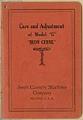
Care and Adjustment of Model "G" "Iron Chink," circa 1906
In 1903, Seattle inventor Edmund A. Smith (1870-1909) developed a machine that gutted and cleaned salmon for canning 55 times faster than human workers. Most Northwest cannery workers were Chinese immigrants, and Smith, with "unselfconscious racism" (in the words of historian Carlos Schwantes), called his invention the "Iron Chink." The innovation increased cannery profits, but forced thousands of people to…
ID Number:2018.3.3.128
Date:Circa 1906
Program
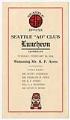
Program for Seattle Ad Club luncheon, February 20, 1912
The Seattle Advertising and Sales Club, or Seattle Ad Club, was started in 1909 and continues as of 2018 as the American Advertising Federation (AAF) Seattle. The club was founded by local business men in part to investigate and prevent fraudulent advertising schemes.This program for the club's monthly luncheon, held February 20, 1912 at the Rathskeller, is printed with humorous…
ID Number:2018.3.3.130
Date:1912
Ephemera
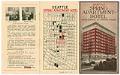
Brochure from the Spring Apartment Hotel, Seattle, circa 1925
The Spring Apartment Hotel was constructed in 1922 for William H. Hainsworth, a representative of the Spring Apartment Hotel Co. The eleven-story building was designed by John Graham Sr. and built by general contractor Hans Petersen for$500,000. There were no retail storefronts and the building was entirely devoted to residential hotel purposes and remained so for three decades.This brochure advertises…
ID Number:2018.3.3.131
Date:Circa 1925
Correspondence
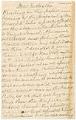
Interview with Mrs. David Webster with letter to Mrs. M.J. Carkeek, Seattle, 1914
In the 1860s, Asa Mercer, Seattle resident and founder of the University of Washington, traveled to the East Coast twice to recruit women to move to Seattle. The second group of women arrived in Seattle in 1866. Anna Robinson, a member of this group, married fellow shipmate David Webster. In 1914, Mrs. Webster was interviewed, probably by a member of…
ID Number:2018.3.3.134
Date:1914
Ephemera
Pacific Coast Coal Co. advertisement blotter, circa 1930
The Pacific Coast Company was organized in 1897, and comprised several existing organizations, most notably the Pacific Coast Steamship Co., Pacific Coast Coal Co. and the Pacific Coast Railway. The Pacific Coast Coal Company oversaw several mines in King County, and by the early 1930s was the top coal producing company in Washington State. This card has a blotter on…
ID Number:2018.3.3.135
Date:Circa 1930
Ephemera
Stan Sayres, Inc., matchbook, circa 1950
Seattle automobile dealer and athlete Stanley S. Sayres (1896-1956) was the owner and driver of the Seattle-designed and Seattle-built hydroplane, Slo-mo-shun IV. Mr. Sayres was piloting the boat June 26, 1950, on Lake Washington when he broke the world speed record on water, beating the previous record by nearly 20 mph.The matchbook pictured here advertises Stan Sayres, Inc., (also called…
ID Number:2018.3.3.136
Date:Circa 1950