3503 results for: Seattle Photographic Co.
Photograph
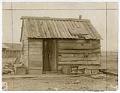
Ellen Phillips in doorway of her home, Seattle, May 10, 1910
In 1910 Chief Si'ahl's (Chief Seattle) nephew, Sbeebayoo (known as "Indian Billy" Phillips) and his wife Ellen (1812-1910), members of the Duwamish Tribe, were struggling to survive in their home at the foot of Stacy Street, just south of the Pioneer Square neighborhood. Seattle Post-Intelligencer reporters seized the story, describing how Sbeebayoo's camping places along the Puget Sound shoreline had…
ID Number:2000.107.095.28.05
Date:1910
Photograph
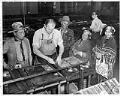
Wanapum visitors in the Seattle Post-Intelligencer composing room, Seattle, October 1956
In this image, printer Roy Jones demonstrates part of the newspaper printing process in the Seattle Post-Intelligencer composing room, for his visitors from the Wanapum Tribe. Washat (then called Washini or Washani) religious leaders from Wapato, Washington, Alba Shawaway, left, and Frank So Happy (also Che-che-mah), center, look on with their wives, Julia So Happy, second from right, and Nettie…
ID Number:2000.107.095.28.06
Date:1956
Photograph
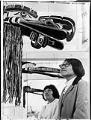
Girls viewing Northwest Coast art at Seattle Center, June 2, 1967
In this image Patricia White, 16, foreground, and Angie SpoonHunter, 16, look at Native ceremonial masks made by Northwest Coast tribes displayed in the Cascade Gallery at Seattle Center. Both girls are members of the Arapaho tribe and were visiting from the Wind River Reservation in Wyoming. Caption information derived from captions written by Post-Intelligencer staff and attached to the…
ID Number:2000.107.095.28.07
Date:1967
Photograph
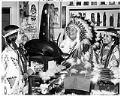
Pat McCloud, Bert Peters, and Billie McCloud at Indian Center, Seattle, May 3, 1967
In this image Pat McCloud, left, Bert Peters, and Billie McCloud admire the Chief Leschi Memorial Trophy, a totemic wooden orca carved by Lawney Reyes, which was to be given to the winners of the Seattle War Dance competition on May 21 at Seattle Center. Pat and Billie McCloud of Yelm, Washington, are members of the Walla Walla and Puyallup…
ID Number:2000.107.095.29.01
Date:1967
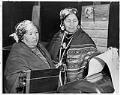
Photograph
Julia So-Happy and Nettie Shawaway visiting Seattle Post-Intelligencer building, Seattle, October 14, 1956
In this image, Julia So Happy, left, and Nettie Shawaway, the wives of Washini religious leaders from Wapato, Washington, inspect a teletype machine at the International News Service Bureau in the Seattle Post-Intelligencer building in downtown Seattle. Caption information derived from captions written by Post-Intelligencer staff and attached to the back of the photograph.
ID Number:2000.107.095.29.02
Date:1956
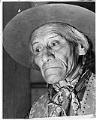
Photograph
Frank So-Happy in Seattle, October 14, 1956
This image of Washat (then called Washini or Washani) religious leader Frank Sohappy (Che-che-mah) of the Wanapum tribe, who was born in 1878, was taken during a visit to Seattle from his home in Wapato, Washington. Caption information derived from captions written by Post-Intelligencer staff and attached to the back of the photograph.
ID Number:2000.107.095.29.03
Date:1956
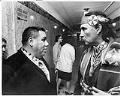
Photograph
Semu and Mad Bear in courthouse, Olympia, November 28, 1966
Richard Claxton "Dick" Gregory (1932-2017) was an American comedian and civil rights activist who helped call attention to Washington State laws restricting Native American rights. The "fish wars" as they were known at the time, led to the Boldt Decision, a federal ruling guaranteeing Washington tribes half the state's salmon and steelhead trout catch.In this image Mad Bear, right, an…
ID Number:2000.107.095.30.01
Date:1966
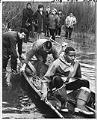
Photograph
Dick Gregory on Nisqually River, March 1, 1966
Richard Claxton "Dick" Gregory (1932-2017) was an American comedian and civil rights activist who helped call attention to Washington State laws restricting Native American rights. The "fish wars" as they were known at the time, led to the Boldt Decision, a federal ruling guaranteeing Washington tribes half the state's salmon and steelhead trout catch.In this image Dick Gregory, foreground, sits…
ID Number:2000.107.095.30.02
Date:1966
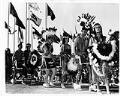
Photograph
Lakota dancers performing at Seattle World's Fair, August 8, 1962
The Century 21 Exposition (also known as the Seattle World's Fair) ran from April 21, 1962, to October 21, 1962. Nearly 10 million people attended the fair, credited with revitalizing Seattle's economic and cultural life.This image was taken at the Plaza of States during a traditional dance performance by Lakota tribe members from San Diego, California. Caption information derived from…
ID Number:2000.107.095.30.05
Date:1962
Photograph
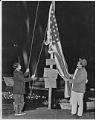
Herman K. Johns Jr. and Billy Frank Jr. lower U.S. flag at protest fishing site, Frank's Landing, Nisqually River, January 21, 1964
In the 1960s, Native Americans and their supporters began protesting Washington State laws restricting Native American fishing rights that had been granted in a series of treaties with the United States between 1854 and 1855. The Survival of the American Indian Society (SAIA), the NAACP, and the National Indian Youth Council (NIYC), coordinated a series of protests and demonstrations over…
ID Number:2000.107.096.01.01
Date:1964