517 results for: Celebrations
Photograph
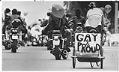
Motorcycles and a bicycle at front of Pride Parade, Seattle, June 29, 1986
The first Pride Week was celebrated by Seattle's gay and lesbian community in June 1974. Now called Seattle Pride, this series of events is held annually in late June to celebrate LGBTQ+ pride in Seattle.Dykes on Bikes began in 1976, with a group of lesbians riding in the San Francisco Pride march. Since then, the tradition has spread to Pride…
ID Number:2000.107.073.36.09
Date:1986
Photograph
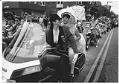
Susan Benner and Michelle riding with Dykes on Bikes in the Pride Parade, Seattle, June 28, 1992
The first Pride Week was celebrated by Seattle's gay and lesbian community in June 1974. Now called Seattle Pride, this series of events is held annually in late June to celebrate LGBTQ+ pride in Seattle.Dykes on Bikes began in 1976, with a group of lesbians riding in the San Francisco Pride march. Since then, the tradition has spread to Pride…
ID Number:2000.107.073.36.11
Date:1992
Photograph
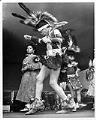
Performers dancing during Christmas Around the World, Seattle, December 1, 1968
The annual "Christmas around the World" program at the Museum of History and Industry (MOHAI) in Seattle began as a way to provide foreign students at the University of Washington with a glimpse of their homeland Christmas celebration, through a series of performances showing the Christmas customs and traditions of other countries. The program grew steadily and showcased a variety…
ID Number:2000.107.095.27.01
Date:1968
Photograph
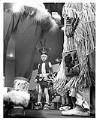
Performers dancing during Christmas Around the World, Seattle, December 1, 1968
The annual "Christmas around the World" program at the Museum of History and Industry (MOHAI) in Seattle began as a way to provide foreign students at the University of Washington with a glimpse of their homeland Christmas celebration, through a series of performances showing the Christmas customs and traditions of other countries. The program grew steadily and showcased a variety…
ID Number:2000.107.095.27.02
Date:1968
Photograph
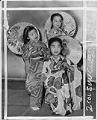
Three girls in costume at Hina Matsuri festival, Seattle, February 25, 1948
Hina Matsuri, also "Doll's Day," "Girls' Day," and "Momo no Sekku," is a Japanese religious holiday celebrated on March 3 to pray for the health and good future of young girls. Traditionally, parents or grandparents of a newborn girl buy a set of hina ningyo ("hina dolls") for the baby, unless they have special dolls that are inherited from generation…
ID Number:2000.107.098.17.02
Date:1948
Photograph
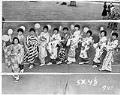
Ten girls performing Bon Odori dance at Children's International Play Fair, Seattle, August 27, 1958
In 1944, the first annual national meeting of the Children’s Theatre Conference was organized with the objectives of promoting the establishment of children’s theatre activities in all communities by educational, community, and private groups, and to provide a meeting ground for children’s theatre workers and educators from all levels. Over the next decades the group grew to include operations in…
ID Number:2000.107.098.17.06
Date:1958
Photograph
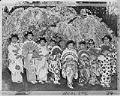
Dancers posing at Cherry Blossom Festival at UW Arboretum, Seattle, April 12, 1959
The Japanese tradition of holding events or festivals surrounding the short-lived blooming of ornamental cherry blossom trees (sakura) is thought to be centuries old and is maintained in many parts of the world. Cherry blossom festivals (hanami) are a reminder to celebrate life and to enjoy the transient beauty of flowers. They are held outside and often include a variety…
ID Number:2000.107.098.17.07
Date:1959
Photograph
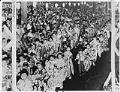
Dancers at Bon Odori festival, Seattle, July 14, 1963
During the summer of 1932, Seattle's first Bon Odori festival was held by the Seattle Buddhist Church (Seattle Betsuin Buddhist Temple). Bon Odori is a traditional Japanese style of dancing performed during Obon, a Buddhist memorial service. The joyful dance celebrates selfless giving and expresses gratitude to departed family members and ancestors. Over the years, the annual open-to-all event has…
ID Number:2000.107.098.18.02
Date:1963
Photograph
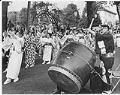
Drummer and dancers at Bon Odori festival, Seattle, July 1977
During the summer of 1932, the Seattle Buddhist Church held the city's first Bon Odori festival. Bon Odori is a Japanese dance which is part of the observance of Obon, a Buddhist memorial service. The joyful dance, which celebrates the Buddhist tradition of selfless giving, expresses gratitude to departed family members. Over the years, the festival grew to include flower…
ID Number:2000.107.098.19.01
Date:1977
Photograph
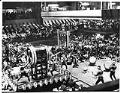
Drummers performing at Cherry Blossom Festival at Seattle Center, May 5, 1979
The Japanese tradition of holding events or festivals surrounding the short-lived blooming of ornamental cherry blossom trees (sakura) is thought to be centuries old and is maintained in many parts of the world. Cherry blossom festivals (hanami) are a reminder to celebrate life and to enjoy the transient beauty of flowers. They are held outside and often include a variety…
ID Number:2000.107.098.19.04
Date:1979