188 results for: Webber, Phil H.
Photograph
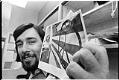
Harold Spence with a photo of his controversial peace symbol flag, June 28, 1974
In May 1970, 23-year-old Harold Spence taped a peace sign to an American flag and hung it outside his University District apartment to protest the US invasion of Cambodia and the Kent State killings. Spence was arrested and convicted at trial for improperly displaying the flag. Spence eventually petitioned the Supreme Court, which heard the case in January 1974. The…
ID Number:2000.107.19740628.2.08
Date:1974
Photograph
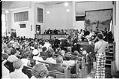
Congregation at Mount Zion Baptist Church after murder of Alberta Williams King, Seattle, June 30, 1974
Alberta Williams King (1904-1974) was an activist, organist, and the mother of martyred civil rights leader Martin Luther King, Jr. (1929-1968). She organized and led the Ebenezer Women's Committee at Ebenezer Baptist Church in Atlanta, where her husband and son were pastors, and was active in the NAACP, the Women's International League for Peace and Freedom, and the YWCA. On…
ID Number:2000.107.19740630.1.17A
Date:1974
Photograph
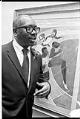
Jacob Lawrence at Seattle Art Museum, December 15, 1974
Painter Jacob Lawrence (1917-2000) was known for his portrayal of the African-American experience, using blacks and browns juxtaposed with vivid colors. Lawrence referred to his style as "dynamic cubism," though by his own account the primary influence was not so much French art as the shapes and colors of Harlem. Lawrence also taught, and spent 15 years as a professor…
ID Number:2000.107.19741215.1.10
Date:1974
Photograph
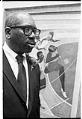
Jacob Lawrence at Seattle Art Museum, December 15, 1974
Painter Jacob Lawrence (1917-2000) was known for his portrayal of the African-American experience, using blacks and browns juxtaposed with vivid colors. Lawrence referred to his style as "dynamic cubism," though by his own account the primary influence was not so much French art as the shapes and colors of Harlem. Lawrence also taught, and spent 15 years as a professor…
ID Number:2000.107.19741215.1.13
Date:1974
Photograph
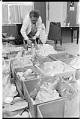
Margaret Jensen, coordinator at South Park food bank, with boxes of food, Seattle, February 4, 1975
In 1975, Seattle and the nation were still suffering from the effects of a nationwide recession brought on by the Boeing Bust and a worldwide oil crisis. Unemployment was still growing. Federal funds supported Neighbors in Need, which ran 15 King County food banks that fed some 55,000 people.When this photo was taken, Margaret Jensen had coordinated Seattle’s South Park…
ID Number:2000.107.19750204.1.16A
Date:1975
Photograph
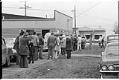
Families lined up outside South Park food bank, February 4, 1975
In 1975, Seattle and the nation were still suffering from the effects of a nationwide recession brought on by the Boeing Bust and a worldwide oil crisis. Unemployment was still growing. Federal funds supported Neighbors in Need, which ran 15 King County food banks that fed some 55,000 people, but these funds were scheduled to end soon.In this early February…
ID Number:2000.107.19750204.1.21A
Date:1975
Photograph
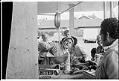
Customers on the first day of the new Inner City Farmer's Market, Seattle, August 2, 1975
In August 1975, the Inner City Farmers’ Market opened at 18th Avenue and Cherry Street in Seattle’s Squire Park neighborhood. During the harvest season, farmers from Yakima, Renton, and elsewhere drove in to provide fresh produce to Central Area residents. Here, Renton farmer Joe Torlai weighs zucchini for a customer as others look on. Caption information source: “A New Market…
ID Number:2000.107.19750802.2.17
Date:1975
Photograph
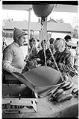
Customers on the first day of the new Inner City Farmer's Market, Seattle, August 2, 1975
In August 1975, the Inner City Farmers’ Market opened at 18th Avenue and Cherry Street in Seattle’s Squire Park neighborhood. During the harvest season, farmers from Yakima, Renton, and elsewhere drove in to provide fresh produce to Central Area residents. Here, Renton farmer Joe Torlai holds a head of romaine lettuce while he waits for payment. Caption information source: “A…
ID Number:2000.107.19750802.2.22
Date:1975
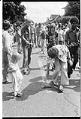
Photograph
Central Area residents painting a red line down the middle of Roy Street to protest red-lining bank policies, August 17, 1975
In the mid-20th century, protesters began challenging long-established inequitable practices in housing. Racially restrictive housing covenants and discriminatory lending (“redlining”) excluded people of color from buying or renting housing in most of Seattle’s neighborhoods. Seattle passed an open housing law in 1968, making redlining illegal, but it often continued in secret and its effects have continued for decades. This photo,…
ID Number:2000.107.19750817.2.21A
Date:1975
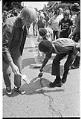
Photograph
Central Area residents painting a red line down the middle of Roy Street to protest red-lining bank policies, August 17, 1975
In the mid-20th century, protesters began challenging long-established inequitable practices in housing. Racially restrictive housing covenants and discriminatory lending (“redlining”) excluded people of color from buying or renting housing in most of Seattle’s neighborhoods. Seattle passed an open housing law in 1968, making redlining illegal, but it often continued in secret and its effects have continued for decades. This photo,…
ID Number:2000.107.19750817.2.22A
Date:1975