234 results for: Northwest Coast Native Peoples
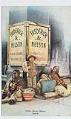
Postcard
Indigenous family selling baskets in downtown Seattle, circa 1912
At the turn of 19th to 20th centuries, Indigenous artists in the Pacific Northwest were making baskets and carvings specifically for the tourist trade and were experimenting with form and design. Making baskets for sale became an important income source for many Indigenous families. On this colorized photo postcard, three women and a boy display woven baskets and rugs on…
ID Number:2002.50.41.1
Date:Circa 1912
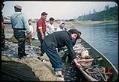
Photograph
Group of people tending to a fishing canoe, La Push, Washington, circa 1955
This photo is one of a sequence of scenes of smelt fishing taken by the photographer at La Push, Washington, on Quileute land. Here, Men and women tend to a canoe and nets on shore. Three of the individuals have been identified as Ramona Bennett, Walter Bennett, and Cynthia Davis.
ID Number:2004.43.1386
Date:Circa 1955
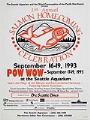
Poster
First Annual Salmon Homecoming poster, Seattle, September 16-19, 1993
In 1992, the Seattle Aquarium held its first Salmon Homecoming celebration, with a month of educational events to highlight the return of salmon to the streams of their birth. In 1993, this became a four-day event called the First Annual Salmon Homecoming Celebration, held on September 16-19 and presented by the Seattle Aquarium in conjunction with the Tribal Communities of…
ID Number:2007.25.14
Date:1993
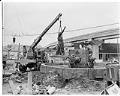
Photograph
Removal of Chief Si'ahl (Chief Seattle) statue for cleaning before the Century 21 Exposition, Seattle, 1962
The Chief Si'ahl (Chief Seattle) statue is an outdoor life-size sculpture by local artist James Wehn, installed at Tilikum Place Park, at the intersection of Fifth Avenue, Denny Way, and Cedar Street in Seattle. Si'ahl (c. 1786-1866), known to settlers as Chief Seattle, became the leader of the Suquamish and Duwamish people sometime around 1810. When settlers started moving to…
ID Number:2009.23.603
Date:1962
Photograph
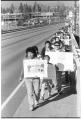
Muckleshoot memorial and protest march on Highway 164, February 27, 1991
On February 27, 1991, a group of Muckleshoot tribal members held a march along Highway 164, also called the Auburn-Enumclaw Road. The march was a memorial to tribal members who had been hit and killed by cars on the highway, as well as a protest to lower the speed limit to 45 mph on Highway 164. Despite high pedestrian traffic…
ID Number:2020.42.3.05.03.01
Date:1991
Photograph
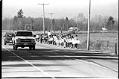
Muckleshoot memorial and protest march alongside cars on Highway 164, February 27, 1991
On February 27, 1991, a group of Muckleshoot tribal members held a march along Highway 164, also called the Auburn-Enumclaw Road. The march was a memorial to tribal members who had been hit and killed by cars on the highway, as well as a protest to lower the speed limit to 45 mph on Highway 164. Despite high pedestrian traffic…
ID Number:2020.42.3.05.03.11
Date:1991
Photograph
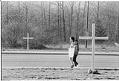
Crosses along route of Muckleshoot memorial and protest march, February 27, 1991
On February 27, 1991, a group of Muckleshoot tribal members held a march along Highway 164, also called the Auburn-Enumclaw Road. The march was a memorial to tribal members who had been hit and killed by cars on the highway, as well as a protest to lower the speed limit to 45 mph on Highway 164. Despite high pedestrian traffic…
ID Number:2020.42.3.05.05.15
Date:1991
Photograph
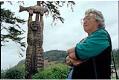
Samish chairwoman Margaret Greene with the Maiden of Deception Pass story pole, April 20, 1992
Margaret Greene (1922-2016) was the chairwoman of the Samish Indian Nation from 1971 to 1974 and again from 1987 to 1996. Greene was descended from Samish people who moved to the Lummi or Swinomish reservations, while many other Samish chose to remain in their ancestral islands. Greene kept her Samish identity and fought tirelessly for Samish rights. During Greene's terms…
ID Number:2020.42.3.21.01.19
Date:1992
Videorecording
Vecinos: Suquamish Elders: the Boarding School Experience, Community Television Agency program, April 20, 1989
Started in 1976 by Virginia Brookbush, CTA produced up to seven half-hour public access television shows a week in the late 1970s and 1980s. Designed to let anyone use public air time to talk about local issues, CTA produced regular shows like "You Have the Right to Know," "Community Bulletin Board," "Visiting Over the Backyard Fence," "This Town's Talent," and…
ID Number:2021.84.10
Date:1989
Videorecording
Vecinos: A Bit of History From the Northwest Indians, Community Television Agency program, July 27, 1989
Started in 1976 by Virginia Brookbush, CTA produced up to seven half-hour public access television shows a week in the late 1970s and 1980s. Designed to let anyone use public air time to talk about local issues, CTA produced regular shows like "You Have the Right to Know," "Community Bulletin Board," "Visiting Over the Backyard Fence," "This Town's Talent," and…
ID Number:2021.84.24
Date:1989