3503 results for: Seattle Photographic Co.
Photograph
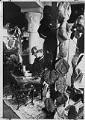
Man making hats in stall at Pike Place Market, Seattle, November 27, 1977
In this image Pike Place Market vendor Mike Loeffler makes and sells denim or wool caps for $7-$7.50. Although the market originally opened as a farmer's market, it has expanded to include local craftspeople and artisans. Caption information derived from captions written by Post-Intelligencer staff and attached to the back of the photograph
ID Number:2000.107.060.41.01
Date:1977
Photograph
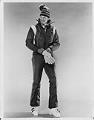
Model posing in Roffe ski wear, Seattle, January 23, 1979
Until the 1990s, Seattle was a thriving apparel-manufacturing center, and enjoyed a reputation as the nation's leader in outerwear, eventually losing business and jobs to cheap overseas labor.In this promotional image from Roffe, Inc., a model poses in the Seattle ski wear company's latest designs, the "Ron" overalls, and the "Harley" parka. From 1953-1996 the company founded by Sam Roffe…
ID Number:2000.107.061.03.01
Date:1979
Photograph
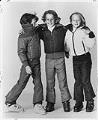
Child models posing in Roffe ski wear, Seattle, December 20, 1979
Until the 1990s, Seattle was a thriving apparel-manufacturing center, and enjoyed a reputation as the nation's leader in outerwear, eventually losing business and jobs to cheap overseas labor.In this promotional image from Roffe, Inc., three young models pose in the Seattle ski wear company's latest designs for children, the "Jr. Ron" overalls, and, from left, the "Chuck," Brad, and "Jack"…
ID Number:2000.107.061.03.02
Date:1979
Photograph
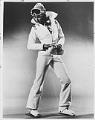
Model posing in Roffe ski wear, Seattle, November 23, 1978
Until the 1990s, Seattle was a thriving apparel-manufacturing center, and enjoyed a reputation as the nation's leader in outerwear, eventually losing business and jobs to cheap overseas labor.In this promotional image from Roffe, Inc., a model poses in the Seattle ski wear company's latest designs, the "Cindy" overalls, and the "Abby" parka. From 1953-1996 the company founded by Sam Roffe…
ID Number:2000.107.061.03.03
Date:1978
Photograph
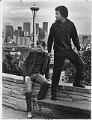
Models posing in Generra Sportswear, Seattle, May 21, 1981
Until the 1990s, Seattle was a thriving apparel-manufacturing center, and enjoyed a reputation as the nation's leader in outerwear, eventually losing business and jobs to cheap overseas labor.In this promotional image from Generra Sporstwear, Inc., models pose at Kerry Park on Queen Anne Hill with the Space Needle in the background, showing off the company's latest designs. Originally a men's…
ID Number:2000.107.061.03.04
Date:1981
Photograph
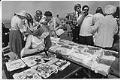
Woman painting t-shirts at Pike Place Market, July 16, 1976
In this image taken at Pike Place Market in downtown Seattle, an artist creates hand-painted t-shirts for sale. Caption information derived from captions written by Post-Intelligencer staff and attached to the back of the photograph.
ID Number:2000.107.061.06.01
Date:1976
Photograph
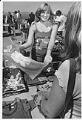
Vendor selling painted t-shirts at Pike Place Market, July 16, 1976
In this image taken at Pike Place Market in downtown Seattle, vendor Margy Erickson displays a batik t-shirt designed by Terry Turrell. Caption information derived from captions written by Post-Intelligencer staff and attached to the back of the photograph.
ID Number:2000.107.061.06.02
Date:1976
Photograph
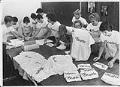
SU students package "Seattle" t-shirts for distribution, August 7, 1977
In this image of a production line set up in Pigott Hall, Seattle University marketing students package "Seattle" t-shirts for distribution. The proceeds from the t-shirts, which cost $5 at the University Bookstore and at Frederick & Nelson, funded SU student scholarships. Caption information source: The Seattle Times, July 9, 1977, page 6Caption information also derived from captions written by…
ID Number:2000.107.061.06.03
Date:1977
Photograph
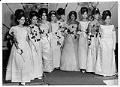
Filipino-American débutantes at Filipino Community Center, Seattle, January 14, 1967
The Filipino Community of Seattle, Inc. (FCS) was formed in 1935 as the Philippine Commonwealth Council of Seattle, and by 1965 had found a permanent home in the Rainier Valley neighborhood. As of 2019 the FCS continues to serve the Filipino American community through educational programs, senior services, dance and language classes, and advocacy. In this image, nine women chosen…
ID Number:2000.107.062.03.01
Date:1967
Photograph
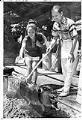
Barbara Bergano and Lope Malle roasting a pig at Seafair Fiesta Filipina, Seattle, August 7, 1971
Fiesta Filipina (also Philippine Festival) began as an annual event commemorating the anniversary of Philippine Independence. The event was held at Seward Park and became part of Seafair, Seattle's ten-week-long summer festival. In 1987 the event was moved to the Seattle Center, where by 1997 it had been renamed Pagdiriwang and become one of the five ethnic and cultural festivals…
ID Number:2000.107.062.03.02
Date:1971