111 results for: Frederick
Ephemera
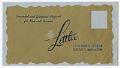
Littler Stores envelope, circa 1950
Upscale men's apparel store Littler was begun in 1931 by Anson A. "Bob" Littler (1900-1991), who started his career as a clerk at Frederick & Nelson in the menswear department. An avid golfer, Mr. Littler began playing in tournaments around 1926, and competed frequently with fellow retail merchants George H. Bartell (1868–1956) and Eddie Bauer (1899-1986). Also a local civic…
ID Number:2018.3.3.89
Date:Circa 1950
Ephemera
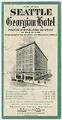
Georgian Hotel brochure, June 1, 1923
Built about 1920, the Hotel Georgian was located in downtown Seattle at 1420 Fourth Avenue. The seven-story, brick-faced building had many Georgian Revival architectural details, such as quoins, a rooftop balustrade, and keystones. The building was demolished in 1971.The brochure pictured here includes a map of the hotel's location in Seattle's shopping district, one block from the Bon Marche and…
ID Number:Lib1987.20.4
Date:1923
Photograph
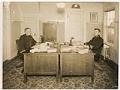
Commandant Freeman and Boatswain Hazard at the Naval Training Station, Seattle, circa 1918
During World War I a temporary Naval Training Station was set up on the University of Washington campus, near where the university's health sciences center is now located. The training camp was active from 1917-1919, during which time over 5,000 mostly college students were trained for both naval and naval aviation units. This image of U. S. Navy officers (left)…
ID Number:Lib1993.35.1.46
Date:Circa 1918
Music, notated
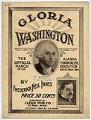
Gloria Washington
The words and music for "Gloria Washington," the official march of the Alaska-Yukon-Pacific Exposition, were written by Frederick Neil Innes (1854-1926), a musician and conductor from Chicago who served as the Fair's director of music. The score was copyrighted by F. B. Innes and published by Clegg Publishing Company of St. Paul, Minnesota. The AYPE was a world's fair held…
ID Number:Lib1996.28.17
Date:1909
Ephemera
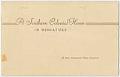
A Southern Colonial House in Miniature, circa 1948
This booklet describes the creation of the "Hammons House," a Colonial Revival miniature mansion co-designed by Claire Bagley Hammons, her husband Frederick Dent Hammons, and architect Joseph S. Coté. The model house was completed in 1948 and given as a gift to the Seattle Historical Society, now known as the Museum of History & Industry, in 1955. The pamphlet has…
ID Number:MS.COLL.814
Date:Circa 1948
Photograph
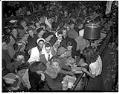
Shoppers buying stockings at Frederick & Nelson, November 3, 1945
In the early 1940s, during World War II, the military needed silk to make parachutes. Silk was rationed, and there was hardly any left over to make underwear, stockings or other everyday products. Women found that rayon stockings bagged and leg makeup smeared or cracked. When the war was over, women jumped at the chance to buy the new sheer…
ID Number:PI21052
Date:1945
Photograph
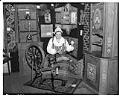
Woman spinning in Swedish Folk Art exhibition, February 1937
In mid-February 1937, various Swedish groups sponsored a Swedish Folk Art Exhibit at Seattle's Frederick and Nelson department store. Exhibits included handicrafts, utensils, furniture and weaving and spinning demonstrations. During the exhibit, Mrs. Ingeborg Soderlund demonstrated how to spin thread on an early 19th century wheel brought to Seattle from Gamtland in northern Sweden.This photo, taken in Seattle in February…
ID Number:PI22473
Date:1937
Photograph
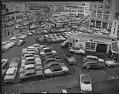
Full downtown parking lot during Christmas shopping season, Seattle, 1954
The day after Thanksgiving has always been a big shopping day in Seattle. Here at the intersection of Westlake Avenue and 7th Avenue shoppers have filled up the parking lots close to the downtown stores. Signs in image read: Mobilgas - Mobiltires, Mobilubrication - Parking Office - Two hours free parking with lubrication. Ready now! - Motorola Color TV. Olympia.…
ID Number:PI23269
Date:1954
Photograph
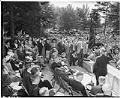
Naturalization ceremony at Woodland Park, Seattle, July 4, 1946
In this photo, a group of foreign-born residents of Seattle are administered the oath of citizenship in front of a large crowd in a naturalization ceremony at Woodland park, a part of the city's annual Fourth of July celebration. The program's main address was given by U. S. Navy Fleet Admiral William Frederick "Bull" Halsey, Jr. (1882-1959), who earlier in…
ID Number:PI24526
Date:1946
Photograph
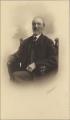
George Frederick Frye, Seattle, circa 1888
Born in Germany, George Frederick Frye came to Seattle in 1853, where he worked with Henry Yesler at his lumber mill. After marrying Louisa Denny in 1860, the couple operated a meat market and bakery, built and invested in real estate, and established the Frye Opera House. They had architects Bebb & Mendel design the 11-story Frye Hotel, which was…
ID Number:SHS2814
Date:Circa 1888