115 results for: Curtis Photo
Photograph
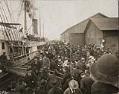
Steamship "Australia" loading at Seattle pier, circa 1898
The United States was in the grip of a nationwide economic depression in the 1890s. When the steamer "Portland" arrived in Seattle in July 1897 with more than a ton of Klondike gold, the city's depression ended. Pacific Northwest shipping companies were eager to profit from the gold rush. They scrambled to provide passenger and freight service to the Alaskan…
ID Number:SHS2506
Date:Circa 1898
Photograph
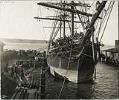
Sailing ship "Lucile" loading at Seattle pier, 1898
In 1897 and 1898 so many people wanted to go north to the Klondike gold fields that all kinds of ships were pressed into service. Some were sailing ships which had carried passengers, coal, lumber, or salmon up and down the west coast of the United States.This 1898 photo shows the wooden sailing ship "Lucile" loaded with gold miners and…
ID Number:SHS2551
Date:1898
Photograph
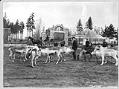
Reindeer and Sami at Woodland Park, 1898
In 1892, the United States government started bringing reindeer from Siberia into Alaska as a new food source for the native peoples. In 1898, the government brought in Norwegian reindeer, along with Sami herdsmen and their families. They stopped in Seattle to wait for a ship to Alaska. Some Sami remained in Alaska, while others eventually returned to Seattle or…
ID Number:SHS2899
Date:1898
Photograph
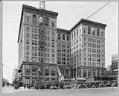
Adding floors to the County-City Building, circa 1930
In 1916, the new King County Courthouse and Municipal Building, also called the County-City Building, opened on Third Avenue in downtown Seattle. The building, designed by Seattle architect Augustus Warren Gould, was five stories tall, with a partial sixth story for the use of the city engineer. In 1929-1931, architect Henry Bittman's six story addition expanded Gould's original building upwards.This…
ID Number:SHS6523
Date:Circa 1930
Photograph
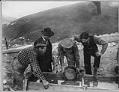
Panning for gold at Gold Hill, Yukon Territory, circa 1898
Miners used water running through sluices to wash the gold out of the pay dirt. Larger chunks of gold and gravel settled out along the uneven bottom of the sluice boxes. The smallest pieces of gold and dirt were washed to end of the sluice box where the gold was removed by panning.This photo, taken around 1898 by Asahel Curtis,…
ID Number:SHS11388
Date:Circa 1898
Photograph
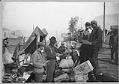
Open-air grocery store in Dawson City, circa 1898
By the end of July 1898, over 40,000 gold seekers had poured into Dawson City, Yukon Territory. Some of the city's busines was conducted in tents or in the open air.In this photo, taken around 1898 by Asahel Curtis, customers are buying pies, loaves of bread, and cans of corned beef and sausage at an open air grocery store. The…
ID Number:SHS11391
Date:Circa 1898
Photograph
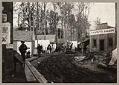
Street in Skagway during the gold rush, circa 1898
Gold seekers who were headed to the Klondike gold fields via White Pass landed in Skagway, Alaska. The weather and the conditions on the White Pass Trail were so bad that people sometimes got stuck in Skagway for several days before they could head north. Businesses in Skagway took advantage of this.This photo, taken around 1898 by Asahel Curtis, shows…
ID Number:SHS14112
Date:Circa 1898
Photograph
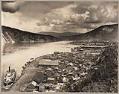
View of Dawson, Yukon Territory, circa 1898
Dawson, Yukon Territory, was wilderness in 1896. By 1898, so many Klondike stampeders had come to the area that Dawson was the largest city in Canada west of Winnipeg, Manitoba. At over 40,000 inhabitants, the crowded city was only slightly smaller than Seattle.This photo, taken around 1898, shows a general view of Dawson and its waterfronts on the Yukon (left)…
ID Number:SHS15451
Date:Circa 1898
Photograph
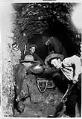
Four men digging tunnel in gold mine at Eldorado, circa 1898
In Alaska and the Yukon, placer gold was found along ancient stream beds, some of which were twelve to forty feet underground at bedrock. The gold was frozen in the dirt or gravel. Miners chopped away at the frozen earth with picks or tried to thaw it with fires or steam machines. They "drifted" all winter, digging tunnels in the…
ID Number:SHS15820
Date:Circa 1898
Photograph
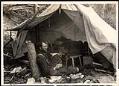
Lucas in tent, 1898
Seattleite Asahel Curtis left for the Klondike in 1897 and stayed two years, taking photos for the Seattle Post-Intelligencer. In 1898, Curtis took this photo of a man named Lucas resting outside his tent. Inside the tent, two pots heat on top of a small woodstove; the chimney of the stove passes up through the roof of the tent. The…
ID Number:SHS16668
Date:1898