1868 results for: Seattle Times
Photograph
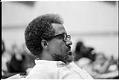
Garfield principal Roscoe Bass at Central Area School Council meeting, Seattle, June 13, 1976
Roscoe Bass was an longtime educator and civil rights activist. He graduated from the Kansas State Teachers College and came to Seattle in 1958 as a substitute teacher. Bass served as the principal of Garfield High School for six years and is credited with helping turn it into one of the best schools in Washington. Bass also worked in the…
ID Number:2000.107.19760613.1.11
Date:1976
Photograph
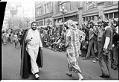
Mardi Gras parade, Seattle, February 19, 1977
In 1977, Seattle held its first Fat Tuesday (Mardi Gras) celebration in Occidental Park, Pioneer Square. The event lasted for five days and was peaceful during the day but got unruly at night. This image shows revelers on a street in Pioneer Square, including one wearing a patterned onesie and another sporting a white suit, cape, face paint, and a…
ID Number:2000.107.19770219.1.22
Date:1977
Photograph
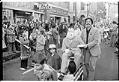
Mardi Gras parade, Seattle, February 19, 1977
In 1977, Seattle held its first Fat Tuesday (Mardi Gras) celebration in Occidental Park, Pioneer Square. The event lasted for five days and was peaceful during the day but got unruly at night. This image shows revelers on a street in Pioneer Square, including a man with a dummy in a wagon pulled by a child. Caption information source: The…
ID Number:2000.107.19770219.1.26
Date:1977
Photograph
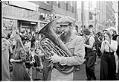
Mardi Gras parade, Seattle, February 19, 1977
In 1977, Seattle held its first Fat Tuesday (Mardi Gras) celebration in Occidental Park, Pioneer Square. The event lasted for five days and was peaceful during the day but got unruly at night. This image shows revelers on a street in Pioneer Square, including a man playing a euphonium, possibly as part of a band. Behind the euphonium player are…
ID Number:2000.107.19770219.1.28
Date:1977
Photograph
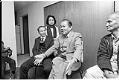
Urbano Quijance speaking about Filipino soldiers in WWII, January 17, 1985
Filipino soldiers began serving with the U.S. Army Forces of the Far East in 1941 when President Franklin Roosevelt offered full veterans’ benefits to Filipinos who enlisted. The Philippines at that time was a U.S. commonwealth, and Filipinos were U.S. nationals. 260,000 Filipinos fought alongside American forces during the war and more than 57,000 Filipino troops died. But once the…
ID Number:2000.107.19850117.1.28A
Date:1985
Photograph
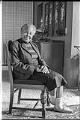
Lillian Gideon at home, Seattle, January 12, 1993
Lillian Morris Gideon (1907-2006) was widely known in Seattle as a volunteer and philanthropist in Seattle's African-American community and other groups. Born in Mobile, AL and educated at Boston College, Gideon served in the American Red Cross during both World Wars, and moved to Seattle in the 1950s with her husband Russell, working as a social worker at the VA…
ID Number:2000.107.19930112.1.35
Date:1993
Photograph
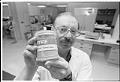
Joseph P. Balint Jr. holding Prosorba Column device at IMRE Corp., Seattle, March 22, 1993
The biotechnology company IMRE Corp. was formed in Seattle in 1981 as Immune Response Systems, Inc., by a group of scientific investigators from various institutions across the country. IMRE moved to San Diego in 1996 and changed its name to Cypress Bioscience. In the early 1980s, IMRE Corp. invented a device for filtering a person’s blood to strengthen the immune…
ID Number:2000.107.19930322.5.42
Date:1993

Photograph
Saros Corp. executives at their Bellevue office, May 1993
Bellevue-based Saros Corporation began in 1986, when founders Wayne Carpenter and Mike Kennewick saw the need for a product to manage the masses of unstructured information floating around in corporate computer networks. They brought together software engineers from the PC world and from the world of multiprocessor mainframe computers to develop a solution to the problem of storing, tracking, and…
ID Number:2000.107.19930513.1.39
Date:1993
Photograph
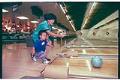
Cheryl Chow bowling at campaign event, May 1993
Cheryl Chow was the daughter of restaurant owner and King County Councilwoman Ruby Chow, and opera singer, US Army veteran and chef Ping Chow. Born in Seattle, Cheryl Chow attended Franklin High School and Western Washington University. Early in her career, she taught physical education at Hamilton International Middle School, was principal of Sharples Junior High School (now Aki Kurose…
ID Number:2000.107.19930525.13.14
Date:1993
Photograph
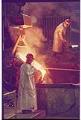
Foundry workers pouring metal from crucible, Seattle, June 16, 1993
In the fall of 1992, Stop the Violence, a non-profit community group dedicated to reducing handgun violence, collected guns in a buy-back program that paid $50 for each weapon turned in. The organization raised more than $93,000 and bought 1,782 handguns from people who brought them to collection points at Seattle police stations. On June 16, 1993, some 900 of…
ID Number:2000.107.19930616.1.26
Date:1993