26 results for: Seattle Transit System
Cartographic material
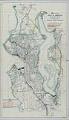
Map of the City of Seattle and Adjacent Territory, Bogue Map No. 2, September 1911
The Municipal Plans Commission of Seattle, established in 1910, hired civil engineer Virgil Gay Bogue (1846-1916) to prepare a strategic development plan for the city. Bogue's 1911 proposal was very ambitious, including a Civic Center in the Denny Regrade area, a park and boulevard system, separation of railroad tracks from streets, and a variety of other municipal improvements. Bogue's "Plan…
ID Number:1966.3805.1
Date:1911
Cartographic material
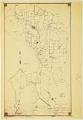
Track System of Seattle Municipal Street Railway map, January 1920
Seattle's first street railway line was built in 1888 and over the next three decades at least six different cable car companies operated throughout the city. In 1919 the City of Seattle took over all of the city's transit lines and formed the Seattle Municipal Street Railway (today's METRO). Because of its steep hills, Seattle kept its cable car lines…
ID Number:1977.6521.4
Date:1920
Serial
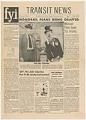
Transit News, May, 1959
The Seattle Transit System was created in 1940 to run the all-bus transit system for the City of Seattle. This department became part of Metro Transit in 1973, serving all of King County. This edition of the newsletter "Transit News" (Volume 2, number 9) covers funding and planning for the monorail, an appearance of bus operator James Wesselius on local…
ID Number:1980.6969.2.1
Date:1959
Ephemera
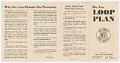
The New Loop Plan, issued by The City of Seattle, 1934
In 1919 the City of Seattle took over all of the city's street car lines and formed the Seattle Municipal Street Railway (today's METRO). Because of its steep hills, Seattle kept its cable car lines longer than any other American city except San Francisco, not replacing them until 1940 when buses that could handle the grades became available. Beginning on…
ID Number:1984.12.2
Date:1934
Photograph
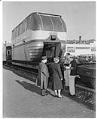
First monorail train arriving at railroad yards, Seattle, 1962
The ALWEG Rapid Transit System of West Germany won the $3.5 million contract to build the Century 21 monorail system. By the time the World's Fair closed, the system had carried over eight million people and more than paid for itself. Here, the first monorail car has arrived in Seattle by train. The system opened to the public on March…
ID Number:1986.5.9876.1
Date:1962
Document
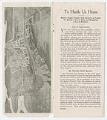
Brochure promoting a rapid transit solution for Seattle, 1926
Seattle’s hourglass shape and steep hills challenged land transportation from the very beginning. By the 1920s, with continuing population growth and the popularity of automobile transportation, traffic congestion had increased drastically. Concurrently, the city’s street railway system was losing money. In 1925, the Rapid Transit Committee of the Seattle City Planning Commission put together an extensive report, proposing that a…
ID Number:1987.66.3
Date:1926
Book
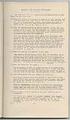
Seattle Rapid Transit Report to the City Planning Commission, 1925
Seattle’s hourglass shape and steep hills challenged land transportation from the very beginning. By the 1920s, with continuing population growth and the popularity of automobile transportation, traffic congestion had increased drastically. Concurrently, the city’s street railway system was losing money. In 1925, the Rapid Transit Committee of the Seattle City Planning Commission put together an extensive report, proposing that a…
ID Number:1987.66.4
Date:1925
Photograph
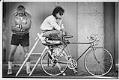
Butch Batt and Di Szillaggi waiting for a West Seattle Bridge shuttle, Seattle, June 8, 1989
By the late 1980s, bicycles had begun to be a recognized part of Seattle’s transportation system. Seattle had even had a bicycle coordinator since the 1970s. Transit planning had begun to shift its focus to include more mass transit, carpool and bus lanes, and bike lanes.The low bridge to West Seattle was being replaced during the summer of 1989. The…
ID Number:2000.107.021.22.02
Date:1989
Photograph
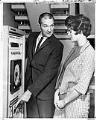
Tom Gibbs and Molly Boone checking water monitoring system, Seattle, August 31, 1963
Charles V. "Tom" Gibbs (1932-2019) was an engineer whose historic projects in the 1960s ended the constant flow of raw sewage into Lake Washington and Puget Sound. Born in Oregon and raised in Winlock, Washington, Mr. Gibbs received civil engineering degrees in 1954 and 1966 from the University of Washington (UW). He and his wife, Jean C. Gibbs, later endowed…
ID Number:2000.107.074.15.01
Date:1963
Photograph
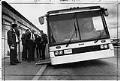
Metro drivers inspecting prototype kneeling bus, Seattle, March, 1975
In this image, the Rohn Industries Transbus, one of three prototype transit buses built by U. S. firms for possible production in the 1980s, gets the once-over from Metro drivers as it "knelt" on its air suspension system, allowing near-level entry up a front door wheelchair ramp. At the time Metro, was planning to replace its fleet of buses and…
ID Number:2000.107.124.28.02
Date:1975