34 results for: Plateau Peoples
Photograph
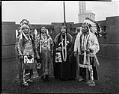
Two Yakama couples in traditional dress, Seattle, January 29, 1921
The Yakama (formerly spelled Yakima) people have lived in the Columbia River basin since time immemorial. During the winter, they lived in permanent villages built on the valley floor, where the climate was most temperate. Starting in spring, they traveled along the rivers and into the hills to gather food. Some gathered roots and berries, and others fished in rivers,…
ID Number:1983.10.2082.1
Date:1921
Photograph
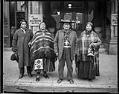
Two Yakama couples outside a Seattle hotel, January 29, 1921
The Yakama (formerly spelled Yakima) people have lived in the Columbia River basin since time immemorial. Historically, they lived in permanent winter villages built on the valley floor where the climate was most temperate. Starting in spring, they traveled along the rivers and into the hills to gather food. Some gathered roots and berries, and others fished in rivers, especially…
ID Number:1983.10.2082.2
Date:1921
Photograph
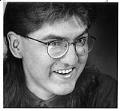
Sherman Alexie, Seattle, August 31, 1993
Sherman Joseph Alexie, Jr. (1966-) is a Spokane-Coeur d'Alene-American novelist, short story writer, poet, and filmmaker. Much of his writing draws on his experiences as an Indigenous American with ancestry from several tribes. He grew up on the Spokane Indian Reservation and now lives in Seattle.In this image Sherman Alexie discusses his 1993 collection of short stories, "The Lone Ranger…
ID Number:2000.107.006.01.01
Date:1993
Photograph
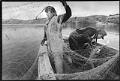
Yakama fishers checking nets on Columbia River near Lyle, Washington, August 24, 1993
Protests in the 1960s and 1970s, known at the time collectively as the "fish wars," eventually led to the Boldt Decision (United States v. Washington, 1974), a federal ruling guaranteeing Washington tribes half the state's salmon and steelhead trout catch.In the 1990s, with growing water pollution nationwide, a study showed that tribal members living and fishing along the Columbia River…
ID Number:2000.107.064.02.04
Date:1993
Photograph
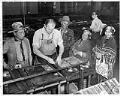
Wanapum visitors in the Seattle Post-Intelligencer composing room, Seattle, October 1956
In this image, printer Roy Jones demonstrates part of the newspaper printing process in the Seattle Post-Intelligencer composing room, for his visitors from the Wanapum Tribe. Washat (then called Washini or Washani) religious leaders from Wapato, Washington, Alba Shawaway, left, and Frank So Happy (also Che-che-mah), center, look on with their wives, Julia So Happy, second from right, and Nettie…
ID Number:2000.107.095.28.06
Date:1956
Photograph
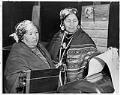
Julia So-Happy and Nettie Shawaway visiting Seattle Post-Intelligencer building, Seattle, October 14, 1956
In this image, Julia So Happy, left, and Nettie Shawaway, the wives of Washini religious leaders from Wapato, Washington, inspect a teletype machine at the International News Service Bureau in the Seattle Post-Intelligencer building in downtown Seattle. Caption information derived from captions written by Post-Intelligencer staff and attached to the back of the photograph.
ID Number:2000.107.095.29.02
Date:1956
Photograph
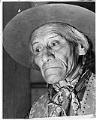
Frank So-Happy in Seattle, October 14, 1956
This image of Washat (then called Washini or Washani) religious leader Frank Sohappy (Che-che-mah) of the Wanapum tribe, who was born in 1878, was taken during a visit to Seattle from his home in Wapato, Washington. Caption information derived from captions written by Post-Intelligencer staff and attached to the back of the photograph.
ID Number:2000.107.095.29.03
Date:1956
Photograph
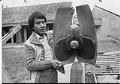
Lawney Reyes with cedar bald eagle sculpture, Seattle, September 26, 1977
Lawney L. Reyes (1931-2022), Sin-Aikst (Colville Confederated Tribe) artist, architect, and author, overcame a childhood of poverty and discrimination to become an award-winning sculptor and a historian of local Indigenous activism and culture. In this image Lawney Reyes stands next to one of his sculptures, a cedar bald eagle, in front of the Daybreak Star Indian Cultural Center in Seattle's…
ID Number:2000.107.151.33.01
Date:1977
Photograph
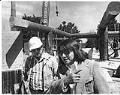
Bernie Whitebear and Pete Schnurman at Daybreak Star construction site, Seattle, June 9, 1976
In 1970, a group of activists led by Bernie Whitebear (1937-2000), Sin-Aikst, or Sinixt (now one of the Confederated Tribes of the Colville Reservation), began a protest which culminated in approval for the development of both a cultural center for Indigenous peoples and a municipal park on decommissioned surplus land at Seattle's Fort Lawton site. After several years spent raising…
ID Number:2000.107.178.13.01
Date:1976
Photograph
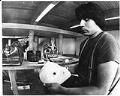
Alex Williams carving mask at Daybreak Star Cultural Center, Seattle, April 13, 1978
Here, Nez-Perce carver Alex Williams shapes a piece of alder wood into a totem mask during a workshop at the Daybreak Star Cultural Center in Discovery Park. Indigenous artists taught painting, carving, and drawing at the Center to anyone who was interested, free of charge. Native Americans from throughout the Northwest were welcomed as participating artists at the center. The…
ID Number:2000.107.178.14.02
Date:1978