28 results for: Boeing Aircraft Co.
Photograph
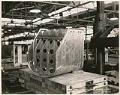
Construction model for main tank of Boeing Model F4 B-1 airplane at Boeing plant, Seattle, October 17, 1929
The Boeing F4B was a fighter biplane produced for the Navy, designed to be capable of landing on aircraft carriers. Caption on photo: Main tank construction Model F4 B-1Embossed with Boeing logo. Stamped on verso with Boeing logo and "Off. Boeing Photo"Photographer's number: 2631-BCaption information source: Boeing website at http://www.boeing.com
ID Number:1953.345.68
Date:1929
Photograph
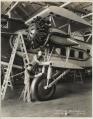
Inspectors examining a Boeing Model 80-A plane at the Boeing factory, Seattle, October 19, 1929
Boeing’s Model 80 commercial transport airplane was the first Boeing plane designed specifically with passenger comfort in mind. Along with the mail, the first Model 80 carried 12 passengers in a spacious cabin with leather upholstery, reading lamps, ventilation and hot and cold running water. The larger Model 80-A, pictured here, and made its first flight on September 12, 1929,…
ID Number:1953.345.71
Date:1929
Photograph
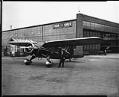
Airplane near hangar, 1935
In the mid-1930s, the Washington Aircraft & Transport Company operated an aircraft sales and service facility and a flight school at Boeing Field, south of Seattle. In this photo, an unidentified man stands by a Stinson plane outside the Washington Aircraft hangar. Signs in image: Stanavo - Standard Oil Products. Stinson Kinner Sales & Service - Washington Aircraft & Transport…
ID Number:1983.10.4963.91
Date:1935
Photograph
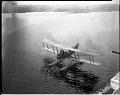
Boeing "Model C" float plane docked on Lake Union, Seattle, 1919
Aviation pioneer William Edward "Bill" Boeing (1881-1956) was born in Detroit to German immigrants. He came to Seattle in 1908, where, during the Alaska-Yukon-Pacific Exposition in 1909, he saw a manned flying machine for the first time and became fascinated with aircraft. With a partner, Mr. Boeing created two B&W prototype float planes in 1916, both of which were rejected…
ID Number:1983.10.10793
Date:1919
Videorecording
Oral history interview with Edward C. Wells, March 1985
Edward C. Wells (1910-1986) was an engineer and senior vice president of the Boeing Company, and served on the company’s board of directors. He played a major role in the design of Boeing planes, from bombers, such as the B-17 Flying Fortress and B-29, to jet transports, including the 707, 747 and others. Wells was born in Boise, Idaho and…
ID Number:1985.135.29
Date:1985
Photograph
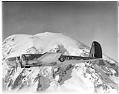
Boeing bomber B-17 in flight with Mount Rainier in the background, 1941
Under military contract, the bomber went from design to flight test in just 12 months. Making its first flight on July 28, 1935, it was Boeing's first military aircraft with a flight deck instead of an open cockpit and was armed with bombs and five .30-caliber machine guns. Boeing plants built 6,981 of more than 12,000 B-17's delivered during World…
ID Number:1986.5.159.3
Date:1941
Photograph
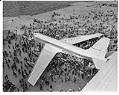
Unveiling of Boeing's new 707 jet, Renton, 1954
On May 14, 1954, Boeing officially rolled out the Dash 80, the prototype of the company's 707 jet transport. Thousands of Boeing employees and guests gathered at the Renton plant and watched Bertha Boeing, wife of the company's founder, christen the brown, yellow and silver plane with champagne. The Boeing Company gambled that airlines would want to switch to jet…
ID Number:1986.5.188.1
Date:1954
Photograph
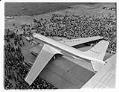
The first showing of Boeing's new 707 jet, Renton, Washington, 1954
On May 14, 1954, Boeing officially rolled out the Dash 80, the prototype of the company's 707 jet transport. Thousands of Boeing employees and guests gathered at the Renton plant to watch Bertha Boeing, wife of the company's founder, christen the brown, yellow and silver plane with champagne. The Boeing Company gambled that airlines would want to switch to jet…
ID Number:1986.5.1344.1
Date:1954
Photograph
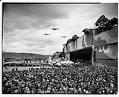
Boeing B-17 ceremony, Seattle, 1945
A large crowd gathers at the Seattle Boeing plant to commemorate the conversion of production from B-17 to B-29 bombers. The Army Air Corps ordered the first B-17s in early 1936, and at the peak of its production in 1944, the Seattle Boeing plant would complete 16 B-17s every 24 hours. The heavily-armed Flying Fortresses were legendary for their ability…
ID Number:1986.5.7449.1
Date:1945
Photograph
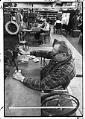
Paul Koyne at a drill press making parts for Boeing at the United Cerebral Palsy machine shop, Seattle, October 1975
Sheltered workshops offer people with disabilities training opportunities and paid work. Starting around 1950, the Boeing Company began contracting with sheltered workshops to make some of its aircraft parts. These might range from simple clips to complex machine parts. Employees had 40-hour work weeks.In 1975, the United Cerebral Palsy Association ran one of the six workshops doing work for Boeing.…
ID Number:2000.107.082.13.05
Date:1975