45 results for: World War II, 1941-1945 (WWII)
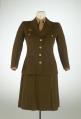
WAC uniform worn by Alice Holcomb (Sheldon) during WWII, ca. 1943
Over 150,000 women served in the Women’s Auxiliary Army Corps (WAAC) during World War II. Recruits had to be between 21 and 45, at least five feet tall, weigh over 100 lbs and have no dependents. At home and overseas, WAACs made weather forecasts, rigged parachutes, drove jeeps, analyzed aerial photos and did many other tasks that left the men…
ID Number:1952.117.1C681
Date:Circa 1943
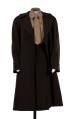
WAAC uniform worn by Jane H. Donlon, 1941
WAAC stands for Women's Army Auxiliary Corps and Ms. Donlon was one of the first in Seattle to volunteer for this organization.
ID Number:1960.1934.C694
Date:1941
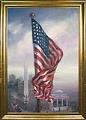
Painting of Victory Square in Seattle, ca. 1949
Victory Square was located on University Street, between 4th and 5th Avenues in front of the Olympic Hotel, and was the center of World War II rallies, bond drives, and a monument that lists the names of Washington state citizens who lost their lives during the war. Nothing of the Square remains as the monument was torn down in 1949,…
ID Number:1960.2087
Date:Circa 1949
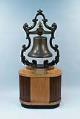
Ship's bell from the SS Victoria, formerly the passenger liner Parthia, 1870
The Parthia was built at Dunbarton-on-the-Clyde, Scotland, in 1870, and was a London-New York passenger liner for her first ten years. She continued as a passenger service in various parts of the world until 1892, when she was renamed the "Victoria." At that time, she served passage to and from Asia and Tacoma, Washington. In 1904, the ship was sold…
ID Number:1962.2514
Date:1870
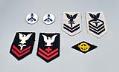
WAVES shoulder rank patches, ca. 1943
WAVES stood for Women Accepted for Voluntary Emergency Service, a branch of the US Naval Reserve. It was established in July 1942 to release officers and men for sea duty, and allow women to fill positions of shore duty as commissioned officers or enlisted rank.
ID Number:1962.2865.6
Date:Circa 1943
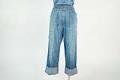
WAVE work jeans, 1943-1946
These jeans belonged to Lieutenant Isabelle K. Moe who served with the Navy WAVES (Women Accepted for Voluntary Emergency Service) during World War II. The formal uniform for the WAVES was a tailored skirt suit, but WAVES who served as aviation machinists, metalsmiths, and parachute riggers needed something more practical for daily work. The pants have deep pockets, a side…
ID Number:1962.2865.8
Date:1943-1946
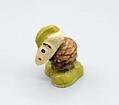
Pelican figurine, 1942
This novelty item, made from a pinecone, appears to be a winking pelican wearing a WWII military cap and boots, possibly representing the United States Naval Services.
ID Number:1963.3033.24
Date:1942
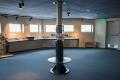
U.S. Navy periscope used in World War II submarine and obtained from the Mare Island Naval Shipyard, ca. 1940
This 43 foot high periscope on loan from the Navy was used in a WWII submarine and obtained from the Mare Island Naval Shipyard. A daytime attack periscope, it may be trained in any direction and photos can be taken through it using any single lens reflex camera. About 30 feet of the periscope is highly ground to precision so…
ID Number:1963.3121.1
Date:Circa 1940
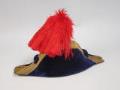
Seafair King Neptune IV hat, 1953
Since 1950, the Seattle Seafair festival has recognized notable local individuals as Seafair Royalty, including King Neptune, Prime Minister, and Seafair Queen (Miss Seafair). Rear Admiral H.H. Good, who commanded heavy cruisers for the US Navy during World War II, was crowned King Neptune for the 1953 Seafair celebrations.
ID Number:1963.3182.10M354
Date:1953
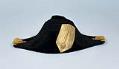
Rear Admiral's hat, ca. 1940
This hat was owned by Rear Admiral Ralph Wood, who was at one time Captain of the Sand Point Naval Air Base on Lake Washington and served in the US Navy during World War II.
ID Number:1963.3182.11M355
Date:Circa 1940