140 results for: Performing Arts and Music
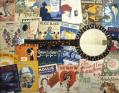
Inlaid frame banjo, 1867
This banjo, made by Henry C. Dobson (1851-1903), was owned by a Seattle druggist and doctor at the turn of the 20th century. Dobson was one of America's most prominent early banjo manufacturers. He patented the closed back banjo in 1867, and is also credited with using frets (in 1878), a resonator, and the first attempted use of a tone…
ID Number:1950.14.b
Date:1867
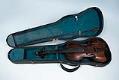
Violin, case, and bow made in Germany, ca. 1800-1830
This violin was played by Jake Harding, who came to Seattle in the 1850s. He played at early Seattle dances that included a mix of European settlers and native people.
ID Number:1950.30.1
Date:Circa 1800-1830
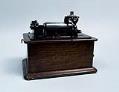
Portable Edison phonograph, ca. 1903
This portable phonograph was one of the first used to transmit music over radio in Seattle in June 1921 under the call letters 7AD, a Francis Brott-owned station. Brott was a prominent radio and television pioneer in Seattle, known both for his promotion of the phonograph and his role in the first TV telecast on June 3, 1929. Brott eventually…
ID Number:1955.984
Date:Circa 1903
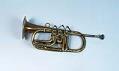
Brass cornet with rotary valves, ca. 1850
This cornet belonged to George Frederick Frye (1833-1912), a German immigrant who came to the US at 16 years of age and arrived in Seattle in 1853. He brought this instrument with him and played in the first Seattle band.
ID Number:1957.1234.4
Date:Circa 1850
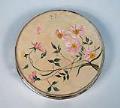
Painted tambourine, ca. 1900
This tambourine, missing the metal discs on the side, was used by Minnie Dalby in a Cascade School drill on April 11, 1900, at Ranke's Hall located at 5th Avenue and Pike Street in Seattle.
ID Number:1960.1822.1
Date:Circa 1900
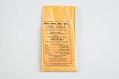
Silk souvenir bag with program from 1962 production of “Aida,” and reprint of program from 1887 “Faust”
As part of Seattle’s 1962 World’s Fair, Seattle’s Civic Auditorium was renovated into a new opera house. During the fair the venue hosted a range of performances, including Verdi’s opera Aida, put on by the Seattle Symphony Opera Committee. This small silk bag was created by Seattle printing firm Lowman & Hanford and held a bottle of perfume. On one…
ID Number:1962.2645.1
Date:1962
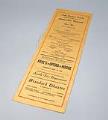
Silk ribbon program for the Dedication Concerts at Seattle's New Opera House held May 15-16, 1962
The new Opera House was built and opened in conjunction with the Seattle World's Fair in 1962. This program is a replica of the one used in the Frye Opera House on November 10, 1887. The Frye was completely destroyed in the Great Seattle Fire of 1889.
ID Number:1962.2645.2
Date:1962
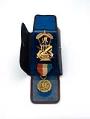
Medal and Pin presented to John M. Spargur, Director, Seattle Philharmonic Orchestra, 1911-1916
John Spargur organized the Seattle Philharmonic in 1911, one year after his arrival from New York where he had been the concert master and assistant conductor of Victor Herbert's Orchestra. The members of the Seattle Philharmonic presented him with the medal during his time as director, and the pin was presented to him by the Seattle Press Club and more…
ID Number:1962.2876
Date:1911-1916
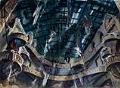
Painting, "'Parting is Such Sweet Sorrow' Metropolitan Theater (interior), Seattle, Wa." by Robert Fetterly, 1961
Metropolitan Theatre opened in 1911 on University Street in Seattle and featured both live theater and movies. This painting, which won first prize in 1961 in the Changing Scenes in Seattle Art Show, depicts the ceiling and balcony boxes at the time the theatre was being torn down. The artist, Robert Fetterly (1920-2009), worked for Boeing, The Bon Marché, and…
ID Number:1963.2967
Date:1961
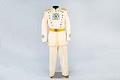
Seattle World's Fair Band uniform, 1962
The official World’s Fair Band uniforms were made by the Pacific Outfitting Company of Seattle. While most of the outfit is classic marching band style, the embroidered design on the front and cuffs shows a flurry of musical notes arranged like electrons around an atom (a nod to the fair’s science and technology theme). The World’s Fair Band, directed by…
ID Number:1963.3119.97C1058
Date:1962