69 results for: Discrimination
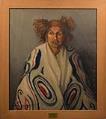
Portrait, "Makah Indian Neah Bay" by Jeanie Walter Walkinshaw, 1937
Controversial oil portrait by Jeanie Walter Walkinshaw (1885-1976). The subject in the painting, possibly fellow artist Jacob Elshin, is dressed in ceremonial dance robe and headdress. If this is indeed Elshin, it is an example of redface and the appropriation of Native culture and dress by white settlers. This was one common example of discrimination and marginalization faced by Native…
ID Number:1951.50
Date:1937
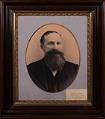
Portrait of William H. Shoudy by unknown artist, ca. 1850-1900
William H. Shoudy was an early settler in Seattle, emigrating by covered wagon from Illinois in a party led by Thomas Mercer. Riding a wave of anti-Chinese sentiments that culminated in race riots, Shoudy was elected Mayor as representative of the People's Party in 1886. The People's Party supported the expulsion of all people of Chinese ancestry from Seattle, narrowly…
ID Number:1960.1854.1
Date:Circa 1850-1900
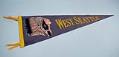
High school pennant, "West Seattle," ca. 1920-1960
This West Seattle High School pennant (date unknown) displays the controversial former "mascot" of an Indian chief. The symbol of the school has since been changed to Wildcats.The appropriation of Indigenous culture as mascots, or to market products or events, are some common examples of discrimination and marginalization faced by Native peoples in the United States.
ID Number:1961.2427.1
Date:Circa 1920-1960
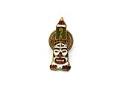
Potlatch pin, ca. 1911-1914
This pin depicts the Potlatch “Bug,” the official emblem for the Golden Potlatch, a city-wide festival first held in July of 1911. It was organized by civic boosters who were hoping to capitalize on the success of the Alaska-Yukon-Pacific Exposition of 1909. The organizers called themselves the Tilikums of Elttaes (Tilikum is "Friends" in Chinook Jargon; Elttaes is Seattle spelled…
ID Number:1962.2652.8
Date:Circa 1911-1914
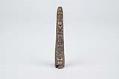
Souvenir metal totem pole from the Golden Potlatch celebration, 1912
The Golden Potlatch was a city-wide festival first held in July of 1911. It was organized by civic boosters who were hoping to capitalize on the success of the Alaska-Yukon-Pacific Exposition of 1909. The event continued for each of the next three summers before being suspended during wartime, and then was started up again as the Potlatch Festival from 1934…
ID Number:1962.2846.7
Date:1912
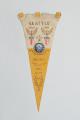
Souvenir pennant of the Golden Potlatch, 1911
The Golden Potlatch was a city-wide festival first held in July of 1911. It was organized by civic boosters who were hoping to capitalize on the success of the Alaska-Yukon-Pacific Exposition of 1909. The event continued for each of the next three summers before being suspended during wartime, and then was started up again as the Potlatch Festival from 1934…
ID Number:1963.3029
Date:1911
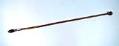
Noisemaker cane, ca. 1911-1941
During the early Seattle Potlatches, many of these canes were used by the celebrants. A tablet the size of an aspirin made of a strong explosive was put in the iron slot at the bottom and when it was thumped on the sidewalk, a very loud explosion occurred. These noisemakers unfortunately burned women's ankles from the flash so they were…
ID Number:1966.3878.63
Date:Circa 1911-1941
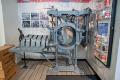
Automated salmon cleaner, "Iron Chink," made by Smith Cannery Machine Company in Seattle, 1909
The "Iron Chink" was named after the Chinese laborers it was invented to replace. Racist terms like this were painfully common in the 1900s, a time marked by anti-Chinese violence throughout the Northwest. Although much of the salmon canning process was mechanised in the early years of the 20th century, the butchering process was done by hand by laborors who…
ID Number:1970.4992
Date:1909
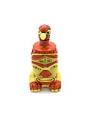
Painted ceramic Potlatch "Bug" souvenir, ca. 1911
This Potlatch “Bug” is a souvenir of the Golden Potlatch, a city-wide festival first held in July of 1911. It was organized by civic boosters who were hoping to capitalize on the success of the Alaska-Yukon-Pacific Exposition of 1909. The organizers called themselves the Tilikums of Elttaes (Tilikum is "Friends" in Chinook Jargon; Elttaes is Seattle spelled backward). They were…
ID Number:1972.5567.46
Date:1911
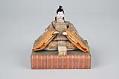
Japanese emperor doll from a Girls' Day set, ca. 1930-1940
Girls’ Day (Hinamatsuri) is traditionally celebrated with a display of decorative dolls representing the Imperial Court. The dolls are arranged on a series of platforms, draped in red cloth. At the top of the display are the Emperor and Empress. In 1942, the majority of the student body of the Bailey Gatzert Elementary School was of Japanese descent and all…
ID Number:1973.5711.1
Date:1930-1940