44 results for: Chinatown International District
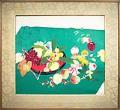
Japanese still-life painting, “Saika (Nihon no Kudamono)” by Shunkou Mochizuki, ca. 1951
Shunkou Mochizuki (1893-1979) was a “master” artist from Yamanashi prefecture in Japan, where there is a monument to him and also an art award given annually in his name. The title of the piece translates to"Japanese Fruits." Seattle's Mayor William Devlin traveled to Japan in 1951 to develop good relations, the first American mayor to visit that country post World…
ID Number:1953.316
Date:Circa 1951
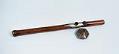
Bamboo opium pipe confiscated in police raid in Seattle's Chinatown, ca. 1900
This opium pipe was said to have been seized in a raid in Seattle's Chinatown around 1900. The area was a favorite for police raids of the time amidst anti-Chinese and anti-immigrant sentiment. The police chief who picked it up, Charles "Wappy" Wappenstein, was eventually convicted of bribery and extortion for accepting payoffs from organized crime.
ID Number:1969.5072.74
Date:Circa 1900
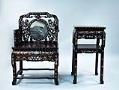
Armchair, part of a set that was imported for the Goon Dip family, ca. 1890-1910
Imported for the Goon Dip family, this rosewood chair is hand-carved, with mother-of-pearl inlay. Typical of Chinese mortise and tenon joinery, there are no metal fasteners except the coins that hold the marble back splat in place. Because abstract landscapes or figures could be seen in cut marble, it was often used as a decorative element in Chinese furniture. In…
ID Number:1974.5914.1a
Date:1890-1910
Side table part of a set belonging to Chinese consul Goon Dip, consul for Oregon, Washington and Idaho, 1880-1930
Imported for the Goon Dip family, this rosewood table is hand-carved, with mother-of-pearl inlay. In the late 19th century, Goon Dip arranged the emigration of Chinese labor for Northwest canneries. He also served as Chinese consul, and owned the Milwaukee Hotel in Seattle's Chinatown. His daughter, Lillian Goon Dip, was born in 1900, grew up in the family hotel, then…
ID Number:1974.5914.2
Date:1880-1930
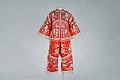
Chinese Theatrical Costume worn by Lillian Goon Dip, ca. 1890-1910
This two-piece theatrical costume belonged to Lillian Goon Dip (1900-1975) and she is shown wearing it in a circa 1925 photo in the MOHAI Collection (shs14125). Lillian was born Lillian Goon in Portland Oregon and spent most of her early life at the Milwaukee Hotel in Seattle’s Chinatown. Her father was Seattle’s Chinese consul and hotel owner, Goon Dip (circa…
ID Number:1974.5914.7
Date:1890-1910
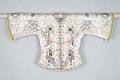
Chinese Theatrical Woman's Jacket from the Goon Dip family, ca. 1890-1910
This is one of several Chinese garments donated to MOHAI by Lillian Goon Dip (1900-1975). Lillian was born in Portland Oregon and spent most of her early life at the Milwaukee Hotel in Seattle’s Chinatown. Lillian was an accomplished dancer, studying ballet with several teachers including Seattle’s well-known Mary Ann Wells. She often performed in traditional Chinese costumes. Her father…
ID Number:1974.5914.24
Date:1890-1910
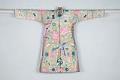
Chinese Theatrical Jacket with Metallic Thread from the Goon Dip family, ca. 1890-1910
This is one of several Chinese garments donated to MOHAI by Lillian Goon Dip (1900-1975). Lillian was born in Portland Oregon and spent most of her early life at the Milwaukee Hotel in Seattle’s Chinatown. Lillian was an accomplished dancer, studying ballet with several teachers including Seattle’s well-known Mary Ann Wells. She often performed in traditional Chinese costumes. Her father…
ID Number:1974.5914.32
Date:1890-1910
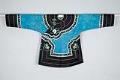
Chinese Woman's Jacket from the Goon Dip family, ca. 1890-1910
This is one of several Chinese garments donated to MOHAI by Lillian Goon Dip (1900-1975). Lillian was born in Portland Oregon and spent most of her early life at the Milwaukee Hotel in Seattle’s Chinatown. Lillian was an accomplished dancer, studying ballet with several teachers including Seattle’s well-known Mary Ann Wells. She often performed in traditional Chinese costumes. Her father…
ID Number:1974.5914.33
Date:1890-1910
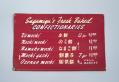
Hand-lettered sign for mochi, used at the Sagamiya Confectionery Co., ca. 1905-1950
This sign was from the Sagamiya Confectionery, formerly located at 6th and Main in the area previously known as Nihonmachi, or Japantown, now in Seattle's Chinatown International District. Sagamiya used traditional Japanese methods in the making of mochi and other wagashi (Japanese sweets). The bakery was founded in 1904 and closed in the early 1970s.
ID Number:1984.54.1
Date:1905-1950
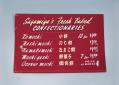
Hand-lettered sign for mochi, used at the Sagamiya Confectionary Co., ca. 1905-1950
This sign was from the Sagamiya Confectionery, formerly located at 6th and Main in the area previously known as Nihonmachi, or Japantown, now in Seattle's Chinatown International District. Sagamiya used traditional Japanese methods in the making of mochi and other wagashi (Japanese sweets). The bakery was founded in 1904 and closed in the early 1970s.
ID Number:1984.54.2
Date:1905-1950