112 results for: Asian American
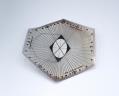
Clear plastic hexagonal isometric protractor template, 1955
Kito Kaneta worked as a draftsman for Boeing from the 1950s - 1980s. This protractor was one of his tools he used at work.
ID Number:2016.29.9
Date:1955
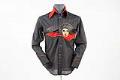
Red and black shirt made by Friends of the Rag, 1978
Friends of the Rag was a collective of artists working in wearable art and performance. Formed in Seattle in 1972 and including 50 members, Friends of the Rag shows included elaborate costumes, jewelry and metalwork, choreography, music, ceramics, and even electronics. Al Young (1946-2022) modeled this shirt in a Friends of the Rag show and was allowed to keep it…
ID Number:2016.37.1
Date:1978
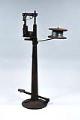
Foot-pedal stapler from the Moritani Farm on Bainbridge Island, ca. 1930s
This foot-pedal stapler, made by St. Joseph Iron Works in Michigan, was used by the Moritani family on their farm located at 542 Winslow Way W. on Bainbridge Island, ca. 1930s-1950s. It’s called a “foot-pedal stapler” because it creates and punches the staples that put the berry trays together. These shallow trays were made specifically for raspberries and Olympic Loganberries…
ID Number:2016.58.1
Date:Circa 1930
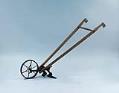
Furrow plow from the Moritani Farm on Bainbridge Island, ca. 1930s
This furrow plow was used by the Moritani family on their farm located at 542 Winslow Way W. on Bainbridge Island, ca. 1930s-1950s. During WWII, when the Moritani family was incarcerated, a Filipino family by the name of Tolentino managed the farm.
ID Number:2016.58.2
Date:Circa 1930
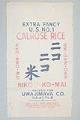
Muslin rice bag from Uwajimaya, 1928-1950
This rice bag is from the Moriguchi family who founded Uwajimaya, a family-owned supermarket chain headquartered in Seattle's Chinatown International District with other locations in the Pacific Northwest. Fujimatsu Moriguchi began his enterprise in 1928, selling fishcakes and other goods from his truck in Tacoma, Washington. In the mid 1940s, after Moriguchi and his family were released from the incarceration…
ID Number:2016.Uwajimaya.2
Date:1928-1950
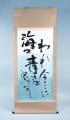
Japanese calligraphy scroll by Ritsuko Kashiba, "Infinite Blue of the Sea", 2016
Ritsuko Kashiba is an artist and the wife of Seattle chef Shiro Kashiba. She painted this scroll for MOHAI's exhibit, "Edible City: A Delicious Journey" that was on display in 2016-2017 and featured Shiro and his restaurants. Shiro came to Seattle from Japan in 1966.
ID Number:2017.45.1
Date:2016
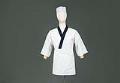
Chef Shiro Kashiba's kimono cooking jacket, short chef's hat, and apron, ca. 2000s-2010s
Chef Shiro Kashiba opened Seattle’s first sushi bar in 1970 at the back of the restaurant Maneki. He arrived in Seattle in 1966 after years of rigorous apprenticeships in Tokyo, including under legendary sushi maestro, Jiro Ono. During his more than 50-year career in Seattle, he has run multiple restaurants including Nikko in the Chinatown International District, Shiro’s in Belltown,…
ID Number:2017.45.24.ONLINE
Date:Circa 2000-2010
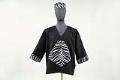
Dashiki and hat made by the Black People's Unity Movement of Camden, New Jersey, 1968-1969
This black and white dashiki and matching hat belonged to Rev. Dr. Samuel B. McKinney (1926-2018), author and leading civil rights advocate in Seattle, Washington. He served as pastor of Mount Zion Baptist Church, one of the largest and oldest Black churches in the Pacific Northwest, from 1958 to 1998 and again from 2005 to 2008. As a visible public…
ID Number:2017.59.5
Date:Circa 1968-1969
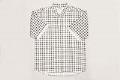
Black and white Shah Safari shirt, reproduction of one used in the film, "Back to the Future," ca. 2000
Brothers Raj and Akhil Shah launched Shah Safari as teenagers in 1975. The Seattle company designed, manufactured, and imported lightweight, breezy gauze shirts from India. After just eight years in business, Shah Safari owned 24 percent of the national young men’s woven shirt market. Michael J. Fox wore a Shah Safari shirt in the 1985 movie "Back to the Future."…
ID Number:2018.84.1
Date:Circa 2000
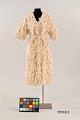
Blush colored "Kandan Dress" with tie belt designed by Suk Chai, 2016
Seattle designer Suk Chai loves designing with luxurious and surprising textiles. This dress, from her line SCHAI, is titled the “Kandan Dress.” Kandan is the Korean word for “simple.” The dress has a basic shape, but is made in an alluringly plush and textural fabric.
ID Number:2019.8.1
Date:2016