683 results for: Clothing and Dress
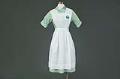
Highline College Nursing School uniform, 1964-1967
Marilyn Hale was part of Highline College's first class of nursing students, enrolling in 1964 and graduating in December of 1967. The uniform was made locally by the Arcadian Uniform Company.
ID Number:2019.14.4
Date:1964-1967
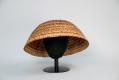
Woven cedar bark Chief Si'ahl (Chief Seattle) style hat made by DeAnn Jacobson, 2019
Native American weaver DeAnn Jacobson (Duwamish, Suquamish), a direct descendant of Chief Si'ahl (Chief Seattle), wove this hat from cedar bark. Coast Salish tribes have used locally sourced materials like cedar bark to make weatherproof clothing for millennia. Such garments range in style from functional to decorative.
ID Number:2019.15.1
Date:2019
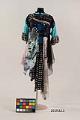
Dress, "3.21" from FEMAIL, 2017
Designers Janelle Abbott (Seattle) and Camilla Carper (Los Angeles) create imaginative garments under the name FEMAIL by mailing items back and forth. Calling the process “reactive collaboration,” they add and subtract elements in turn until the piece feels complete. This dress incorporates a Pike Place Market umbrella Abbott found abandoned outside her studio.
ID Number:2019.22.1
Date:2017
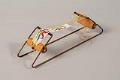
Bead loom with headband in process, 1960s
The owner and maker of this beaded headband joined the King County Council chapter of the Camp Fire Girls organization in the late 1950s. She enjoyed wearing the uniforms, attending day camps in Blyth Park in Bothell, and working on various art products including the beaded headband seen here.
ID Number:2019.28.6
Date:Circa 1960
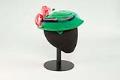
Green and pink John Eaton hat, ca. 1950s-1960s
This hat has a striking combination of green velvet with bright pink trim. It also includes small rhinestones on the pink decoration, a band of dark blue velvet, a green net veil, and a matching hatpin with a small green pom-pom. Cornish School of Arts graduate John Eaton (1914-1991) was a successful milliner, designer, and teacher whose individually-styled hats became…
ID Number:2019.41.1
Date:Circa 1950-1960
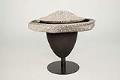
Silver hat with rhinestones made by John Eaton, ca. 1960s
This sparkling silver hat was made by local milliner John Eaton and worn in Seattle by Stina Johannesen. Cornish School of Arts graduate John Eaton (1914-1991) was a successful milliner, designer, and teacher whose individually-styled hats became known all over the country. Eaton and partner James Neher opened their first store in 1950, and eventually opened “John Eaton Of Course!”…
ID Number:2019.51.1
Date:Circa 1960-1969
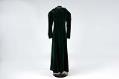
Green velvet coat, owned by Mary Ann Wells, 1930s
This green velvet coat belonged to Seattle dance instructor Mary Ann Wells (1894-1971). Wells founded the ballet department at the Cornish School of the Arts (now Cornish College of the Arts) and directed the dance department for seven years. She later formed her own studio, the Mary Ann Wells School of the Dance at 804 1/2 Pine Street. Wells retired…
ID Number:2019.72.2
Date:1930-1939
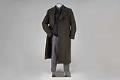
Georgio Armani trenchcoat, sweater, shirt, and trousers from Butch Blum
Retailer Butch Blum opened in 1974 and introduced Seattle shoppers to emerging, often unknown, European designers unavailable elsewhere in the city. Originally focused on menswear, this was the second store in the US to carry high-end Italian designer Giorgio Armani. This ensemble was donated to MOHAI in 2019 as part of the exhibit Seattle Style: Fashion/Function. The coat, shirt, and…
ID Number:2019.90.14.ONLINE
Date:1981-2018
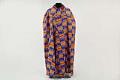
Church robe made of Kente cloth, worn by Reverend Dr. Samuel B. McKinney, ca. 1970s-1980s
This robe belonged to Rev. Dr. Samuel B. McKinney (1926-2018), author and leading civil rights advocate in Seattle, Washington. He served as pastor of Mount Zion Baptist Church, one of the largest and oldest Black churches in the Pacific Northwest, from 1958 to 1998 and again from 2005 to 2008. As a highly visible public figure, McKinney was conscious of…
ID Number:2019.105.1
Date:Circa 1970-1990
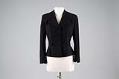
Black jacket worn by Flossie Smith to 1961 event with Martin Luther King Jr.
This black jacket belonged to Flossie McFarlin Smith who wore it to an event with Dr. Martin Luther King, Jr. when he visited Seattle in 1961. Smith was a deaconess at Mount Zion Baptist church. The pastor of Mount Zion, Rev. Dr. Samuel Berry McKinney had been classmates with King at Morehouse College and was the one who invited him…
ID Number:2019.105.16
Date:1958-1961