683 results for: Clothing and Dress
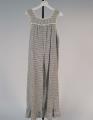
Navy and white checkered designed cotton house dress, ca. 1900
This house dress is in the smock style, open in the back with two buttons at the top. There is a low rounded neck, wide sleeve openings, and a pocket at the right hip.
ID Number:1958.1516.73C197
Date:Circa 1900
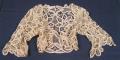
Battenberg lace cape jacket, 1895
This lace cape jacket was handmade by a mother and daughter team.
ID Number:1958.1571.1
Date:1895
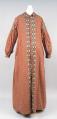
Red print calico wrapper, 1850s
This 1850s maternity wrapper is made of washable cotton with a pattern that disguises dirt. Wrappers were worn as casual home-wear when the realities of frontier life necessitated practical choices and garments that could serve multiple purposes.
ID Number:1959.1770.4C40
Date:Circa 1850
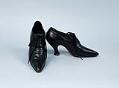
Pair of black French-style heeled shoes, ca. 1905
These women's shoes belonged to Mrs. Charles Fagan of Cascade School, and were purchased from Frederick & Nelson in Seattle.
ID Number:1959.1801.2
Date:Circa 1905
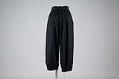
Woman's bicycling bloomers, 1890s
Dress reformer Amelia Bloomer invented her eponymous wide-cut pants in the 1850s, but it wasn’t until the late 19th-century craze for bicycling that they caught on. While some women rode in skirts or garments designed to look like skirts and conceal the fact they were split underneath, others boldly adopted bloomers as part of their cycling costume. These bloomers would…
ID Number:1959.1803.19C151
Date:Circa 1895
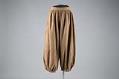
Woman's bicycling bloomers, 1890s
Dress reformer Amelia Bloomer invented her eponymous wide-cut pants in the 1850s, but it wasn’t until the late 19th-century craze for bicycling that they caught on. While some women rode in skirts or garments designed to look like skirts and conceal the fact they were split underneath, others boldly adopted bloomers as part of their cycling costume. These bloomers would…
ID Number:1959.1803.20C152
Date:Circa 1895
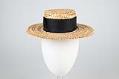
Woman's straw boater, ca. 1895
This women’s straw “boater” hat was worn in the late 19th century as part of an outfit for bicycling. Bicycling was wildly popular in the 1880s and 1890s and was considered particularly liberating for women. The bicycle offered a new kind of mobility and independence, and bicycling costumes often included split skirts or bloomers. Bicycling costumes were nearly always paired…
ID Number:1959.1803.21M213
Date:Circa 1895

Muff covered with silk violets, ca. 1900
This muff was owned by Mrs. Donald E. Frederick, wife of founder of Seattle's Frederick & Nelson Department Store.
ID Number:1960.1865.1
Date:Circa 1900
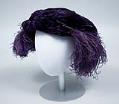
Purple velvet hat from MacDougall & Southwick, ca. 1905
This hat was sold at Seattle department store MacDougall & Southwick. In 1875 Polish immigrants Ferdinand Toklas (1845-1924) and Paul Singerman (1847-1915) opened a retail business which soon became the city's first department store. Originally located at Cherry and Front Street (later called 1st Avenue), the store moved and expanded multiple times and was an early adopter of new technologies…
ID Number:1960.1901.1M221
Date:Circa 1905
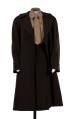
WAAC uniform worn by Jane H. Donlon, 1941
WAAC stands for Women's Army Auxiliary Corps and Ms. Donlon was one of the first in Seattle to volunteer for this organization.
ID Number:1960.1934.C694
Date:1941