683 results for: Clothing and Dress
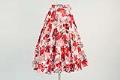
Pink and red circle skirt, ca. 1950s
This cotton circle skirt has an exuberant red and pink printed pattern. It was made by Foster-Hochberg Manufacturing, one of the leading clothing companies in Seattle in the 1950s and 60s. Foster-Hochberg specialized in casual sportswear for women and teen girls.
ID Number:2016.4.2
Date:Circa 1950
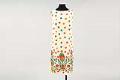
Patterned shift dress from Sailmates, 1960s
This dress has a label for “Sailmates Seattle,” one of the clothing lines designed and made by Foster-Hochberg Manufacturing. In the 1950s and 1960s Foster-Hochberg was one of Seattle’s leading clothing manufacturers, specializing in casual sportswear for women and teen girls.
ID Number:2016.4.3
Date:Circa 1960
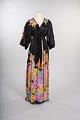
Black dress with bright floral pattern designed by Richmond of Seattle, ca. 1970s-1980s
Robert Richmond made a name for himself by creating custom designs for clients who craved something unique. Rather than sketching, his inspiration came through draping and experimenting with fabric on a dress form.
ID Number:2016.4.4
Date:Circa 1970-1980
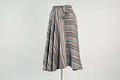
Multicolored ribbon skirt with "Jinni Seattle" label, ca. 1960s
This colorful striped skirt was made in Seattle by local designer Virginia De Haven. In the early 1960s her “Jinni” brand was sold in stores across the West Coast and even had a few orders from Saks Fifth Avenue in New York.
ID Number:2016.4.6
Date:Circa 1960
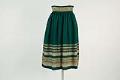
Green handwoven skirt from Chamberlin’s, 1950
Chamberlin’s was a Seattle brand of fashionable handwoven clothing run by Edward and Helen Chamberlin. The weaving was done by skilled blind craftspeople who were trained through the Division for the Blind of the State of Washington. Chamberlin’s had a storefront in Seattle and a wholesale division which sold to stores around the country.
ID Number:2016.4.7
Date:1950
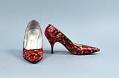
Multicolored high heels from Nordstrom, ca. 1950s
Nordstrom began as a shoe retailer established in Seattle in 1901 by Carl Wallin and Swedish immigrant John Nordstrom (Wallin & Nordstrom). By 1929, both Nordstrom and Wallin had retired and sold their shares to Nordstrom's sons, Everett and Elmer. In 1930, when the newly remodeled Second Avenue store was reopened, the name changed to Nordstrom, or sometimes Nordstrom’s. In…
ID Number:2016.4.8
Date:Circa 1950
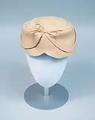
Tan felt hat with John Eaton label, ca. 1950s-1960s
This twist on a classic pillbox hat is made with tan colored felt. Cornish School of Arts graduate John Eaton (1914-1991) was a successful milliner, designer, and teacher whose individually-styled hats became known all over the country. Eaton and partner James Neher opened their first store in 1950, and eventually opened “John Eaton Of Course!” at 509 Pine Street, across…
ID Number:2016.4.9
Date:Circa 1950-1960
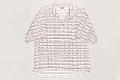
Shirt with pattern of people made by Union Bay, ca. 1980s-1990s
Founded in 1981 and named after Seattle's Union Bay on Lake Washington, UNIONBAY is one of the city's longest-running jeans and casualwear companies. This shirt, from the late 1980s or early 1990s, features a print of rows and rows of people, with lettering spelling out U N I O N B A Y.
ID Number:2016.4.10
Date:Circa 1980-1990
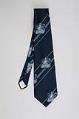
Necktie with Brittania label, ca. 1970
German immigrant brothers Theodore, Herman, and Max Schoenfeld founded a neckwear company in Seattle in 1906. Schoenfeld Brothers Inc. manufactured at their building at Fairview and Denny and sold products under the label Fashion Craft Neckwear. In 1968, Max’s son Walter became president of the business. Soon after this change, Max launched a new neckwear line called “Brittania.” He had…
ID Number:2016.4.11
Date:1968-1975
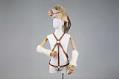
Pegasus costume made and worn by Ric Weiland, 1983
Richard "Ric" Weiland (1953-2006) was a software developer, programmer, philanthropist, and active member of the Northwest gay community. Weiland enjoyed creating costumes and dressing up for LGBTQ parties in Seattle. He made this body-revealing Pegasus costume for a 1983 Halloween party. It consisted of a horse head made of foam and built over a helmet, a leather harness, a pair…
ID Number:2016.10.1.ONLINE
Date:1983