157 results for: Transportation
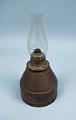
Fourth (4th) order light from West Point Light Station, Discovery Park, 1881-1926
The West Point Light Station was the first manned light station on Puget Sound. It began operation in 1881 and, though it is automatic today, it is still in use in its Discovery Park location, which now includes a visitor center.
ID Number:1958.2153.1
Date:1881-1926
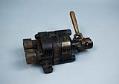
Straight air brake valve from Seattle cable car, 1912-1940
This type of air brake valve, made by the National Brake and Electric Company in Milwaukee, was used by Seattle cable cars run from 1912-1940 by the Seattle Municipal Street Railway, a city-owned transit network.
ID Number:1959.1618.44
Date:1912-1940
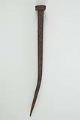
Spike from Imperial Russian Navy sidewheel gunboat, the POLITKOFSKY, ca. 1850s
Built by the Russians in Sitka, the POLITKOFSKY came under United States ownership in 1867 when Russian Alaska was sold to the US. The gunboat was then sold into civilian service as a tugboat, Polly, working the northwest coast of North America until 1896. It was then converted to a schooner barge and carried eager gold seekers to Alaska during…
ID Number:1959.1623.1
Date:Circa 1850
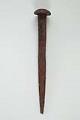
Spike from Imperial Russian Navy sidewheel gunboat, the POLITKOFSKY, ca. 1850s
Built by the Russians in Sitka, the POLITKOFSKY came under United States ownership in 1867 when Russian Alaska was sold to the US. The gunboat was then sold into civilian service as a tugboat, Polly, working the northwest coast of North America until 1896. It was then converted to a schooner barge and carried eager gold seekers to Alaska during…
ID Number:1959.1623.2
Date:Circa 1850
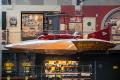
Slo-Mo-Shun IV hydroplane, built in 1929 and rebuilt in 1956
The Slo-Mo-Shun IV hydroplane (rebuilt with a model of the engine) brought unlimited hydroplane racing to Seattle with her Gold Cup win. The unlimited hydroplane is an example of aerodynamic design in boat building, and it is best remembered by the estimated 200,000 exhilarated spectators on Lake Washington's shoreline as it sped to a new world record in the 1951…
ID Number:1959.1701
Date:1929
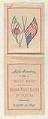
Program on silk ribbon for the arrival of the Miike Maru steamship in Puget Sound, 1896
On August 31, 1896, the Miike Maru docked in Elliott Bay, beginning a regular run between Seattle and Japan. The steamship carried a cargo of silk and tea, and was owned by the Nippon Yusen Kaisha (Japanese Steamship Company).
ID Number:1960.1818.15
Date:1896
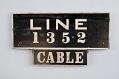
Sign from the James Street cable car line, ca. 1920
This wooden sign is from the James Street cable powerhouse once located at the corner of James Street and Broadway. This wooden sign is from the James Street cable powerhouse once located at the corner of James Street and Broadway. Cable cars operated by gripping an underground, continuously moving cable, which is pulled by a central powerhouse, allowing the cars…
ID Number:1960.2003.1
Date:Circa 1920
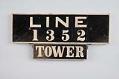
Sign from the James Street cable car line, ca. 1920
This wooden sign is from the James Street cable powerhouse once located at the corner of James Street and Broadway. Cable cars operated by gripping an underground, continuously moving cable, which is pulled by a central powerhouse, allowing the cars to move and stop by releasing and gripping the cable as needed. The powerhouse was torn down in 1960.
ID Number:1960.2003.2
Date:Circa 1920
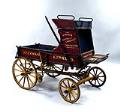
Model of a Heckmann's coal wagon, 1895
Henry Heckmann owned a fuel and transfer business in Seattle from the late 1800s into the 20th century. This model wagon was made by Joseph F. Hardwiger as a gift to Heckmann's children in 1895. Hardwiger made all of Heckmann's full-sized wagons.
ID Number:1960.2051.1
Date:1895
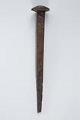
Spike from Imperial Russian Navy sidewheel gunboat, the POLITKOFSKY, ca. 1850s
Built by the Russians in Sitka, the POLITKOFSKY came under United States ownership in 1867 when Russian Alaska was sold to the US. The gunboat was then sold into civilian service as a tugboat, Polly, working the northwest coast of North America until 1896. It was then converted to a schooner barge and carried eager gold seekers to Alaska during…
ID Number:1961.2194.1
Date:Circa 1850