35 results for: Unknown
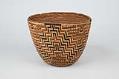
Coast Salish coiled basket, ca. 1900
This coiled basket with a stepped pattern was created by an unknown indigenous Coast Salish basketmaker.
ID Number:1963.2944.1
Date:Circa 1880-1920
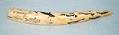
Scrimshaw carving on ivory walrus tusk, undated
This scrimshaw piece was donated anonymously and the date is unknown. The etchings depict hunters in a baidarka and one in a kayak chasing seals, fish, a whale, and other marine life.
ID Number:1969.4596.6
Date:Before 1950
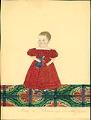
Watercolor portrait of Mary Folger Brown by unknown artist, ca. 1833
The subject of this portrait, Mary F. Brown, was the niece of Captain Isaiah Folger of the schooner EXACT which brought the Denny party to Seattle. Mary's great uncle was Mayhew Folger, captain of the brigantine TOPAZ, and who rediscovered the Pitcairn Islands in 1808 where one of the HMS BOUNTY mutineers was still living. This portrait was painted on…
ID Number:1971.5127.1
Date:1833
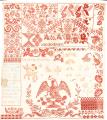
Red and white sampler with Spanish text by Petra Montes Cholu, 1880
This sampler, maker unknown, is from the Blanche Payne collection of textiles. MOHAI has over 400 textile and costume pieces donated by Payne. She was born in 1897 in Thayer, Kansas, and taught costume and design at the University of Washington starting in 1927. Payne travelled through Central Europe and the Balkans surveying folk costume in the former Czechoslovakia, Hungary,…
ID Number:1971.5263.342
Date:1880
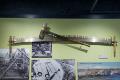
Puget Sound Falling Axe, ca. 1910
Falling or felling is a term for cutting down trees. Like most falling axes this one is double-bit, meaning it has a blade on either end. What makes the Puget Sound axe different is that the bit is longer and narrower, typically about 12 to 14 inches from end to end. It also has a longer handle. This one is…
ID Number:1978.6600.1
Date:Circa 1910
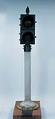
City of Seattle traffic signal, ca. 1950
Removed from an unknown intersection in the city of Seattle, this type of traffic signal was first introduced after World War II. It is a pedestrian walk signal with a red "WAIT" light on top, and a green "WALK" light on the bottom.
ID Number:1979.6818
Date:Circa 1950
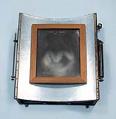
Glass plate x-ray of abdomen, 1920
This x-ray was taken at the office of Dr. E.W. Rawson, MD, in Seattle most likely by the Victor chest X-Ray machine also in MOHAI's collection. The patient is unknown.
ID Number:1980.7077.14
Date:1920
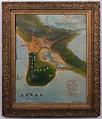
Painted map made by Adolph P. Wagner circa 1900-1920 and featuring an aerial view of Seattle in 1855-1856
On the morning of January 26, 1856, the "Battle of Seattle" began when Native Americans raided the white settlement in what is now known as Seattle. Previously warned of the attack, most settlers had barricaded themselves in a blockhouse. The attackers were driven off by artillery fire. The battle was the penultimate event in a series of armed conflicts, known…
ID Number:1981.7184.1
Date:Circa 1900-1920
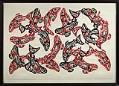
Print by Marvin Oliver, "New Generation," 1997
This serigraph by Native American sculptor and printmaker Marvin Oliver (d. 2019) depicts a new generation of salmon hatching from eggs. Born to Quinault and Isleta-Pueblo parents, and raised in Washington and San Francisco, Marvin Oliver (date of birth unknown) was an Associate Professor of American Indian Studies and Art History at the University of Washington and Curator of Contemporary…
ID Number:2001.70.1
Date:1997
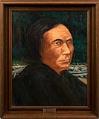
Portrait of Chief Leschi painted 1950-1960, artist unknown
Leschi was born to Nisqually and Yakama parents and grew up among the Nisqually people. When he was 25 years old, the Hudson Bay Company (HBC) built a fort at the mouth of the Nisqually River, and soon the HBC was farming throughout the plain. Leschi was working for the HBC in 1848 when Oregon Territory was created. Two years…
ID Number:2005.16.1
Date:1950-1960