696 results for: Clothing
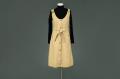
Leather jumper, worn by Olive Smith, 1960s
This leather jumper belonged to Olive J. Smith (1917-1996), fashion buyer and Seattle style authority. Smith worked for Rhodes and The Bon Marché department stores until 1963 when she was recruited by Nordstrom. Nordstrom had just purchased women’s specialty store Best’s Apparel, and so Smith was brought on to help with the pivotal transition from being a shoes-only retailer to…
ID Number:1984.123.12C2702
Date:Circa 1960
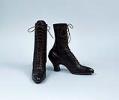
Pair of dark brown kid leather high laced boots, ca. 1916
Mabel Frances Whalley Baer (1894-1985) was a lifelong Seattleite and daughter of State Senator John A. Whalley. These high laced kid shoes were sold by Turrell's, an early Seattle shoe retailer.
ID Number:1986.21.42
Date:Circa 1916
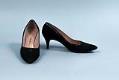
Black pump evening shoes, ca. 1960s
These classic women's evening shoes were sold at Nordstrom Best in Seattle in the 1960s.
ID Number:1986.24
Date:Circa 1960
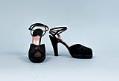
Black beaded platform heels, 1940s
These women's shoes were made for Pessemiers' Shoe Store in downtown Seattle. During 1940, its first year in business, the store promoted itself as a place "Where women may select fine footwear - Leisurely and to their utmost satisfaction." Platform shoes were very popular in the 1940s, 1960s, and 1990s.
ID Number:1987.12
Date:Circa 1940
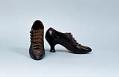
Bronzed kid leather shoes, ca. 1912
These beaded women's shoes were sold at Turrell's, an early Seattle business, and made by Laird, Schober & Co. in Philadelphia around 1912. They were worn by Mrs. Ada Bonner Staadecker (Mrs. Victor).
ID Number:1988.14
Date:Circa 1912
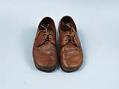
Dropped heel design "Earth" shoes, ca. 1970
These "Earth" shoes were an example of counterculture style of the 1960s and 1970s. The dropped heel was supposed to be good for the foot. Reviews in the 1971 Last Whole Earth Catalog, a compendium of counterculture ideas and products, stated “The shoes are strange to look at and stranger to wear; they hurt for the first few days but…
ID Number:1989.27
Date:Circa 1970
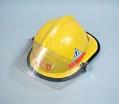
Seattle Fire Department helmet, ca. 1969
This fiberglass fireman's helmet was worn by paramedic M. J. Garvey during his rescue missions.
ID Number:1990.5.3
Date:Circa 1969
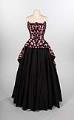
Ball gown from the House of Schiaparelli, ca. 1951
This gown is from the couture house of Elsa Schiaparelli, likely during Hubert de Givenchy’s design tenure in the early 1950s. It boldly contrasts the black skirt and beading with Schiaparelli’s signature color, “shocking pink.”The wearer, Ruth Schoenfeld Blethen Clayburgh, was a prominent arts patron who attended and organized many of Seattle’s most glamorous fundraising events. She was a founder…
ID Number:1991.18
Date:Circa 1951
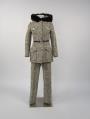
Black and white houndstooth pantsuit worn by Peggy Corley, 1973
The pantsuit was a controversial garment for women in the 1970s. Detractors believed that pants were too masculine and should only be worn by women in private or casual settings. But pantsuits were designed to be worn for public settings, such as work or as eveningwear. This one was designed by Robert Taboh for the brand Devon Hall. This pantsuit…
ID Number:1991.40.1
Date:1973
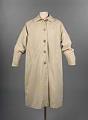
Raincoat, "Fairweather" made by Totem Sports Wear, 1962
This coat is made from a light, waterproofed cotton, so the “Fairweather” name could refer to those balmy rainy days that have only a light sprinkle—“fair” weather by Seattle standards. It likely also refers to the World’s Fair Seattle hosted from April to October of 1962.Seattle’s Totem Sportswear made this raincoat in their factory in South Lake Union. In 1962,…
ID Number:1992.2
Date:1962