259 results for: Innovation and Invention
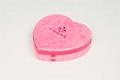
Heart-shaped box from Fran's Chocolates, 2018
Fran Bigelow opened her original shop, Fran’s Patisserie & Chocolate Specialties, in Seattle in 1982. Today, there are four Seattle-area boutiques plus mail order and wholesale lines of truffles, caramels, bars, and chocolate-covered nuts and fruit. President Barak Obama is among Fran’s Chocolates fans and he would gift Gray and Smoked Salt Caramels to White House visitors.
ID Number:2019.Candy.02
Date:2018
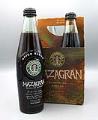
Cardboard carrier with 4 bottles of Starbucks "Mazagran Sparkling Coffee", ca. 1995
In 1994, Starbucks partnered with Pepsi to launch this bottled coffee soda and sell it in grocery stores. The name Mazagran comes from the French Foreign Legion posted in Algeria in the 19th century. The new carbonated coffee drink was not well-received and was pulled from the shelves by 1995. At which time Starbucks and Pepsi launched the bottled Frappacino…
ID Number:2019.Mazagran
Date:Circa 1995
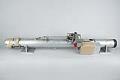
Prototype of a Multi-Wavelength Integrating Nephelometer, 1971, US Patent 3,563,661
This integrating nephelometer is part of a collection of prototypes of devices that were patented by the University of Washington from the 1960s into the 1980s that relate to climate and atmospheric monitoring and measurement. This prototype, co-invented by Professor Robert Charlson (1936-2021), was used in a 1969 experiment at CalTech that was referred to by the participants as "The…
ID Number:2020.11.2
Date:1971
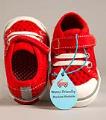
Pair of red "Saylor" children's shoes from See Kai Run, 2019
See Kai Run was founded in 2004 in Seattle by mom Cause Haun. The company makes children’s shoes which are fun, well crafted, and engineered to promote healthy foot development. This red pair is also “water friendly” and machine washable.
ID Number:2020.20.1
Date:2019
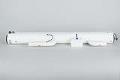
Operating nephelometer used by the National Oceanic and Atmospheric Association (NOAA) for work on Arctic Haze studies, 1970s
This device was one of the first operational nephelometers designed by Dr. Robert Charlson (1936-2021) at the University of Washington and used by NOAA for work on Arctic Haze studies in the 1970s. The nephelometer measured the spatial distribution of smog and haze from human activity and would be attached to an airplane to capture data in flight. Robert Charlson…
ID Number:2020.22.1
Date:Circa 1970
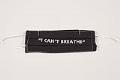
Mask, "I Can't Breathe," made by Sonia Wooten-Gill, FayWoo's Signature Collection, 2020
Among the local designers and artists who began making face masks in 2020, many Black designers were inspired to infuse powerful messages into their creations. This mask was made by local milliner and clothing designer Sonia Wooten-Gill whose line is called FayeWoo’s Signature Collection. "I Can't Breathe" were the last words of Eric Garner, a Black man who died in…
ID Number:2020.30.1
Date:2020
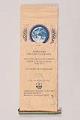
Flour sack from Fairhaven Organic Flour Mill, 2020
During the COVID-19 pandemic and worldwide quarantine lockdown in 2020, many people took to baking and, in various places including Seattle, it was difficult to buy flour which was flying off the grocery store shelves. The donor of this artifact, along with his roommate, drove to Burlington (about 65 miles) to purchase this flour bag from Fairhaven Organic Flour Mill.…
ID Number:2020.43.1
Date:2020

Smiley face pin from University Federal Savings, 1967
The now-ubiquitous yellow smiley icon that graces this pin was, according to one story, invented by David Stern in 1967. He was an advertising executive who planned a campaign to encourage people to open accounts at a small bank in Seattle called University Federal Savings and Loan.
ID Number:2021.20.4
Date:1967
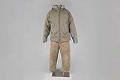
Daiber-Jensen parka, down pants, and boots, ca. 1940s
Ome Daiber (1907-1989) was known as the “Father of Mountain Rescue.” His interest in mountain equipment led him to found Ome Daiber Inc. in 1936. Some of his most well-known inventions were the two-legged “Penguin” sleeping bag, the “Birdcage” crampon, and “SnoSeal” waterproofing compound. He also manufactured Eddie Bauer’s first down jackets, before Bauer had his own factory. When World…
ID Number:2021.54.1
Date:Circa 1940
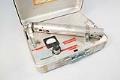
Slope Indicator 200 and case, early inclinometer probe, 1960s
The inclinometer is a tilt sensing device used to measure lateral displacement of earth or structures in various applications such as landslide monitoring, high-rise building pit excavations, bridge foundations, and more. The inclinometer was invented in the 1950s by Stanley D. Wilson, co-founder of the Slope Indicator Company (SINCO), which was established in Seattle in 1958. This device was used…
ID Number:2021.69.1
Date:Circa 1960