45 results for: World War II, 1941-1945 (WWII)
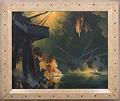
Painting of a nighttime naval battle off Saipan by Edward Grigware, 1944
The artist, Edward Grigware (1889-1960), lived in Seattle and Spokane and was an accomplished mural artist. During World War II, he was a War Record painter for the US Navy, working from the carrier Enterprise in the midst of the Pacific campaigns. Some of his works appeared in Life magazine.
ID Number:1966.3803
Date:Circa 1944-1950
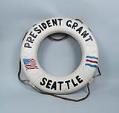
Life preserver ring from the SS President Grant/Seattle, ca. 1948
The USS Grant (AP-29) was a U.S. transport ship from the 1920s through World War II.
ID Number:1974.5920.1
Date:Circa 1948
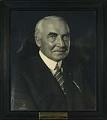
Photograph of President Warren Harding posing for World War I veterans at Cushman Hospital by Seattle photographer Martin A. Grady, 1923
President Harding went on a tour of the western states arriving in Tacoma on July 3, 1923. He visited the WWI veterans at Cushman Hospital which was originally the Puyallup Indian School established in 1860, then renamed the Cushman Indian School in 1910, and then became the hospital in 1918. On July 5, Harding sailed to Alaska, returning to Seattle…
ID Number:1974.5977.9
Date:1923
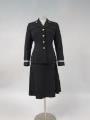
World War II Coast Guard (SPAR) uniform, ca. 1940
During World War II, the Coast Guard Women’s Reserve was known as the SPARs. SPAR is an acronym of the Coast Guard motto “Semper Paratus –Always Ready.” SPAR assignments range from essential clerical positions to air control operations, parachute rigging and more. The SPAR uniforms were the same design as the Navy WAVES (Women Accepted for Volunteer Emergency Service). The…
ID Number:1978.6708.15C2403
Date:Circa 1940
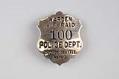
Air Raid Warden's badge #100, Police Department, City of Seattle, ca. 1940
During WWII, there were fears that cities in the United States would be bombed like England was during the blitz. President Roosevelt formed the Office of Civilian Defense to organize communities of volunteers. Air Raid Wardens educated their neighbors about blackouts and air raid procedures, ran drills, and did patrols at night.
ID Number:1980.6898.2
Date:Circa 1940
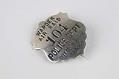
Seattle Air Raid Warden badge, 1941-1945
During WWII, there were fears that cities in the United States would be bombed like England was during the blitz. President Roosevelt formed the Office of Civilian Defense to organize communities of volunteers. Air Raid Wardens educated their neighbors about blackouts and air raid procedures, ran drills, and did patrols at night.
ID Number:1980.6898.3
Date:Circa 1944
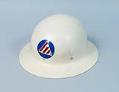
Civil Defense helmet, ca. 1940
Civil defense refers to the organized non-military effort to prepare Americans for military attack. During World War II, the Civil Defense Corps, organized approximately 10 million volunteers who were trained to fight fires, decontaminate after chemical weapon attacks, provide first aid, and other duties. This helmet would have been worn by one of these volunteersl. In recent decades, civil defense…
ID Number:1980.6924.16
Date:Circa 1940
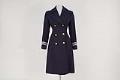
U.S. Navy WAVE uniform, worn by Jane Blogg, 1942
During World War II, the Women’s division of the United States Naval Reserve was known as the WAVES (Women Accepted for Volunteer Emergency Service). WAVES filled a variety of roles, including rigging parachutes, guiding planes in the control tower, work as metalsmiths, and more. WAVES were in high demand and received equal pay to their male counterparts of the same…
ID Number:1980.6961.1C2449
Date:1942
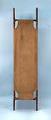
Two-man canvas stretcher, 1940-1941
This stretcher was one of many provided by the American Red Cross prior to World War II to be used in emergency hospitals set up in Seattle schools as preparation for possible air raids and bombings. There were various units organized to work at the school gymnasiums consisting of doctors, nurses, stretcher bearers, panel truck drivers, motorcycle and foot messengers,…
ID Number:1981.7389.23
Date:1940-1941
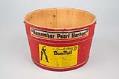
Home defense "BomPail" for scooping up bombs, ca. WWII
This home defense artifact was sold nationwide as a security measure during World War II. It is difficult to believe that this is a safe activity and this seemingly simple wooden pail should probably not have been marketed as such. Nevertheless, here are the instructions for using the BomPail as posted on the outside of the bucket: "(1) Scatter dry…
ID Number:1986.6
Date:Circa 1940