25 results for: Women's Rights
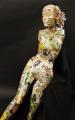
Mannequin, "The WomanCan," used in lectures by Georgie Bright Kunkel, ca. 1970
Activist Georgie Bright Kunkel (1920-2025) renamed this mannequin the "WomanCan,” covering her in a collage of sexist and nonsexist images she found in magazines. In the 1970s, she carted the "WomanCan" around the state, talking to groups about equal rights. "My mother never talked about getting married, never talked to us about getting a man. ‘You have to be independent.…
ID Number:2007.62.1
Date:Circa 1970
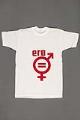
Equal Rights Amendment (ERA) T-shirt, ca. 1970s
The Equal Rights Amendment (ERA) was introduced in the US Congress for the first time in 1921 and has prompted conversations about the meaning of equality for women and men ever since. With the rise of the women's movement in the 1960s, the ERA garnered increasing support, was reintroduced to Congress in 1972, and was submitted to the state legislatures…
ID Number:2007.62.2
Date:Circa 1970
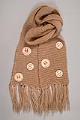
Knit scarf with a collection of HJR 61 buttons attached, ca. 1972
This scarf was donated by local activist Georgie Bright Kunkel (1920-2025) who, in the 1970s, traveled around Washington state talking to groups about equal rights. House Joint Resolution (HJR) 61, Washington's Equal Rights Amendment, passed narrowly in 1972.
ID Number:2007.62.3
Date:Circa 1972

Sculpted ceramic scene depicting a brothel interior and exterior by Lorene Spencer, 1970
This work is part of a series of sculptures that depict the stalls and stores at the Pike Place Market and other places in Seattle around 1970. The artist, Lorene Spencer (1923-2016), was well known for her pottery and clay sculptures. She and her then-husband Ralph owned a studio in south Seattle in the 1950s and 1960s. Lorene also produced…
ID Number:2010.43.4
Date:1970

Compact disc, Brandi Carlile, "Live at Easy Street Records," BMG Music Entertainment © 2007
Brandi M. Carlile (b. 1981) is an American singer-songwriter. Carlile was born in Ravensdale, Washington, and began her career performing in Seattle music clubs. Carlile's music has been categorized in various genres including pop, rock, alternative country, and folk. Carlile has been a vocal advocate for causes like LGBTQ rights, the empowerment of women, and awareness about health issues. This…
ID Number:2013.71.19
Date:2007
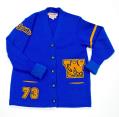
West Seattle High School blue letterman sweater, 1973
This sweater belonged to Laurie Sleight Kleespies who lettered in multiple sports at West Seattle High School after the passage of Title IX in 1972. Title IX banned discrimination on the basis of sex in federally-funded educational institutions and included sports and recreational activities. Laurie was born and raised in West Seattle and grew up playing tennis with her brother.…
ID Number:2013.131.1
Date:1973
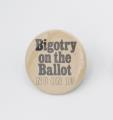
Button pin, "Bigotry on the Ballot: No on 13," 1978
On November 7, 1978, Seattle voters reject Initiative 13 decisively, by nearly two to one. Initiative 13 would have repealed city ordinances protecting employment and housing rights for gays and lesbians. Also, it would have dissolved the City of Seattle's Office of Women's Rights.
ID Number:2014.56.5
Date:1978

Shoelaces, political advertisement for Patty Murray, "The Mom in Tennis Shoes", 1998
Patty Murray ran for re-election to the US Senate for Washington state in 1998. She ran under the image of a "Mom in Tennis Shoes". Throughout her tenure in the Senate, Murray has been a strong proponent for education and children's issues, and has become a national leader on budget, transportation, ecomonic development, health care, women's health, and veterans' issues.
ID Number:2015.73.16
Date:1998

Maroon knitted Pussyhat, 2017
This “Pussyhat” was worn at the Women's March on Seattle (also spelled Womxn's March on Seattle) on January 21, 2017. It was one of hundreds such marches held internationally the day after the inauguration of President Donald Trump. The marches protested the threat to women's rights represented by Trump's policies and vulgar rhetoric. The Pussyhat Project was created in Los…
ID Number:2017.18.1
Date:2017

Pink knitted Pussyhat, 2017
This “Pussyhat” was worn at the Women's March on Seattle (also spelled Womxn's March on Seattle) on January 21, 2017. It was one of hundreds such marches held internationally the day after the inauguration of President Donald Trump. The marches protested the threat to women's rights represented by Trump's policies and vulgar rhetoric. The Pussyhat Project was created in Los…
ID Number:2017.21.1
Date:2017