135 results for: Popular Culture
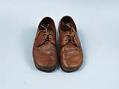
Dropped heel design "Earth" shoes, ca. 1970
These "Earth" shoes were an example of counterculture style of the 1960s and 1970s. The dropped heel was supposed to be good for the foot. Reviews in the 1971 Last Whole Earth Catalog, a compendium of counterculture ideas and products, stated “The shoes are strange to look at and stranger to wear; they hurt for the first few days but…
ID Number:1989.27
Date:Circa 1970
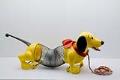
Pull toy, "Slinky Dog," 1960s
Seattleite Helen Herrick Malsed (1910-1998) designed this classic Slinky Dog toy. Malsed invented toys and games in her basement workshop and had her kids help as testers. This toy was one of more than 26 inventions that she created and sold to various toy companies around the country. "Slinky Dog" was manufactured by James Industries, Inc., Hollidaysburg, Pennsylvania.
ID Number:1991.27.1
Date:Circa 1960
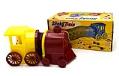
Pull toy, "Slinky Train," 1960s
This Slinky Train was designed by local resident Helen Malsed, who designed the original line of similar slinky toys including the Slinky Dog.
ID Number:1991.27.2
Date:Circa 1960
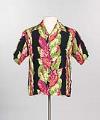
Hawaiian sport shirt worn by Admiral Ira E. Eskridge, 1948
Aloha, or Hawaiian, shirts were first created in Hawaii in the 1930s. They reflect island motifs and can be worn for a variety of occasions. The shirts became particularly popular stateside after World War II, when members of the military, such as Admiral Eskridge, brought the style home. On the mainland, the look was co-opted and reproduced as something kitschy…
ID Number:1992.39.1
Date:1948
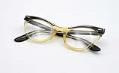
Pair of eyeglasses, 1965-1967
These 1960s "pixie" style Bausch & Lomb women's bifocal glasses, bought and worn in Seattle, are typical of the style worn at that time.
ID Number:1994.7.11
Date:Circa 1965
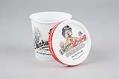
Danken’s ice cream carton, J.P.'s Patches of Pralines, ca. 1992
Danken’s ice cream was started by Dan Samson in 1983. The original location was at 50th and University Way but moved in 1984 to 4507 University Way. Through a partnership with Breyers Ice Cream, Danken’s was able to sell pints of ice cream in stores throughout the Pacific Northwest and make custom flavors for regional businesses. Of the over 150…
ID Number:2003.35.1
Date:Circa 1992
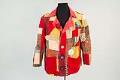
J.P. Patches's jacket, 1960-2002
This is one of several jackets that local entertainer Chris Wedes (1928-2012) wore as clown J. P. Patches on the KIRO-TV children’s program "The J.P. Patches Show" from 1958 to 1981. The live improv show was immensely popular in the Puget Sound area and southwestern British Columbia. J.P. Patches was the Mayor of the City Dump, so his costumes had…
ID Number:2003.35.2
Date:1960-2002
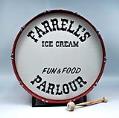
J.P. Patches' marching bass drum, ca. 1970
Chris Wedes played fun-loving clown J.P. Patches twice a day on local television, reaching up to 100,000 kids. He often played a large bass drum featuring Farrell's Ice Cream as part of his show. Patches' 23-year run from 1958-1981 made it America's longest-running local children's program.
ID Number:2003.35.3
Date:Circa 1970
J.P. Patches' drumstick for marching bass drum, ca. 1970
Chris Wedes played fun-loving clown J.P. Patches twice a day on local television, reaching up to 100,000 kids. He often played a large bass drum featuring Farrell's Ice Cream as part of his show. Patches' 23-year run from 1958-1981 made it America's longest-running local children's program.
ID Number:2003.35.4
Date:Circa 1970
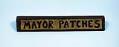
Wooden nameplate, for J.P. Patches, "Mayor Patches," ca. 1960-2002
Chris Wedes' playful clown character J.P. Patches, affectionately known as the "Mayor of the Dump", hosted one of America's longest-running local children's program from 1958-1981. This plaque was featured on his television show.
ID Number:2003.35.5
Date:Circa 1960-2002