39 results for: Police and Law Enforcement
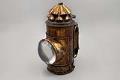
Dietz brand police lantern flashlight, ca. 1900
This police flashlight belonged to Thor Ulstrop (1861-1941) who was born in Norway and came to Seattle in 1889. He worked as a deckhand on a steamer on Puget Sound, and also as a bricklayer, helping to build the White Henry Stuart building in 1913.
ID Number:1973.5679.2
Date:Circa 1900
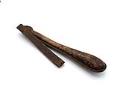
Blackjack belonging to law officer in Aberdeen, Washington, ca. 1890
Blackjacks, also known as billy clubs or saps, were a common weapon for law enforcement in the late 18th and early 20th centuries.
ID Number:1973.5731.1
Date:Circa 1890
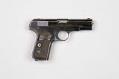
Automatic Colt .32 caliber pistol that belonged to Tobert T. Hodge, King County Sheriff, 1916
Robert T. Hodge served as King County Sheriff from 1909 to 1916. In 1902, when he was an officer in the King County Sheriff's department, he helped lead the chase of outlaw and prison escapee Harry Tracy who had left a trail of murders from Colorado to the Pacific Northwest. Hodge and his team pursued Tracy from western Washington to…
ID Number:1973.5763
Date:1916
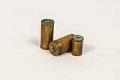
Collection of four bullet shell casings from the Everett Massacre in 1916
Four bullet shell casings gathered by Arthur Riggs who was present during the 1916’s Everett Massacre, a confrontation between citizen and sheriff deputies and demonstrating members of the International Workers of the World union (IWW). About 300 IWW members met in Seattle, boarded the steamers Verona and Calista, and headed to Everett. The Verona arrived first to be met by…
ID Number:1980.6886.74
Date:1916
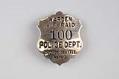
Air Raid Warden's badge #100, Police Department, City of Seattle, ca. 1940
During WWII, there were fears that cities in the United States would be bombed like England was during the blitz. President Roosevelt formed the Office of Civilian Defense to organize communities of volunteers. Air Raid Wardens educated their neighbors about blackouts and air raid procedures, ran drills, and did patrols at night.
ID Number:1980.6898.2
Date:Circa 1940
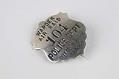
Seattle Air Raid Warden badge, 1941-1945
During WWII, there were fears that cities in the United States would be bombed like England was during the blitz. President Roosevelt formed the Office of Civilian Defense to organize communities of volunteers. Air Raid Wardens educated their neighbors about blackouts and air raid procedures, ran drills, and did patrols at night.
ID Number:1980.6898.3
Date:Circa 1944
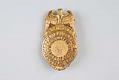
Badge, "Inspector, American Protective League, Auxiliary to U.S. Dept. of Justice, F 68," ca. 1917
The American Protective League was an organization of private citizens who spied on and reported the activities of suspected German sympathizers during WWI, as well as other “radicals” who were considered a threat to the war effort. The latter included left-wing labor and political organizations, anarchists, and anti-war activists. The APL was sponsored by the United States Department of Justice…
ID Number:1982.178.43
Date:Circa 1917
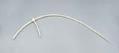
Cable tie handcuffs from the World Trade Organization (WTO) protests in Seattle, 1999
The Third Ministerial Conference of the World Trade Organization (WTO) was held in Seattle from November 30 to December 3, 1999. Tens of thousands of activists for many causes gathered to protest what they saw as the WTO's favoring of corporate interests over social and environmental concerns. Heavy police response included the use of riot gear, tear gas, and rubber…
ID Number:1999.69.3
Date:1999

Rubber bullets from the World Trade Organization (WTO) protests in Seattle, 1999
The Third Ministerial Conference of the World Trade Organization (WTO) was held in Seattle from November 30 to December 3, 1999. Tens of thousands of activists for many causes gathered to protest what they saw as the WTO's favoring of corporate interests over social and environmental concerns. Heavy police response included the use of riot gear, tear gas, and rubber…
ID Number:1999.69.47.ONLINE
Date:Circa 1999
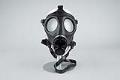
Gas mask used by WTO protester, 1999
The Third Ministerial Conference of the World Trade Organization (WTO) was held in Seattle from November 30 to December 3, 1999. Tens of thousands of activists for many causes gathered to protest what they saw as the WTO's favoring of corporate interests over social and environmental concerns. Heavy police response included the use of riot gear, tear gas, and rubber…
ID Number:1999.72.1
Date:Circa 1970-1990