540 results for: Businesses and Corporations
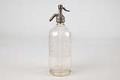
Clear glass soda seltzer bottle, "Pacific & Puget Sound Bottling Co.," 1910-1919
Pacific & Puget Sound Bottling Company was located on the corner of Minor Avenue and Stewart Street in Seattle as early as 1908.
ID Number:1981.7300.3
Date:Circa 1910-1919
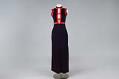
Navy blue acetate evening gown designed by Rudi Gernreich, 1969
This dress belonged to Stella Cane Bacher, an advertising executive for the Bellevue Square Shopping Center. She was born in Pittsburg, Pa. and moved to Bellevue in 1957. In addition to being promotion director of Bellevue Square and previously marketing director for Southcenter Mall, she was a member of the Seattle chapter of Fashion Group International. The dress was designed…
ID Number:1981.7320.1C2577
Date:1969
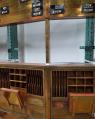
New York Stock Exchange booth, 1929
This three-part booth was Stock Exchange Tradiing Post #4 on the floor of the New York Stock Echange from 1929 to 1932 during the stock market crash and subsequent Depression. Pneumatic tube stations connected all 13 posts which served to process the increasing volume of trades. Washington state companies listed on Post #4 included Boeing, Weyerhauser, Puget Sound Power &…
ID Number:1981.7352.1
Date:1929
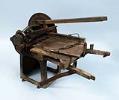
Rubber band making machine, ca. 1930s
During the Depression, Clarence Gowey worked for the Seattle Rubber Band Company located in the basement of the Ankeny-Gowey house on Queen Anne Hill before becoming a pipe fitter. He purchased this machine and, according to one of his grandchildren, Gowey and his children would go to the dump and recover the best inner tubes from car tires. They used…
ID Number:1982.15.1
Date:Circa 1930
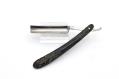
Seattle Hardware razor, ca. 1900-1950
Seattle Hardware Company opened in Pioneer Square in 1883, and held several locations in the Seattle downtown area through the 1950s.
ID Number:1982.116.101
Date:Circa 1900-1950
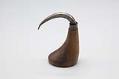
Hook with handle, Japanese tool from Tashiro Hardware, Seattle, early 20th century
This hook was from Tashiro's Hardware Store, established in 1917, and located on Prefontaine Avenue in the heart of Seattle's Nihonmachi. Kanjiro Tashiro (without hat) sold Japanese folding knives before opening his hardware store in Seattle. During World War II, he stored his inventory at Northcoast Importing. After the war, Tashiro reopened his business and continued to sell hardware as…
ID Number:1982.156.31
Date:Circa 1920-1940
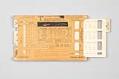
Flight computer chart for the Model B-17F, used by Bessie Dempsey while working for Boeing, 1950
While Helen Holcombe is recognized as the earliest female employee in Boeing's drafting department (joining the team in 1917), Bessie Hall Dempsey (1914-1971) is credited as Boeing's first female aeronautical engineer hired in 1946. She had moved to Seattle as a child with her mother and older sister, attending Broadway High School and then Cornish School of Fine Arts. She…
ID Number:1982.172.27
Date:1950
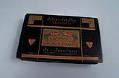
Candy box, "Helen Ardelle's Chocolates," ca. 1917
Sisters Martha and Helen Ardelle started selling chocolates in 1917 from a Seattle boarding house, wholesale and "by mail--everywhere--even to Cuba!" Martha took over the business, changed her name to Helen, divorced a renowned Arctic explorer and fur trader, and later sold the company to Brown & Haley (of Almond Roca fame).
ID Number:1982.200.1
Date:Circa 1917
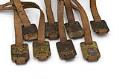
Set of brass luggage claim check tags from Seattle Steamship Company, ca. 1900-1920
The Seattle Steamship Company waiting room was located at the White Star Dock at the foot of Spring Street. In the early twentieth century, travellers most likely received their baggage claim checks at this location before boarding. The numbers on these tags include: 108, 302, 375, 492, 719, 725,773, and 794.
ID Number:1984.20.ONLINE
Date:Circa 1900-1920
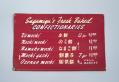
Hand-lettered sign for mochi, used at the Sagamiya Confectionery Co., ca. 1905-1950
This sign was from the Sagamiya Confectionery, formerly located at 6th and Main in the area previously known as Nihonmachi, or Japantown, now in Seattle's Chinatown International District. Sagamiya used traditional Japanese methods in the making of mochi and other wagashi (Japanese sweets). The bakery was founded in 1904 and closed in the early 1970s.
ID Number:1984.54.1
Date:1905-1950