136 results for: Government and Public Services
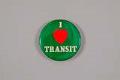
Button pin, "I (heart) Transit," ca. 1990s
This button promotes the public transit systems in the Puget Sound region including King County Metro, established in 1973, and Sound Transit, established in 1993.
ID Number:2019.40.15
Date:Circa 1990-2000
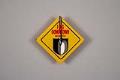
Button pin, "I Dig Downtown Metro," ca. 1990
This button promotes the project to build the Downtown Seattle Transit Tunnel (DSTT), or Metro Bus Tunnel, which opened in 1990. Only buses used the tunnel until 2005 when light rail was added.
ID Number:2019.40.16
Date:Circa 1990
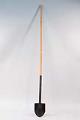
Extra-long handled shovel, or "spade," used for digging power pole holes, ca. 1910s-1940s
This type of long-handled shovel was used prior to electric augurs or hole digging machines. A crew of ten to twelve men would work together to dig power pole holes using a "spade, spoon, and bar," which consisted of a pointed shovel (spade), round shovel (spoon), and steel bar. These extra-long tools may have been used by predecessors of Joe…
ID Number:2019.68.1
Date:Circa 1910-1940
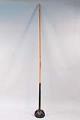
Extra-long handled shovel, or "spoon," used for digging power pole holes, ca. 1910s-1940s
This type of long-handled shovel was used prior to electric augurs or hole digging machines. A crew of ten to twelve men would work together to dig power pole holes using a "spade, spoon, and bar," which consisted of a pointed shovel (spade), round shovel (spoon), and steel bar. These extra-long tools may have been used by predecessors of Joe…
ID Number:2019.68.2
Date:Circa 1910-1940
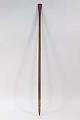
Long steel bar used for digging power pole holes, ca. 1910s-1940s
This steel bar was used along with shovels to dig power pole holes prior to electric augurs or hole digging machines. A crew of ten to twelve men would work together to dig power pole holes using a "spade, spoon, and bar," which consisted of a pointed shovel (spade), round shovel (spoon), and steel bar. These extra-long tools may have…
ID Number:2019.68.3
Date:Circa 1910-1940
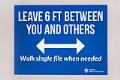
Seattle park sign, "Leave 6 ft Between You and Others," 2020
The Seattle Parks Department created a selection of instructional signs for use in local parks during various stages of the COVID-19 pandemic. Strongly recommended health and safety protocols included staying six feet away from each other at all times.
ID Number:2020.44.3
Date:2020
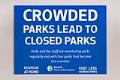
Seattle park sign, "Crowded Parks Lead to Closed Parks," 2020
The Seattle Parks Department created a selection of instructional signs for use in local parks during various stages of the COVID-19 pandemic. As social distancing was a strongly recommended health and safety protocol, people were encouraged not to crowd together. One unfortunate oversight on this particular sign is the incorrect spelling of "excercise."
ID Number:2020.44.4
Date:2020
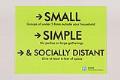
Seattle park sign, "Small, Simple, Socially Distant," 2020
The Seattle Parks Department created a selection of instructional signs for use in local parks during various stages of the COVID-19 pandemic. Strongly recommended health and safety protocols included social distancing and keeping groups small, even when gathering outside.
ID Number:2020.44.5
Date:2020
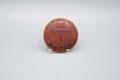
Seattle Transit System Visitor pin, ca. 1940s-1950s
Seattle had a robust streetcar system up until 1940 when the Muicipal Street Railway System transitioned to an all-bus network and became the Seattle Transit System, or what is today known as the Municipality of Metropolitan Seattle (METRO).
ID Number:2021.20.1
Date:Circa 1940-1950

METRO pin, "Ride with Pride," ca. 1990s
King County Metro, established in 1973, is the public transit authority for Seattle and King County, Washington. The slogan "Ride with Pride" was later used to celebrate the LGBTQ community.
ID Number:2021.20.15
Date:Circa 1990-1999