184 results for: European American Settlement
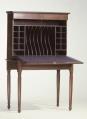
Desk of Arthur Denny, ca. 1850-1860
Arthur Denny used this, his personal desk, as the mail distribution desk when he was appointed Seattle's first postmaster on August 27, 1853.
ID Number:1968.4366.2
Date:1850-1860
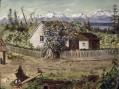
Oil painting, "The Denny Farmhouse in the Swale," by Emily Inez Denny, 1906
The daughter of one of Seattle’s founding families, Emily Inez Denny (1853 – 1918) was both a painter and writer. Greatly influenced by seeing the drawings of Sarah Willoughby as a student at the Washington Territorial University, she took on painting as a life-long pursuit. Emily's parents, David Denny and Louisa Boren married in 1853 in Seattle and lived in…
ID Number:1968.4387.1
Date:1906
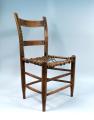
Side chair that belonged to David Denny, 1840-1880
David Thomas Denny (1832-1903) was the younger brother of Arthur Denny and spouse to Louisa Boren. David, John Low, and Lee Terry arrived in the Puget Sound, specifically Alki Point, prior to the rest of the Denny Party in order to find a place to settle and build a cabin. David, along with his brother, were significant contributors to the…
ID Number:1968.4387.8
Date:1840-1880
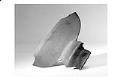
Broadax head that belonged to David T. Denny, ca. 1850-1890
This broadax head belonged to David Thomas Denny (1832-1903). While his older brother Arthur was considered the official leader of the group of settler known as the “Denny Party,” David was the first member to arrive in the future city of Seattle in 1851. David Denny staked a claim to the future site of Seattle Center and in 1853 married…
ID Number:1969.4645.3
Date:Circa 1850-1890
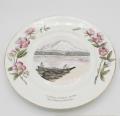
Plate with Sweet Briar Bride pattern, ca. 1903
This plate features a handpainted scene of David T. Denny and Louisa Boren Denny paddling a canoe on Puget Sound with Mt. Rainier in background. It is part of a commemorative set that was made to celebrate the 50th anniversary of Louisa Boren Denny's wedding. She was nicknamed the "Sweet Briar Bride" for the sweet briar plants she brought with…
ID Number:1969.4645.4
Date:Circa 1903
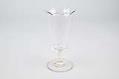
Celery vase from the David T. Denny family, ca. 1850-1880
Celery is native to the Mediterranean, but in the early 19th century farmers began to cultivate it in England. It didn’t grow easily and so was considered a luxury food. Glass celery vases became fashionable in England and the United States as a way to turn stalks of celery into a dinner table centerpiece. This one belonged to the family…
ID Number:1969.4645.6
Date:Circa 1850-1880
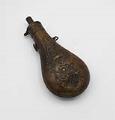
Powder flask, ca. 1850
This powder flask belonged to Angus Mackintosh, born in Ontario, Canada in 1839, fought with the Union Army in the Civil War, and came to Seattle in 1876. He worked in real estate and had a mill on the waterfront that was destroyed in the Seattle Fire of 1889. He then went on to found a merchants bank, lumber company…
ID Number:1969.4687.1
Date:Circa 1850
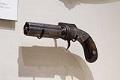
Pepperbox pistol, ca. 1830s
The Allen style pepperbox pistols were one of the best selling handguns of their day. The pepperbox design was the main competitor to the Colt percussion pistol at that time. According to history records, many of these pistols were sold to emigrants heading west in 1849. Manufactured from the 1830s to right after the Civil War, this style was inexpensive…
ID Number:1969.5072.25
Date:Circa 1830
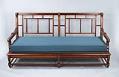
Cherry wood settee, ca. 1860
This settee with reupholstered cushions, was made by Charles Terry, one of the original white settlers in Seattle. The wood is from the first cherry tree grown on the Terry Farm once located on Lake Washington.
ID Number:1970.4966
Date:Circa 1860
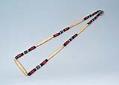
Trade bead necklace, ca. 1910
This necklace was collected by Aubrey Archer in the early part of the 20th century. His father, Finch R. Archer, was the Alotting Agent for the Quinault, Queets, and Hoh tribes from 1906 to 1912. He was in charge of alotting these government land to these tribes. Aubrey worked with his father during school vacations.
ID Number:1970.4971.2
Date:Circa 1910