125 results for: Puget Sound
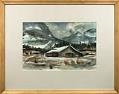
Watercolor, "The First Snow," by Charles Lussier, 1940
Charles Lussier (1912-1981) lived in Washington and was a member of the Puget Sound Group of Northwest Painters. He was also a skilled architectural draftsman and, during WWII, he attended a course in the Camouflage School Division of the Office of Civil Defense at the University of Washington.
ID Number:2015.80.5
Date:1940
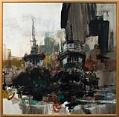
Acrylic painting, "Tugs," by Fred Marshall, 1967
Fred Bruce Marshall (1904-1976) was a painter, illustrator, and cartoonist. He was born in Oregaon and attended Washington State University. Marshall worked as a cartoonist at the Seattle Post-Intelligencer for 38 years. He was a member of the American Watercolor Society, the Puget Sound group of Northwest painters, and the the Northwest Watercolor Society.
ID Number:2015.80.6
Date:1967
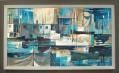
Oil painting, "Fishing Fleet," by Thomas W. Wells, ca. 1959
Thomas Wells (1916 – 2004) was born in Chicago, Illinois, and was a member of the Marine Historical Societies of Seattle, San Diego, San Francisco and New York. He was also a life member of the Puget Sound Group of Northwest Painters. A maritime enthusiast, Wells was known for his works that featured ships and the sea. Other works by…
ID Number:2015.80.10
Date:Circa 1959
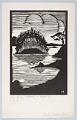
Woodcut by Richard Bennett, "San Juan Islands, Washington, July 4, '25", 1925
Richard Bennett (1899-1971) was a nationally known printmaker, illustrator, and painter. He was born in Ireland but grew up just outside Seattle in Washington State, and he also spent time in New York City and Ireland. A leading children's book author and illustrator, he received national recognition for his woodblock prints and engravings. He was close friends with several leading…
ID Number:2017.15.2
Date:1925
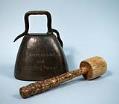
Brass bell and mallet made in honor of Bob Meyer, a leader in the Puget Sound farmers markets community, 1938-2002
Bob Meyer was a revered member of the Puget Sound region farmers markets community. He served on the board of Tilth Producers of Washington and was board president of the Olympia Farmers Market. Meyer sold his produce at farmers markets throughout the Thurston, Pierce, and King counties. This bell was made in his honor at the time of his death…
ID Number:2017.60.1
Date:2002
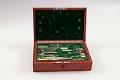
Lowman & Hanford drafting set, 1910
The Lowman & Hanford Company, established around 1885, was a printing company and retail stationery business operating in Seattle's Pioneer Square. This drafting kit, sold by Lowman & Hanford and owned by Percy Kendall, was a cherished item for Percy's granddaughter Barbara Elizabeth "Liz" Kendall. Percy Kendall (1891-1940) received his engineering degree from the University of Washington and followed his…
ID Number:2019.36.1
Date:1910

Button pin, "I (heart) Transit," ca. 1990s
This button promotes the public transit systems in the Puget Sound region including King County Metro, established in 1973, and Sound Transit, established in 1993.
ID Number:2019.40.15
Date:Circa 1990-2000
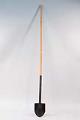
Extra-long handled shovel, or "spade," used for digging power pole holes, ca. 1910s-1940s
This type of long-handled shovel was used prior to electric augurs or hole digging machines. A crew of ten to twelve men would work together to dig power pole holes using a "spade, spoon, and bar," which consisted of a pointed shovel (spade), round shovel (spoon), and steel bar. These extra-long tools may have been used by predecessors of Joe…
ID Number:2019.68.1
Date:Circa 1910-1940
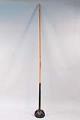
Extra-long handled shovel, or "spoon," used for digging power pole holes, ca. 1910s-1940s
This type of long-handled shovel was used prior to electric augurs or hole digging machines. A crew of ten to twelve men would work together to dig power pole holes using a "spade, spoon, and bar," which consisted of a pointed shovel (spade), round shovel (spoon), and steel bar. These extra-long tools may have been used by predecessors of Joe…
ID Number:2019.68.2
Date:Circa 1910-1940
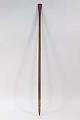
Long steel bar used for digging power pole holes, ca. 1910s-1940s
This steel bar was used along with shovels to dig power pole holes prior to electric augurs or hole digging machines. A crew of ten to twelve men would work together to dig power pole holes using a "spade, spoon, and bar," which consisted of a pointed shovel (spade), round shovel (spoon), and steel bar. These extra-long tools may have…
ID Number:2019.68.3
Date:Circa 1910-1940