130 results for: Indigenous Peoples
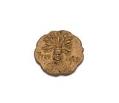
Token coin, "Tyee 1913 Klahowya! Potlatch, Seattle" made by Mayer Bros. Makers
This token is from the Seattle "Potlatch" of 1913 and made by the Mayer Bros., prominent Seattle jewelry maker. "Klahowya" means "Welcome" in Chinook jargon and “Tyee” means chief or an important person. The name "Golden Potlatch" appropriates a Chinook Jargon word describing a Native ceremony celebration and gift giving. It also reflects the importance of the Klondike Gold Rush…
ID Number:2016.34.1
Date:1913
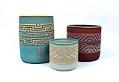
Tlinget basket, white and blue, part of 3-piece set #B16-34 by Preston Singletary, 2012
Preston Singletary (Tlingit American, b. 1963) is a well-known and respected glass artist in Seattle. He uses European glass blowing techniques to create Northwest Native art and features themes of transformation, animal spirits and shamanism.
ID Number:2016.35.1
Date:2012
Tlinget basket, blue and orange, part of 3-piece set #B16-34 by Preston Singletary, 2013
Preston Singletary (Tlingit American, b. 1963) is a well-known and respected glass artist in Seattle. He uses European glass blowing techniques to create Northwest Native art and features themes of transformation, animal spirits and shamanism.
ID Number:2016.35.2
Date:2013
Tlinget basket, dark red and taupe, part of 3-piece set #B16-34 by Preston Singletary, 2016
Preston Singletary (Tlingit American, b. 1963) is a well-known and respected glass artist in Seattle. He uses European glass blowing techniques to create Northwest Native art and features themes of transformation, animal spirits and shamanism.
ID Number:2016.35.3
Date:2016
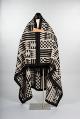
Salish pattern Honor blanket, designed by Louie Gong of Eighth Generation, 2018
Eighth Generation is taking back the wool blanket market and empowering Indigenous artists along the way. In 2015, they became the first Indigenous-owned company to offer wool blankets. They stand as an ethical alternative to companies that profit from designs that are “Native-inspired.” This particular design references Coast Salish weaving patterns that stretch back thousands of years. While these blankets…
ID Number:2018.72.1
Date:2018
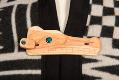
Blanket pin made by Peter Gong, 2018
Carver Peter Gong (Squamish) made the custom yew wood wolf pin closure. Peter is uncle to Louie Gong, founder of Eighth Generation, a Seattle-based and Indigenous-owned wool blanket company. This pin was made to fasten the Salish blanket when worn around the shoulders. Eighth Generation strengthens the Indigenous artist community by contracting directly with cultural artists from around the country.
ID Number:2018.72.2
Date:2018
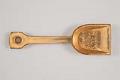
Souvenir glass shovel from the 1911 Seattle Golden Potlatch celebration
The Seattle Potlatch was an annual event which began in 1911 to celebrate Seattle's prosperity after the Alaska-Yukon-Pacific Exposition in 1897. This souvenir was collected at the Dreamland Pavilion, once located at the corner of Seventh and Union Street, where many of the Potlatch activities took place. The name "Golden Potlatch" appropriates a Chinook Jargon word describing a Native ceremony…
ID Number:2018.102.1
Date:1911
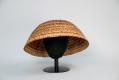
Woven cedar bark Chief Si'ahl (Chief Seattle) style hat made by DeAnn Jacobson, 2019
Native American weaver DeAnn Jacobson (Duwamish, Suquamish), a direct descendant of Chief Si'ahl (Chief Seattle), wove this hat from cedar bark. Coast Salish tribes have used locally sourced materials like cedar bark to make weatherproof clothing for millennia. Such garments range in style from functional to decorative.
ID Number:2019.15.1
Date:2019

Contemporary art paddle commemorating the opening of the Seattle Duwamish Longhouse and Cultural Center, 2009
Contemporary art paddle commemorating the opening of the Seattle Duwamish Longhouse and Cultural Center in 2009.
ID Number:2019.60.1
Date:2009
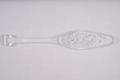
Contemporary art paddle made by Marvin Oliver celebrating Seattle's sesquicentennial in 2001
In 2001, the metropolitan area of Seattle celebrated 150 years of existence dating back to the Alki landing of the Denny Party in 1851. The artist of this piece, Marvin Oliver (1946-2019), was born to Quinault and Isleta-Pueblo parents, and raised in Washington and San Francisco. He was an Associate Professor of American Indian Studies and Art History at the…
ID Number:2019.60.2
Date:2001