132 results for: Recreation
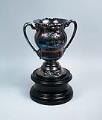
Winning cup from 1908 Coach Pioneer Race
Harry Whitney Treat won this silver trophy cup when he competed in a horse-driven carriage race. The Treat family moved to Seattle in 1904 and were active in the founding of many local organizations and clubs.
ID Number:1952.70.1
Date:1908
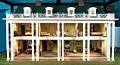
Claire Hammons miniature house, 12th scale model, 1945-1955
This miniature mansion was donated to MOHAI by Claire Bagley Hammons in 1955. Mrs. Hammons and her husband, Frederick Dent Hammons, had the house model designed by Seattle architect Joseph S. Cote (designer of the Green Lake Carnegie Library) and then spent more than a decade working on the detailed furnishings. Hand-made carpets, miniature paintings, clocks made from vintage watches,…
ID Number:1955.974.1.1
Date:1945-1955
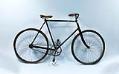
Bicycle, "Rambler,"1901
This 1901 bicycle was made by Gormully & Jeffery Manufacturing Company in Chicago. In 1878, Thomas Jeffery created the "Rambler" brand and it was the predecessor to his Rambler Automobile. The bike has five small license plates on it: one (upside down) on the front from Spokane in 1905, one on the top tube with only numbers (no location or…
ID Number:1958.1477.1
Date:1901
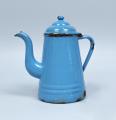
Coffee pot, 1905-1915
This bule enamel coffeepot was used at the Penrose Family Camp on Penrose Point in lower Puget Sound near Lakebay, Washington. The family established the camp in 1908, and it was used almost continuously until 1952 by members of the Penrose and Copeland families. The coffeepot was used daily on a wood burning cast iron stove.
ID Number:1959.1625.2
Date:1905-1915

Slo-Mo-Shun IV hydroplane, built in 1929 and rebuilt in 1956
The Slo-Mo-Shun IV hydroplane (rebuilt with a model of the engine) brought unlimited hydroplane racing to Seattle with her Gold Cup win. The unlimited hydroplane is an example of aerodynamic design in boat building, and it is best remembered by the estimated 200,000 exhilarated spectators on Lake Washington's shoreline as it sped to a new world record in the 1951…
ID Number:1959.1701
Date:1929
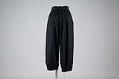
Woman's bicycling bloomers, 1890s
Dress reformer Amelia Bloomer invented her eponymous wide-cut pants in the 1850s, but it wasn’t until the late 19th-century craze for bicycling that they caught on. While some women rode in skirts or garments designed to look like skirts and conceal the fact they were split underneath, others boldly adopted bloomers as part of their cycling costume. These bloomers would…
ID Number:1959.1803.19C151
Date:Circa 1895
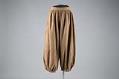
Woman's bicycling bloomers, 1890s
Dress reformer Amelia Bloomer invented her eponymous wide-cut pants in the 1850s, but it wasn’t until the late 19th-century craze for bicycling that they caught on. While some women rode in skirts or garments designed to look like skirts and conceal the fact they were split underneath, others boldly adopted bloomers as part of their cycling costume. These bloomers would…
ID Number:1959.1803.20C152
Date:Circa 1895
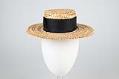
Woman's straw boater, ca. 1895
This women’s straw “boater” hat was worn in the late 19th century as part of an outfit for bicycling. Bicycling was wildly popular in the 1880s and 1890s and was considered particularly liberating for women. The bicycle offered a new kind of mobility and independence, and bicycling costumes often included split skirts or bloomers. Bicycling costumes were nearly always paired…
ID Number:1959.1803.21M213
Date:Circa 1895
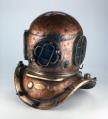
Diver's helmet and shoulder gear used by Henry Finch, 1890 - 1920
This copper and brass diver’s helmet relied on its weight (about 40 lbs) to keep the diver’s body submerged. The helmet was made by A.M. Morse & Sons of Boston, and used by Henry Finch, who dove in Elliot Bay and was known nationally in his time as the “King of Divers” because of his diving expertise and knowledge about…
ID Number:1959.1816.7
Date:1890-1920
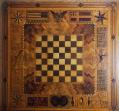
Gaming table, 1893
This gaming table was made in 1893 by Otto Roseleaf, a Seattle building contractor at the turn of the 20th century. It consists of 8,500 pieces of various natural woods from all parts of the world. The top of the table is elaborately inlaid, made up of a central checker or chess board, surrounded by three concentric rectangular bands. The…
ID Number:1960.1947.1
Date:1893