15 results for: Fish and Fishing
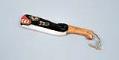
Fish club, 1900-1920
This fish club was carved and painted by an unknown local tribe, possibly for trade or other commercial use.
ID Number:1958.1581.2
Date:1900-1920
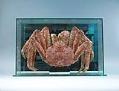
King crab in case, ca. 1910-1920
The donor of this stuffed King Crab was Mrs. J. W. Wheeler. She was an avid collector of shells, whales teeth, turtle and snail shells, and other marine life that washed up on the local beaches. Her house in Seattle was filled with display cases, shelves, trays, and tables, all showcasing her immense and stunning collection.
ID Number:1969.4738.7
Date:Circa 1910-1920
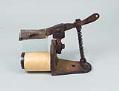
Salmon can making device, 1878
Before there was machinery to make fish cans, workers might use this hand tool. This particular device was found in a salmon cannery in Klawak, Alaska.
ID Number:1970.4988
Date:Circa 1878
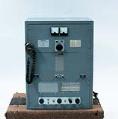
Northern Radio Company Radio Telephone, model no. N529E/N620E, ca. 1965
This radiotelephone was built by Northern Radio Company, a Seattle business established in 1926. This communication equipment was widely used by various Alaskan salmon canneries, bush airlines, oil explorations and drilling during the 1960s and early 1970s. An advertisement for the Northern Radiotelephone states: "Versatility, clean uncluttered lines and genuinely rugged construction characterize the new N529 transmitter and N620 receiver.…
ID Number:1975.6036
Date:Circa 1965
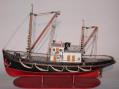
Model made circa 1950-1970 of cannery tender, M.S. Captain Bing
The donor of this ship model, John Tenneson, owned and operated the Superior Packing Company plant in Tenakee, Alaska, with the home port based in Seattle, Washington. Superior Packing Company was in operation from 1916 into the 1960s, canning and distributing salmon, crab, and shrimp under the Captain Bing brand. The M.S. Bing was one of the company's vessels and…
ID Number:1975.6066.1
Date:Circa 1950-1970
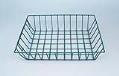
Cast metal feed prep tray for salmon hatchery, ca. 1940
This basket tray was used by the University of Washington Fisheries program. It was most likely used with the incubator (also in the MOHAI collection) designed by faculty member Lauren Donaldson in the 1940s. Donaldson was a pioneer in fish genetics and he is most remembered for his work in the study of salmon and his hatchery-raised fish. There is…
ID Number:1996.49.3
Date:Circa 1940
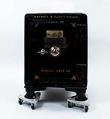
Astoria & Puget Sound Canning Company safe, ca. 1910
The fishing and canning industry has always been a boon for Seattle and all of the Pacific Northwest, including Alaska. This safe was first used by the Astoria & Puget Sound Canning Company in the early 1900s, and then shipped to Excursion Inlet, Alaska, for use in the company cannery store located there. The tumblers locked in the early 1970s…
ID Number:1997.11.1
Date:Circa 1910
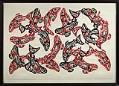
Print by Marvin Oliver, "New Generation," 1997
This serigraph by Native American sculptor and printmaker Marvin Oliver (d. 2019) depicts a new generation of salmon hatching from eggs. Born to Quinault and Isleta-Pueblo parents, and raised in Washington and San Francisco, Marvin Oliver (date of birth unknown) was an Associate Professor of American Indian Studies and Art History at the University of Washington and Curator of Contemporary…
ID Number:2001.70.1
Date:1997
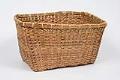
Duwamish carrying basket, attributed to Kikisoblu (Princess Angeline), ca. 1885
This basket was possibly made by Kikisoblu (Princess Angeline) to deliver clams and other materials to Seattle customers. Kikisoblu (ca. 1820-1896) was the daughter of Chief Si'ahl (Chief Seattle). The 1855 Treaty of Point Elliott required all Duwamish people leave Seattle to live on reservations, but Kikisoblu remained in a cabin on the waterfront. She earned a living doing laundry…
ID Number:2003.62.1
Date:1884-1896
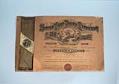
Alaska-Yukon-Pacific Exposition (AYPE) Diploma and Grand Prize ribbon awarded to Smith Cannery Machines Co. for the "Iron Chink" fish cleaning machine, 1909
The Smith Cannery Machine Company invented the world's first fish cleaning machine and was awarded the Grand Prize at the Alaska-Yukon-Pacific Exposition in Seattle in 1909. The nickname for the machine, "Iron Chink," illustrates the derogative attitude towards Chinese immigrant laborers the machine was intended to replace.
ID Number:2005.52.1
Date:1909