For more than a century, motorcycles have been part of Seattle’s landscape—speeding over its hills, racing through its outskirts, and uniting riders from all walks of life. These photographs from MOHAI’s collection capture how motorcycles have evolved from practical machines to powerful symbols of freedom, identity, and connection.
/ November 24, 2025
Soldier on a Harley-Davidson motorcycle, circa 1918
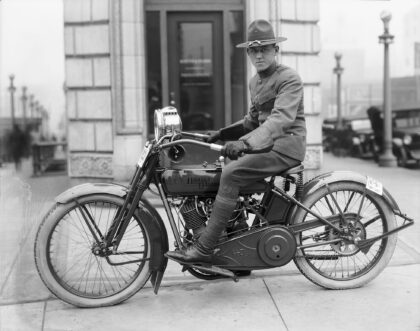
MOHAI, PEMCO Webster & Stevens Collection, 1983.10.1367
In the early twentieth century, motorcycles were an effective way to navigate Seattle’s hilly streets and became popular for their practicality for tasks including deliveries and medical house calls. Seattle’s police department invested in motorcycles starting in 1910, and during World War I, the local military used motorcycles to transport messages, as seen in this photo of a soldier on a Harley-Davidson motorcycle outside the Times Square building in downtown Seattle around 1918.
Motorcycles racing at festival in Kent, 1966
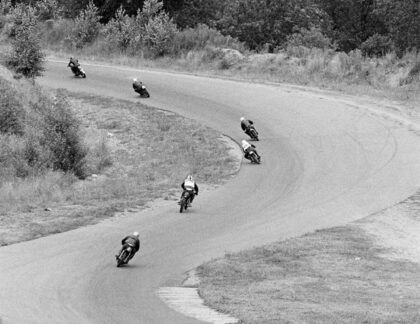
MOHAI, Seattle Post-Intelligencer Collection, 1986.5.528.2
Motorcycle enthusiasts participated in tours and races, like multiple-day adventures called Endurance Runs, or in hill climbs and dirt-track races. By the mid-twentieth century, racetracks were holding festivals, such as the weekend All America Race Festival in Kent in July 1966. Sponsored by the racetrack and local radio station KJR, the event featured several races, including this motorcycle race.
Susan Benner and Michelle with the Dykes on Bikes club at the Pride Parade, 1992
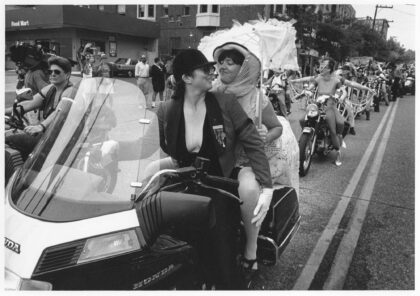
MOHAI, Seattle Post-Intelligencer Collection, 2000.107.073.36.11, photo by Gilbert W. Arias
In the Northwest, motorcycle communities were known for diversity and strong bonds, and often family affairs or formed around shared identities. Clubs included ones formed for women or Native Americans, Blacks, Asian, Latino, and Jewish groups. The first formal gay motorcycle club in Seattle, the Border Riders, was founded in 1969, and the lesbian club Dykes on Bikes has headed up the Seattle Pride Parade for decades. This photo shows two members of the Dykes on Bikes club at the start of the 1992 Pride Parade.